Plant Overview
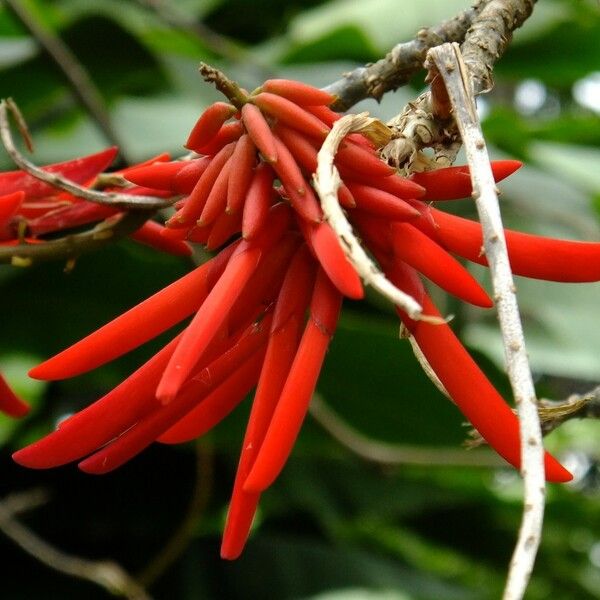
Known as the Coral Bean or the Machete Flower, Erythrina rubrinervia is a vibrant tropical tree that turns heads with its sword-shaped, fiery red blossoms. Native to Central and South America, it is often used as a "living fence" because of its sturdy growth and defensive spines. In folklore, its bright seeds are sometimes used in jewelry, but they carry a hidden danger that requires respect.
🔍 How to Identify
- 🗡️ The Flowers: The most striking feature is the elongated, tubular red flowers that grow in clusters. They resemble small curved blades or machetes, which gives the plant its common name in many Spanish-speaking regions.
- 🍃 The Foliage: Look for "trifoliate" leaves—meaning they grow in groups of three. A key giveaway for this specific species is the reddish tint often found on the leaf veins (the "nerves" of the plant).
- 🌵 The Bark: Younger branches are often armed with short, sharp prickles that act as a natural deterrent against climbing animals.
🏡 In Your Garden
- 🌱 Nitrogen Power: As a member of the legume family, this plant is a "soil builder." It has a symbiotic relationship with bacteria in its roots that helps fix nitrogen into the earth, naturally fertilizing the area for surrounding plants.
- 🧱 The Living Fence: If you are planting this, choose its permanent home wisely. It develops a deep taproot quickly and resents being moved once established. In its native habitat, farmers simply stick a branch into the ground, and it will often take root to form a sturdy, flowering wall.
⚠️ Safety & Toxicity
- 🚫 Status: Toxic if Ingested.
- 🐾 The Danger: All parts of the plant, especially the bright red seeds, contain alkaloids like erythroidines. If eaten, these can cause vomiting, sedation, or even respiratory distress. Keep this plant away from curious pets and young children who might be attracted to the "bean-like" seeds.
- 🌵 Physical Injury: The small spines on the trunk and branches can cause painful scratches, so wear gloves when pruning.
✨ Fun Fact
The flowers of the Machete Flower are specially designed for "ornithophily"—pollination by birds. Their sturdy, tubular shape and high nectar production make them the ultimate fueling station for hummingbirds, who are one of the few creatures that can reach the nectar hidden deep within the "blade."

Detailed Care Instructions
Growing Erythrina rubrinervia, also known as the Brazilian coral tree, requires the following steps:
- Climate: Ensure that you live in a suitable climate for Erythrina rubrinervia. It thrives in tropical and subtropical regions, with average temperatures between 20-30°C (68-86°F).
- Soil: Choose a well-draining soil mix with a pH level between 6-7. Add organic matter to improve fertility and moisture retention.
- Sunlight: Provide your coral tree with full sun exposure for 6-8 hours a day. This will help it grow and flower properly.
- Watering: Water the plant regularly, especially during dry spells. Aim to keep the soil consistently moist, but avoid over-watering, as it can lead to root rot.
- Fertilizer: Feed the plant with a balanced slow-release fertilizer during the growing season (spring and summer) to promote healthy growth. Follow the manufacturer's instructions for dosage.
- Pruning: Prune the tree during the dormant season (winter) to maintain its shape and remove any dead or damaged branches.
- Support: As Erythrina rubrinervia grows into a tree, it may need additional support, particularly during strong winds. Stake the tree or use structural support to prevent it from bending or breaking.
- Propagation: You can propagate Erythrina rubrinervia through seeds or stem cuttings. For seeds, soak them overnight in warm water before planting. For stem cuttings, take a 6-8 inch cutting from a healthy tree, remove lower leaves, and plant it in a pot with moist soil. Place it in a warm and bright location until it develops roots.
- Protection: Protect the young plant from frost or extreme cold temperatures, as it can damage or kill the tree.
- Pests and diseases: Watch for common pests like aphids, spider mites, or mealybugs. Regularly check the leaves for signs of discoloration or damage. Use organic or chemical pest control methods if needed.
Remember to consult local gardening resources or professionals for specific advice tailored to your region.

Place in a bright room that is sun drenched almost all day. Or directly in a south-facing window.

To properly water this plant, you should first evaluate the soil moisture level. This can be done by feeling the top few inches of soil with your finger. If the soil feels dry, it is time to water. When watering, make sure to thoroughly saturate the soil, allowing the water to soak in and reach the roots. It is important to avoid overwatering, as this can lead to root rot and other problems. To prevent this, water only when the soil is dry and avoid letting the plant sit in standing water for extended periods of time. Additionally, it is best to water early in the day to allow excess moisture to evaporate before cooler nighttime temperatures arrive.
- Choose a well-draining pot or soil patch for planting the plant.
- Use a balanced fertilizer with an N-P-K ratio of 10-10-10 or 20-20-20.
- Apply the fertilizer early in the growing season when the plant is actively growing.
- Use a slow-release fertilizer that will gradually release nutrients over an extended period.
- Apply the fertilizer according to the manufacturer's instructions for the appropriate amount and method of application.
- Water the plant thoroughly after fertilizing to help the roots absorb the nutrients.
- Avoid over-fertilizing as it can lead to root burn or other plant problems.
The Erythrina Rubrinervia plant requires well-drained soil that is fertile and rich in organic matter. The ideal soil pH should be slightly acidic to neutral, ranging from 5.5 to 7.0. It is recommended to use a soil mix that is comprised of equal parts of loam, sand, and organic matter such as compost or peat moss. The soil should be able to retain moisture while also allowing excess water to drain adequately. The plant prefers full sun and requires consistent moisture, but should not be overwatered. Fertilizer should be applied regularly during the growing season to promote healthy growth and flowering.
Erythrina Rubrinervia, also known as a red-flowering coral tree, can be propagated through several methods. One method is through seed propagation, where mature seeds are collected and sown directly into a well-draining planting medium. Provide consistent moisture and warmth to promote germination.
Another method is through cutting propagation, where a cutting is taken from the parent plant and rooted in a rooting hormone and well-draining soil mix. It is important to remove any leaves on the cutting that will be buried in the soil, as this will prevent excessive moisture loss through transpiration. Keep the cutting in a warm and humid environment while it establishes roots.
The final method is through air layering, where a section of the stem is cut and wrapped in a moist, well-draining medium. This section is then covered in plastic to create a moist, humid environment that encourages rooting. Once roots have formed, the section can be cut from the parent plant and planted in a well-draining soil mix.
Regardless of the propagation method chosen, it is important to maintain consistent moisture and provide regular care to promote healthy growth and development.








