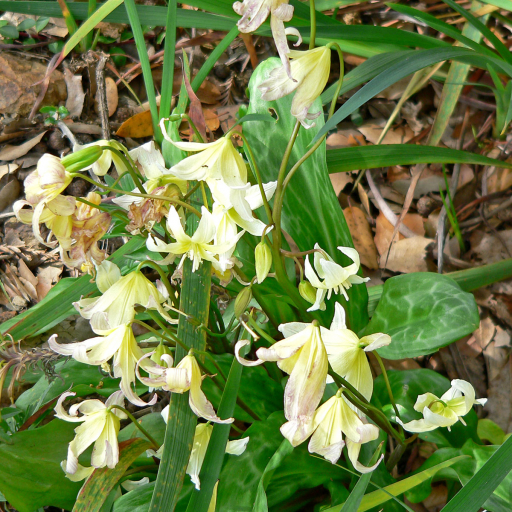
Plant Overview
Often called the California Fawn Lily, this elegant woodland native is a spring treasure found tucked away in the dappled shade of the Pacific Northwest. Its common name comes from its striking mottled leaves, which look just like the spots on a young deer’s back. It is a "spring ephemeral," meaning it puts on a brief, spectacular show before vanishing underground to sleep through the heat of summer.
🔍 How to Identify
- 🍃 Mottled Foliage: The leaves are broad and lance-shaped, decorated with striking chocolate-brown or bronze splotches against a deep green background.
- 🔔 Reflexed Blooms: Features nodding, creamy-white flowers with petals that gracefully curve backward to reveal a bright yellow "eye" and delicate stamens.
- 🌱 Growth Habit: This low-growing perennial sends up leafless flower stalks (scapes) that reach about 8 to 12 inches high, usually bearing one to three flowers each.
🏡 In Your Garden
- 🌳 The Woodland Vibe: This plant thrives in "bright shade"—think of the light filtering through an oak or redwood canopy. It demands well-draining soil rich in leaf mold or organic matter to mimic its native forest floor.
- 💤 Summer Dormancy: Don’t panic when the plant disappears! After flowering in late spring, the foliage dies back completely. It spends the rest of the year as a bulb, so it’s wise to mark its location to avoid accidentally digging it up during its nap.
⚠️ Safety & Toxicity
- 🐾 Mildly Toxic: Like many bulbs, the California Fawn Lily contains saponins. While not typically lethal, ingesting the bulbs can cause gastrointestinal distress, including vomiting and diarrhea in pets or humans.
- 🖐️ Skin Sensitivity: While the flowers and leaves are generally safe to touch, the raw sap from the bulbs may cause mild skin irritation or contact dermatitis in sensitive individuals.
✨ Fun Fact
🦴 A "Dog's" Root: The genus name Erythronium is often associated with the nickname "Dog’s Tooth Violet." This isn't because of the flower’s shape, but rather the underground bulb, which is long, white, and pointed, looking remarkably like a canine's tooth!

Detailed Care Instructions
To grow Erythronium californicum, also known as California fawn lily, you can follow these steps:
- Choose a suitable location: Erythronium californicum prefers well-draining soil and partial shade. Find a spot in your garden or yard that receives dappled sunlight, such as under deciduous trees or on the north side of a building.
- Prepare the soil: Loosen the soil in the planting area and amend it with organic matter like compost or well-rotted manure. This will help improve drainage and provide necessary nutrients.
- Planting time: Erythronium californicum bulbs are typically planted in the fall, around September or October, as they require a period of cold stratification. You can also plant them in early spring, but they may not bloom the first year.
- Planting depth: Plant the bulbs about 2-4 inches (5-10 cm) deep, with the pointed end facing up. Space the bulbs about 4-6 inches (10-15 cm) apart.
- Watering: After planting, water the bulbs well to settle the soil and ensure good root establishment. Erythronium californicum prefers moist but well-draining soil, so water regularly during the growing season, especially during dry periods. Avoid overwatering, as this can lead to bulb rot.
- Mulching: Apply a layer of organic mulch, such as wood chips or leaf litter, around the plants to help retain moisture and suppress weeds. Avoid mulching directly over the bulbs to prevent them from rotting.
- Fertilizing: Erythronium californicum doesn't typically require additional fertilization if the soil is amended with organic matter. However, you can apply a balanced, slow-release granular fertilizer in early spring to provide some extra nutrients.
- Maintenance: Erythronium californicum is a low-maintenance plant. Remove any dead foliage after it has withered away to improve aesthetics, but avoid removing the leaves prematurely, as they provide energy for the bulbs to bloom the following year.
- Division: Every 3-5 years, when the plants become overcrowded and flowering declines, you can lift and divide the bulbs in late summer or early fall. Replant the bulbs in prepared soil at the appropriate depth, spacing them apart as mentioned earlier.
By following these guidelines, you should be able to successfully grow Erythronium californicum plants and enjoy their beautiful flowers in your garden.

Place in a window with dappled sun or a spot in the middle of a room. Or directly in a window facing west or east.

To care for this plant, it is important to provide adequate watering. The plant prefers consistently moist soil, but it is important not to overwater. This can lead to root rot and damage to the plant. To water, it is recommended to check the top layer of soil to see if it is dry to the touch. If so, water the plant thoroughly, making sure that excess water is able to drain away from the roots. It is also important to avoid getting water on the leaves or flowers, as this can lead to damage or disease. Additionally, it is recommended to water in the early morning or late afternoon to avoid evaporation and allow the plant to soak up the water before the hottest part of the day.
To fertilize this plant, you should use a balanced fertilizer that contains equal parts nitrogen, phosphorus, and potassium. Apply the fertilizer in early spring before the plant starts to actively grow. Be careful not to over-fertilize, as this can burn the plant's roots. Always follow the instructions on the fertilizer packaging and water the plant after applying the fertilizer to help it absorb the nutrients.
Erythronium Californicum plants prefer well-draining, slightly acidic soil with a pH of around 6.0 to 6.5. They require soil that is rich in organic matter, such as compost or well-rotted manure. Sandy loam soil is also ideal for these plants. It is important to avoid heavy clay soils, as they can cause the bulbs to rot. Additionally, these plants prefer soil that is moist but not excessively wet, as this can also cause rot. It is recommended to mulch the soil around the plants to help retain moisture and provide a constant supply of nutrients.
Propagation of this plant can be done by dividing the bulbs in the late summer or early fall when the plant is dormant. Carefully remove the bulbs from the soil and gently separate any offsets or bulbils that have formed. Plant the separated bulbs immediately in a well-draining soil mixture. It may take a few years for the newly planted bulbs to mature and produce flowers.








