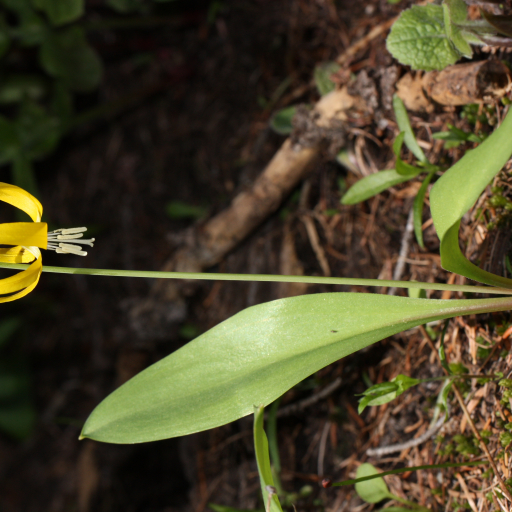
Plant Overview
🏔️ The Sun of the Snowline
Known affectionately as the Glacier Lily or Yellow Avalanche Lily, this resilient wildflower is the ultimate herald of spring in the high mountains of Western North America. It is famous for its "thermal melting" ability, where its dark leaves absorb enough sunlight to melt a small circle in the retreating snow, allowing it to bloom while winter still lingers on the ground.
🔍 How to Identify
- 🟡 Golden Blossoms: Each stem carries one to three nodding flowers with six brilliant yellow tepals that curve sharply backward, exposing long, prominent stamens.
- 🍃 Sleek Foliage: Unlike many of its Erythronium cousins, its twin basal leaves are a solid, waxy green and lack any brown or purple "watermark" mottling.
- 🦷 The "Dog's Tooth": If you were to look underground, you’d find a long, slender white corm (a bulb-like structure) shaped remarkably like a canine tooth, which gives the genus its common name.
🏡 In Your Garden
- ⏳ Ephemeral Nature: This plant is a "spring ephemeral," meaning it lives fast and dies back early. It goes completely dormant shortly after blooming in early summer, so mark its spot carefully so you don't accidentally dig it up during the off-season.
- ❄️ Cool & Damp: It thrives in conditions that mimic its mountain home—rich, humusy soil that stays cool and moist during the growing season. It struggles in hot, dry clay and prefers a spot that gets morning sun but afternoon shade.
⚠️ Safety & Toxicity
- 🐾 Pet & Child Safety: While not considered deadly, the plant contains "tulipalin A," which can cause skin irritation in some people and mild digestive upset if eaten in large quantities.
- 🐻 Wildlife Context: In the wild, it is a critical high-energy food source for Grizzly bears, who use their massive claws to till the mountain soil and feast on the nutrient-dense corms.
✨ Fun Fact
The Glacier Lily has a secret partnership with ants! Its seeds have a tiny, fatty attachment called an "elaiosome." Ants carry the seeds back to their nests to feed their larvae the fat, effectively "planting" the lily seeds in nutrient-rich, protected underground tunnels.

Detailed Care Instructions
Here are some steps to help you grow Erythronium grandiflorum:
- Choose a suitable location: Erythronium grandiflorum prefers partial shade to full shade. Select a location in your garden that receives dappled sunlight or shade for most of the day.
- Prepare the soil: The plant prefers well-draining soil that is rich in organic matter. Amend the soil with compost or well-rotted manure to improve its fertility and drainage.
- Plant the bulbs: Erythronium grandiflorum grows from bulbs. Plant the bulbs in the fall, around 4-6 inches deep and 6-8 inches apart. Place them with the pointed side facing upwards. Water the area after planting to settle the soil.
- Watering routine: Erythronium grandiflorum prefers slightly moist soil but does not tolerate soggy conditions. Water the plants regularly during the growing season, keeping the soil moist but not waterlogged.
- Mulch: Apply a layer of organic mulch around the plants to help retain moisture and suppress weed growth. It also keeps the soil cool during hot summer months.
- Fertilize: Erythronium grandiflorum generally does not require heavy fertilization. However, you can apply a balanced organic fertilizer in early spring, before the plant starts actively growing.
- Pruning: After the plant has finished flowering, allow the foliage to die back naturally. This helps replenish the bulbs for the following year. Avoid cutting back the foliage prematurely.
- Propagation: Erythronium grandiflorum can be propagated by dividing the bulbs in late summer or early fall. Lift the bulbs from the ground, separate the offsets, and replant them in prepared soil.
- Pest and disease control: Generally, Erythronium grandiflorum is relatively pest-free. However, keep an eye out for slugs and snails, as they can damage the leaves and flowers. Use organic pest control methods to deter them.
By following these steps, you can successfully grow Erythronium grandiflorum and enjoy its beautiful blooms.

Place in a window with dappled sun or a spot in the middle of a room. Or directly in a window facing west or east.

To properly water this plant, it is important to ensure that the soil is moist but not waterlogged. This can be achieved by allowing the soil to dry out slightly between waterings, and then watering thoroughly so that water penetrates the root zone. It is also important to avoid getting water on the foliage of the plant, as this can increase the risk of fungal disease and damage the delicate leaves. Finally, it is recommended to water this plant in the morning or early evening when temperatures are cooler, rather than during the heat of the day.
To fertilize the plant, use a balanced fertilizer with equal amounts of nitrogen, phosphorus, and potassium. Apply the fertilizer in a liquid form or use a slow-release granular formula, following the instructions on the packaging. Fertilize the plant before it blooms in the early spring and again after the flowers fade. Avoid over-fertilizing as it can cause damage to the roots and leaves.
The best type of soil for this particular plant is a well-draining loam soil that is rich in organic matter. It is important to ensure that the soil is not compacted, as this can lead to poor drainage and root rot. The soil should also be slightly acidic, with a pH range of 5.5 to 6.5. It is recommended to add a layer of mulch to the soil around the plant to help retain moisture and keep the soil cool. Additionally, this plant prefers a location with partial to full shade, and should be watered consistently but not overwatered.
To propagate this plant, one can use bulb offsets. Harvest the offsets from the parent plant during the dormant season. Ensure that each offset has a healthy root system and a small shoot. Pot the offsets in a well draining soil mix and place them in a bright location with indirect sunlight. Water the plants regularly, keeping the soil moist but not too wet. Once the offsets have established themselves in their new pots, they can be transplanted into the garden.








