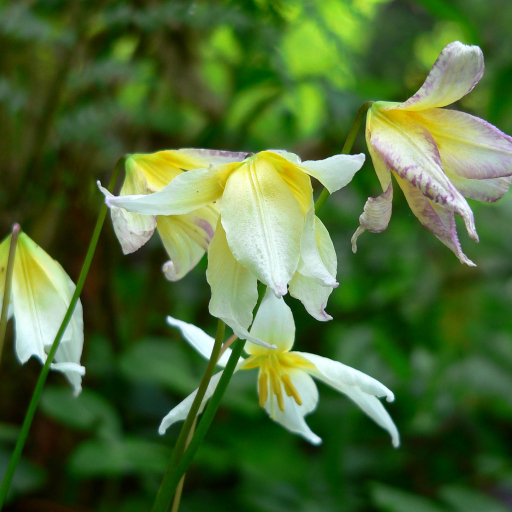
Plant Overview
Known as the St. Helena Mountain Fawn Lily, this elegant spring ephemeral is a rare gem of the California landscape. Found almost exclusively on the volcanic and serpentine slopes of the Mayacamas Mountains, it greets the end of winter with nodding, star-like blooms. Its name "fawn lily" isn't just a poetic whim—it's a direct nod to the dappled, marbled leaves that resemble the coat of a young deer hiding in the forest shadows.
🔍 How to Identify
- 🌸 The Bloom: Features large, creamy white petals that "reflex" (curl dramatically backward) as they age, revealing a vibrant, sun-yellow center.
- 🍃 Mottled Foliage: The wide, lance-shaped leaves are beautifully marbled with brown or deep purple patterns against a green base.
- 🧶 The Anthers: Look for prominent, dangling yellow anthers in the center of the flower, which distinguish it from some of its paler relatives.
🏡 In Your Garden
- ⛰️ Volcanic Roots: In the wild, it thrives in rocky, serpentine soils. If you are growing this rarity, it demands excellent drainage and a "cool" root run—it is happiest in shaded rock gardens or under the canopy of deciduous trees.
- 💤 The Summer Sleep: This is a spring ephemeral, meaning it vanishes completely by mid-summer. It retreats into a deep underground corm to survive the heat. Mark the spot so you don't accidentally dig it up during its dormant phase!
- 💧 Spring Moisture: It requires consistent moisture while blooming but prefers to stay relatively dry during its summer nap to prevent the bulb from rotting.
⚠️ Safety & Toxicity
- 🐾 Pet Safety: It is generally considered non-toxic to cats and dogs in small amounts, though the underground bulbs can cause digestive upset if dug up and chewed.
- 👶 Human Caution: While not considered deadly, the bulbs contain alkaloids that can act as an emetic (inducing vomiting). It is best treated as an ornamental treasure rather than a food source.
✨ Fun Fact
- 📍 The Homebody: Erythronium helenae is what botanists call a "narrow endemic." It is found almost nowhere else on Earth except for the area immediately surrounding Mount Saint Helena in California, making it a true botanical local.

Detailed Care Instructions
To grow Erythronium Helenae plants, follow these steps:
- Select a suitable planting location: Erythronium Helenae plants prefer partial to full shade and well-draining soil. Choose a location that receives dappled sunlight, such as under deciduous trees or in a shaded garden area.
- Prepare the soil: Erythronium Helenae plants prefer humus-rich, slightly acidic soil. Amend the soil with organic matter like compost or well-rotted manure to improve drainage and fertility.
- Planting time: It is best to plant Erythronium Helenae bulbs in the fall (September to November) when the soil is cool. This allows the bulbs to establish before the onset of winter.
- Planting depth and spacing: Dig holes for the bulbs, placing them about 2-3 inches (5-7.5 cm) deep and 4-6 inches (10-15 cm) apart. The pointed end of the bulb should face up. Cover the bulbs with soil and gently firm it down.
- Watering: After planting, water the bulbs thoroughly to help settle the soil around them. Water them regularly, keeping the soil moist but not waterlogged. Avoid overwatering, as bulbs can rot in soggy conditions.
- Mulching: Apply a layer of organic mulch, such as chopped leaves or bark chips, around the newly planted bulbs. Mulching helps retain soil moisture, suppresses weeds, and moderates soil temperature.
- Maintenance: Erythronium Helenae plants are generally low-maintenance. However, be sure to remove any weeds that may compete with the plants for nutrients and water.
- Fertilization: Erythronium Helenae plants do not typically require fertilization. However, if your soil lacks fertility, you can apply a balanced slow-release fertilizer in early spring, following the package instructions.
- Winter care: Erythronium Helenae plants are hardy and can tolerate frost. However, in areas with severe winters, a layer of mulch can provide extra insulation and protect the bulbs from extreme cold.
- Propagation: Erythronium Helenae plants can be propagated by dividing the bulbs in late summer when they are dormant. Carefully dig up the bulbs and separate the offsets, then replant them at the appropriate depth and spacing.
By following these steps, you can successfully grow Erythronium Helenae plants and enjoy their beautiful flowers in the spring.

Place in a window with dappled sun or a spot in the middle of a room. Or directly in a window facing west or east.

One way to water this plant is to ensure that the soil is consistently moist, but not waterlogged. This can be achieved by watering deeply and thoroughly, but allowing the soil to dry out slightly between watering sessions. It is important to avoid overwatering as this can cause root rot and other problems. In addition, it is best to water Erythronium Helenae plants directly at the base, rather than overhead, to prevent disease and damage to the leaves. Mulching around the plant can also help maintain moisture levels and provide additional protection.
To fertilize this plant, apply a balanced fertilizer with a ratio of 10-10-10 in early spring before new growth appears. Use a slow-release fertilizer or apply liquid fertilizer every 4-6 weeks during the growing season. Avoid fertilizing in late summer or fall to prevent stimulating new growth before winter dormancy. Water well after fertilizing to ensure nutrients are absorbed properly.
The ideal soil for this plant is rich in organic matter and well-draining. It benefits from a soil that is slightly acidic to neutral in pH. The soil type should be sandy loam to clay loam with good drainage. It should also have a high moisture retention capacity to provide consistent moisture for the plant. It is recommended to amend the soil with compost, leaf mold, or well-rotted manure to improve the soil structure and fertility. The plant prefers a shaded to partially shaded site where it can grow with minimal competition from other plants.
Erythronium Helenae plant can be propagated through bulb division or seed propagation. For bulb division, the bulbs need to be lifted from the soil after the foliage has died down, usually in late spring or early summer. The bulbs should be separated from the parent plant and replanted in well-draining soil at a depth of around 2-3 inches.
Seed propagation is another method of propagation for Erythronium Helenae plant. The seeds should be collected from the parent plant when the seed pods have ripened and turned brown. The seeds should then be sowed in moist, well-draining soil that is slightly acidic. The seeds should be sowed at a depth of around 1/8 inch and kept moist until they germinate.
Erythronium Helenae plant can also be propagated through tissue culture, a process that involves growing plant cells in a laboratory environment. This is a more advanced method of propagation and is typically used for commercial purposes.








