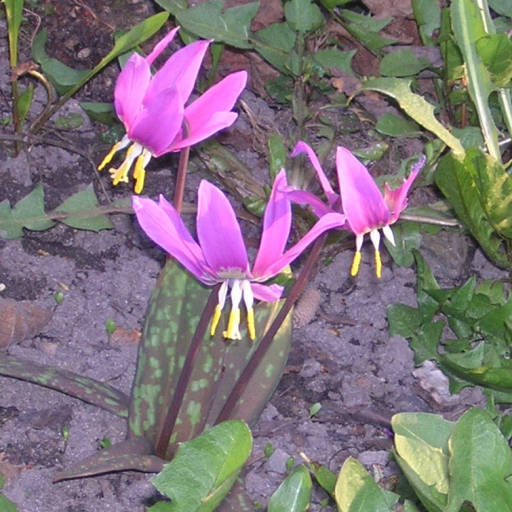
Plant Overview
Known to many as the Siberian Fawn Lily or "Kandyk" in its native Russian lands, this resilient beauty is a true survivor of the Altai Mountains. Often called the "Trout Lily" due to its speckled leaves that resemble a fish's back, it is one of the first splashes of color to emerge as the Siberian snow melts. In folklore, these delicate blooms are seen as brave heralds that wake the sleeping forest from its long winter slumber.
🔍 How to Identify
- 🌸 The "Reflexed" Bloom: The flowers are a striking magenta or pinkish-purple, with petals that curve sharply backward, exposing a bright yellow throat and prominent stamens.
- 🍃 Marbled Foliage: The wide, lance-shaped leaves are rarely just green; they are usually decorated with attractive, irregular brownish-maroon mottling or "splotches."
- 🌱 Low Stature: As a spring ephemeral, it stays close to the ground, rarely exceeding 8 inches in height, making it a perfect resident for the front of a shaded border.
🏡 In Your Garden
- ⏳ The Vanishing Act: This plant is a "Spring Ephemeral." This means after it flowers in early spring, the entire plant will go dormant and disappear underground by mid-summer. Don’t panic—it isn't dead; it’s just resting until next year!
- 🌲 Woodland Preferences: Because it originates from forest floors, it thrives in cool, dappled shade and organic, leaf-mold-rich soil. It hates "wet feet" during its summer dormancy, so well-draining soil is a must to prevent the bulbs from rotting.
⚠️ Safety & Toxicity
- 🐾 Low to Moderate Risk: While not considered "deadly," the bulbs of the Erythronium family contain alkaloids that can cause stomach upset if ingested.
- 🧒 Keep Away from Curious Nibblers: Ingesting large amounts of the bulb can lead to vomiting or diarrhea in pets and small children. It is best treated as an ornamental plant only.
✨ Fun Fact
In some Siberian cultures, the starch-rich bulbs were historically harvested, dried, and ground into a flour for porridge or even fermented into a traditional drink—though today, it is much more valued for its rare beauty than its nutritional content!

Detailed Care Instructions

Place in a window with dappled sun or a spot in the middle of a room. Or directly in a window facing west or east.

Water-loving plants flourish in wet or sloppy soil and near ponds. The extensive root system enables these plants to absorb plenty of water. The surface of the soil should be kept moist at all times. Place your pot in a container filled with water to guarantee that plants get enough water. If the ground becomes dry, it is recommended that you water it well. Plants in smaller pots will need to be watered more frequently. Water the soil in which the plant is standing thoroughly using a watering can.








