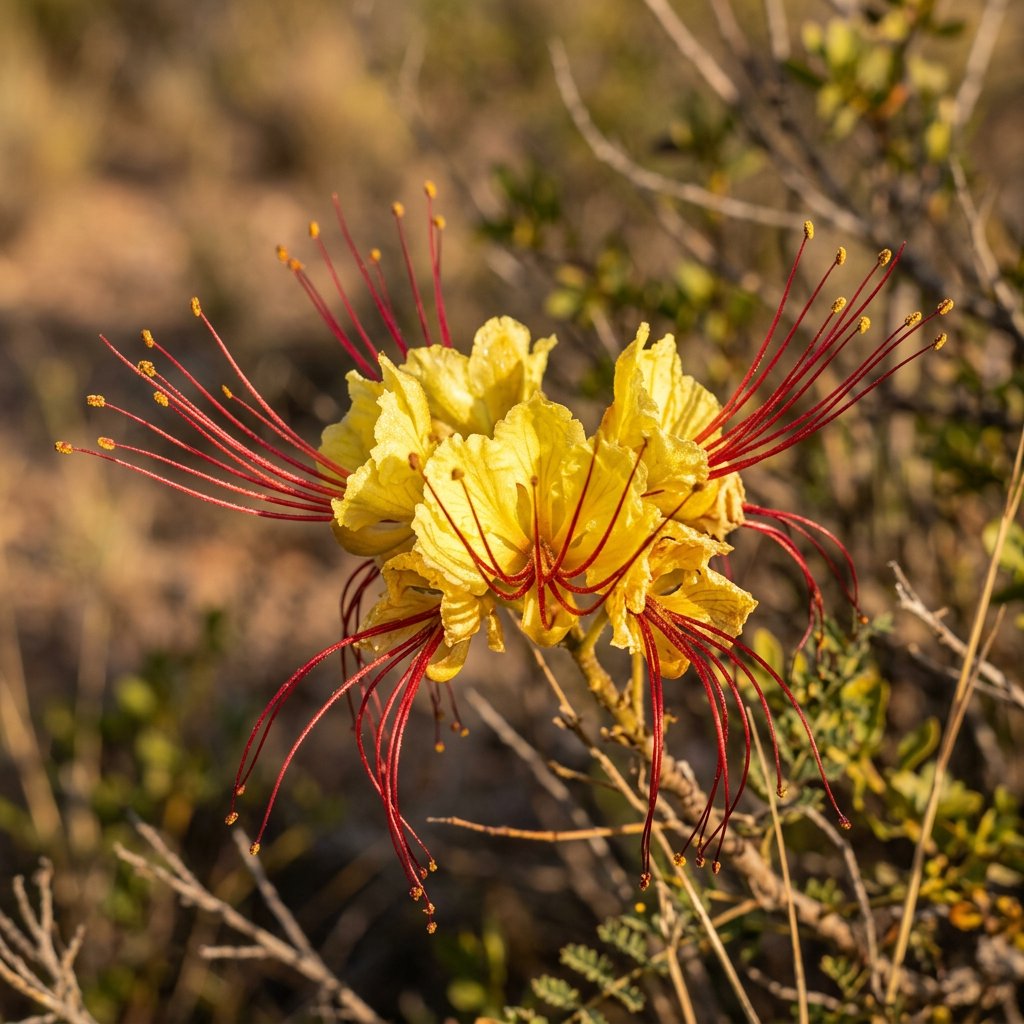
Plant Overview
Known affectionately as the Bird of Paradise Bush or the Desert Bird of Paradise, this striking shrub is a master of the heat. While it shares a name with the famous tropical orange flower (Strelitzia), it is actually a member of the pea family from South America. Its airy, fern-like foliage and "exploding" crimson stamens make it a favorite for gardeners looking to add a touch of the exotic to dry, sun-drenched landscapes.
🔍 How to Identify
- 🌿 Feathery Foliage: The leaves are bipinnately compound, meaning they look like delicate, lacy fern fronds that give the shrub an elegant, see-through quality.
- 🌺 Exotic Blooms: It produces upright clusters of pale yellow flowers, but the real showstoppers are the long, bright red stamens that protrude 3–4 inches out of the petals like whiskers.
- 🫛 Velvety Pods: Following the flowers, the plant develops flattened, leathery seed pods that are often covered in fine, sticky hairs.
🏡 In Your Garden
- 🏜️ Arid Ambition: This is a "tough-as-nails" plant that thrives in rocky, poor soil and intense heat. It is a staple of xeriscaping because it requires very little water once established.
- ✂️ Shape Management: Left to its own devices, it can become a bit "leggy" or sparse. Gardeners often give it a hard prune in late winter to encourage a bushier, more compact shape and more prolific blooming.
- 🦋 The Hummingbird Magnet: The unique structure of the flower is perfectly evolved for hummingbirds; as they reach for nectar, the long red stamens dust their feathers with pollen.
⚠️ Safety & Toxicity
- 🚫 Toxic Seeds: All parts of the plant are considered toxic if ingested, but the seeds and green seed pods contain the highest concentration of tannins.
- 🐾 Pet & Child Warning: Swallowing the seeds can cause severe abdominal pain, vomiting, and diarrhea. It is best to plant it in areas where curious pets or small children are supervised.
✨ Fun Fact
The seed pods of the Erythrostemon gilliesii are "explosive." On hot, dry days, the pods can suddenly twist and snap open with an audible pop, flinging the seeds several feet away to help the plant colonize new territory!

Detailed Care Instructions
To grow Erythrostemon gilliesii plant, also known as the southern firecracker plant or firewheel tree, you can follow these steps:
- Choose the right location: Erythrostemon gilliesii plants prefer a location with full sun to partial shade. Make sure the area receives at least 6 hours of direct sunlight per day.
- Prepare the soil: The plant grows well in well-draining soil that is rich in organic matter. Amend the soil with compost or well-rotted manure to improve its fertility and drainage.
- Sow the seeds: You can either sow the seeds directly in the garden bed or start them indoors. If starting indoors, sow the seeds in seed trays or pots filled with moist seedling mix. Place the seeds at a depth of about 1/4 inch and keep the soil consistently moist.
- Transplanting: If you started the seeds indoors, once the seedlings have developed a few sets of true leaves and the risk of frost has passed, you can transplant them outdoors. Space the plants at least 24 inches apart to allow for their mature size.
- Watering: Keep the soil consistently moist, especially during the first few weeks after transplanting. Once established, the plant is drought-tolerant and will require minimal watering.
- Mulching: Apply a layer of mulch around the plant to help retain moisture, suppress weed growth, and regulate soil temperature.
- Fertilizing: Apply a balanced, slow-release fertilizer in early spring to promote healthy growth. Follow the instructions on the fertilizer packaging for proper application rates.
- Pruning: Erythrostemon gilliesii plants generally do not require much pruning. However, you can trim back any dead or damaged branches as needed to maintain a tidy appearance.
- Winter care: In areas with colder winters, the plant may experience damage from freezing temperatures. Provide a layer of mulch around the base of the plant in late fall to protect the roots from frost. In severe winter conditions, you may need to cover the plant with a frost cloth or move potted plants indoors.
- Propagation: Erythrostemon gilliesii plants can be propagated by collecting and planting seeds, or by taking softwood cuttings in spring or summer. Follow the same steps as mentioned above for sowing seeds or root the cuttings in a well-draining rooting medium.
Remember to check for any specific instructions or recommendations for your specific region, as Erythrostemon gilliesii may have different requirements depending on the climate and soil conditions.

Place in a bright room that is sun drenched almost all day. Or directly in a south-facing window.

To properly water this plant, you should use a watering can or hose with a gentle spray nozzle. Water the soil around the base of the plant until it is moist, but not soggy. Make sure to avoid getting water on the leaves or flowers, as this can cause them to rot. Check the soil regularly and only water when the top inch of soil feels dry to the touch. In general, it's better to underwater this plant than to overwater it, as it is drought-tolerant and can be susceptible to root rot if given too much water.
To fertilize this plant, use a slow-release fertilizer high in phosphorus and potassium. Apply the fertilizer in the spring when new growth starts to show, and again in the summer after the first flush of flowers. Be sure to follow the manufacturer's instructions for application rates. Avoid over-fertilization, as too much can lead to excessive foliage growth at the expense of flowers.
The Erythrostemon Gilliesii plant prefers a well-draining soil that is moderately fertile. It is essential to use a soil mix that is well-draining and does not retain too much moisture in order to prevent root rot. A mixture of sand, perlite, and peat moss or coconut coir can be used to create a well-draining soil. Additionally, the soil should be slightly acidic with a pH ranging from 5.5-6.5. It is important to avoid using heavy soils that can compromise root growth and overall plant health. Lastly, organic matter such as compost or leaf mold can be incorporated into the soil to improve nutrient content and texture.
One way to propagate this plant is through seed. Collect the ripe seed pods and extract the small black seeds inside. Soak the seeds in hot water to weaken the hard seed coat, then plant them in a pot of well-draining mix. Keep the soil moist and warm, and the seeds should germinate within a few weeks.
Another method of propagation is by stem cuttings. Take a cutting of a healthy stem with a few leaves attached. Remove the bottom leaves and dip the cut end in rooting hormone. Plant the cutting in a pot of well-draining mix, and keep the soil moist but not waterlogged. Place the pot in a warm, bright spot but out of direct sunlight. Within a few weeks, roots should form and new growth will emerge.
Common pests of the yellow bird of paradise include Scale insect, mealybugs, spider mites, aphids. Make a habit of checking your yellow bird of paradise frequently for pests so that any infestations can be caught and managed early.








