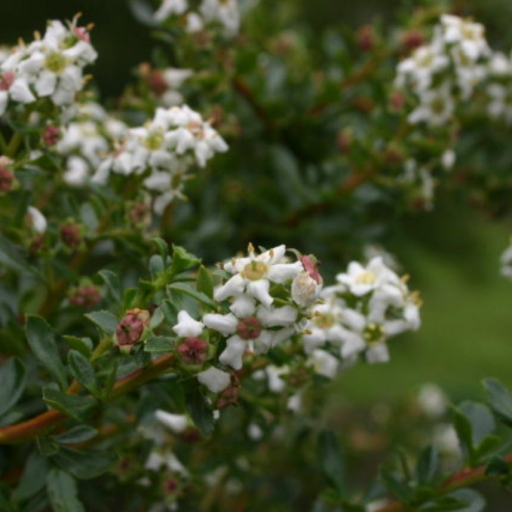
Plant Overview
Known as the "Coastal Queen" of shrubs, the Escallonia is a resilient evergreen native to the misty mountains of South America. Often used to create lush, flowering privacy screens, these shrubs are beloved for their glossy foliage and delicate, honey-scented blossoms that appear throughout the summer. Whether you are battling salty sea breezes or looking for a sturdy garden backbone, this South American gem offers year-round beauty.
🔍 How to Identify
- 🍃 The Leaves: Small, oval, and leathery with finely serrated (toothed) edges. They possess a high-gloss finish that makes the plant sparkle in the sunlight.
- 🌸 The Flowers: Clusters of small, bell-shaped or tubular flowers. Depending on the variety, they range from snowy white to soft pink and vibrant crimson.
- 🍯 The Scent: If you crush a leaf or stand near a blooming bush on a warm day, you may notice a sweet, resinous, or honey-like fragrance.
- 🌿 Growth Habit: Typically a dense, upright shrub, though some varieties can be trained against a wall or grow into small, elegant trees.
🏡 In Your Garden
- 🌊 Salt Spray Hero: Escallonia is famous for its "maritime tolerance." It has a specialized leaf structure that prevents salt from burning the foliage, making it the go-to choice for seaside gardens.
- ✂️ The Pruning Secret: Because it grows rapidly, it can become "leggy" or thin. To keep it dense and full of flowers, prune it immediately after the summer blooms fade; this encourages new wood for next year’s display.
- ☀️ Sun Seeker: While it can survive in partial shade, it needs plenty of sunlight to produce its signature abundance of flowers. It prefers well-draining soil and dislikes "wet feet" during the winter.
⚠️ Safety & Toxicity
- ✅ Status: Generally Non-Toxic.
- 🐾 Details: Escallonia is not considered poisonous to cats, dogs, or horses. It is a very "safe" choice for family gardens, though as with any garden plant, ingestion of large amounts of foliage might cause minor stomach upset in curious pets.
✨ Fun Fact
The genus was named in honor of Antonio Escallón y Flórez, an 18th-century Spanish traveler and physician who discovered these hardy shrubs while exploring the rugged terrain of Colombia. In their native Andean habitat, they are vital for stabilizing soil on steep slopes!

Detailed Care Instructions

Place in a bright room that is sun drenched almost all day. Or directly in a south-facing window.

To properly water this plant, you should thoroughly soak the soil around it with water until the liquid drains through the bottom of the container or into the ground. It is important to avoid getting water on the foliage, as this can lead to fungal growth or sunburn. Depending on the climate and soil conditions, this plant may require watering once or twice a week, or as little as once every few weeks. Observing the soil moisture level, as well as the plant's overall health and appearance, can help you determine the best watering schedule.
In order to ensure adequate growth and development of the Escallonia plant, it is recommended to use a soil that is well-draining and rich in nutrients. It is important to avoid heavy soils with high clay content, as they can cause problems with drainage and water retention. Ideally, the soil should have a neutral to slightly acidic pH, as Escallonia plants tend to prefer slightly acidic conditions.
A suitable soil mix for Escallonia plants might include a blend of organic matter such as peat or compost, along with sand, perlite, or vermiculite to improve drainage. It is also worth adding some slow-release fertilizer to the soil, to provide ongoing nutrition to the plant over an extended period of time.
When planting, it is important to ensure that the soil is well-prepared and free from large rocks or debris. For best results, the depth of the planting hole should be at least twice the width of the plant's root ball, to allow for adequate root growth. Finally, it is recommended to water the plant thoroughly after planting, and to water regularly throughout the growing season to avoid water stress.







