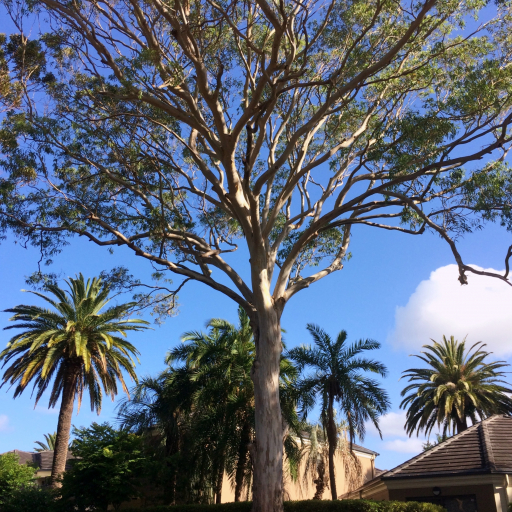
Plant Overview
Often called the Forest Red Gum or Queensland Blue Gum, this Australian icon is a true skyscraper of the plant world. Known for its smooth, "mottled" bark that looks like a camouflage pattern, it is a vital lifeline for wildlife, serving as one of the primary food sources for koalas. Whether standing tall in a coastal forest or a vast paddock, it commands attention with its massive stature and elegant, weeping foliage.
🔍 How to Identify
- 🎨 The Bark: Features a smooth, patchy trunk with a mosaic of white, grey, and bluish-grey colors; the old bark sheds in large, irregular flakes.
- 🍃 The Leaves: Mature leaves are long, slender, and curved like a sickle (falcate), typically displaying a dull green hue on both sides.
- 🎺 The Buds: Look for the distinctive flower buds; they have an unusually long, horn-shaped cap (operculum) that is much longer than the base.
🏡 In Your Garden
- 🌳 Room to Move: This is not a plant for a small suburban yard. It needs significant space as it can reach heights of over 150 feet, and its aggressive root system can easily lift pavement or interfere with pipes.
- 🐨 Wildlife Magnet: If you have the acreage to grow one, you are planting a sanctuary. It provides essential nectar for honeyeaters and bees, while its hollows offer nesting sites for cockatoos and gliders.
⚠️ Safety & Toxicity
- 🐾 Pet Warning: Like most Eucalyptus species, the leaves contain concentrated essential oils (eucalyptol) that are toxic to dogs, cats, and horses if ingested.
- 🏗️ Falling Branches: Old trees are prone to "self-pruning," meaning they may drop large, heavy limbs without warning. It is best to keep seating areas and structures well away from the "drip line" of the canopy.
✨ Fun Fact
The species name tereticornis comes from the Latin words teretus (rounded/cylindrical) and cornu (horn). This perfectly describes the long, pointy caps on the flower buds that look like tiny wizard hats before they pop open!

Detailed Care Instructions
To grow Eucalyptus Tereticornis (also known as Forest Red Gum), you can follow these steps:
- Location: Choose a suitable location with full sun exposure. Eucalyptus Tereticornis prefers warm climates and can tolerate various soil types, including sandy or loamy soil.
- Soil preparation: Prepare the soil by digging it up and removing any weeds or rocks. The soil should have good drainage to prevent waterlogging, as these plants prefer slightly acidic soil with a pH of 6.0 to 7.5.
- Planting: Plant the Eucalyptus Tereticornis seeds in either seed trays or directly in the ground. If using trays, fill them with seed raising mix and sprinkle the seeds on top, lightly covering them with a thin layer of soil. If planting directly in the ground, make small holes in the soil and plant the seeds. Space the seeds at least 1 to 2 feet apart.
- Watering: Water the seeds regularly but avoid overwatering, as Eucalyptus Tereticornis prefers drier conditions. Water the seeds when the top inch of soil feels dry to the touch.
- Maintenance: Monitor the plant's growth and regularly remove any competing weeds. Prune the plant occasionally to maintain its shape and remove any dead or diseased branches.
- Fertilization: Apply a slow-release fertilizer once a year during the growing season to provide necessary nutrients for the plant's healthy growth. Use a balanced fertilizer with equal amounts of nitrogen, phosphorus, and potassium.
- Mulching: Apply a layer of organic mulch around the base of the plant to help retain moisture, suppress weed growth, and maintain a consistent soil temperature.
- Pest and disease control: Eucalyptus Tereticornis is generally resistant to pests and diseases. However, keep an eye out for common garden pests such as aphids, scale insects, or leaf miners. If necessary, use appropriate organic insecticides or seek professional advice.
- Pruning: Eucalyptus Tereticornis can grow quite large, so regular pruning may be required to control its size, shape, and density. Prune during the dormant season, removing any dead or damaged branches.
- Patience: Eucalyptus Tereticornis is a slow-growing tree, so be patient in waiting for it to reach its full potential. It can take several years to establish and begin significant growth.

Place in a bright room that is sun drenched almost all day. Or directly in a south-facing window.

Eucalyptus Tereticornis plant prefers to be watered deeply and infrequently. To water this plant, ensure that the soil is dry to a depth of 2-3 inches before watering. When watering, apply water slowly and evenly around the base of the plant, allowing the soil to absorb the water. Avoid getting water on the leaves as this can cause leaf burn. Watering once a week during the growing season and less frequently during the dormant season is recommended. However, the frequency of watering may need to be adjusted depending on the climate and soil conditions.
To fertilize this plant, use a slow-release fertilizer with a balanced ratio of NPK. Apply it during the growing season, from spring to early fall, and follow the instructions on the fertilizer package. Avoid fertilizing during the winter months when the plant is dormant. Apply the fertilizer to the soil around the base of the plant, and water it in thoroughly. Consider adding a layer of organic mulch around the base of the plant to help conserve moisture and add nutrients over time.
The ideal soil for this particular plant is well-draining and sandy. It should have good fertility and a pH level between 6.0 and 7.5. This type of soil should also retain moisture well, but not be too heavy or waterlogged. Organic matter can also be added to the soil, such as compost or leaf mold, to improve its structure and nutrient content. It is important to avoid using soil that is heavy in clay, as this can cause the roots of the plant to become waterlogged and starved of oxygen. Additionally, the soil should not be too acidic, as this can hinder the growth and health of the plant. Overall, the soil for this plant should be well-draining, fertile, and have a neutral to slightly alkaline pH level.
To propagate this plant, you will need to collect seeds from the mature plant. Once you have the seeds, you can start the germination process by placing them in a container of moist soil or potting mix. Make sure to keep the soil consistently moist and provide plenty of light for the seeds to sprout. Once the seedlings have grown a few leaves, you can transplant them into individual containers or into a larger outdoor garden. Eucalyptus tereticornis may also be propagated through cuttings taken from the plant's branches. To take cuttings, use sharp, clean shears to cut off a section of the branch and remove any leaves or flowers. Dip the base of the cutting into rooting hormone and plant it in a container of soil. Keep the soil moist and provide plenty of light until the cutting takes root.








