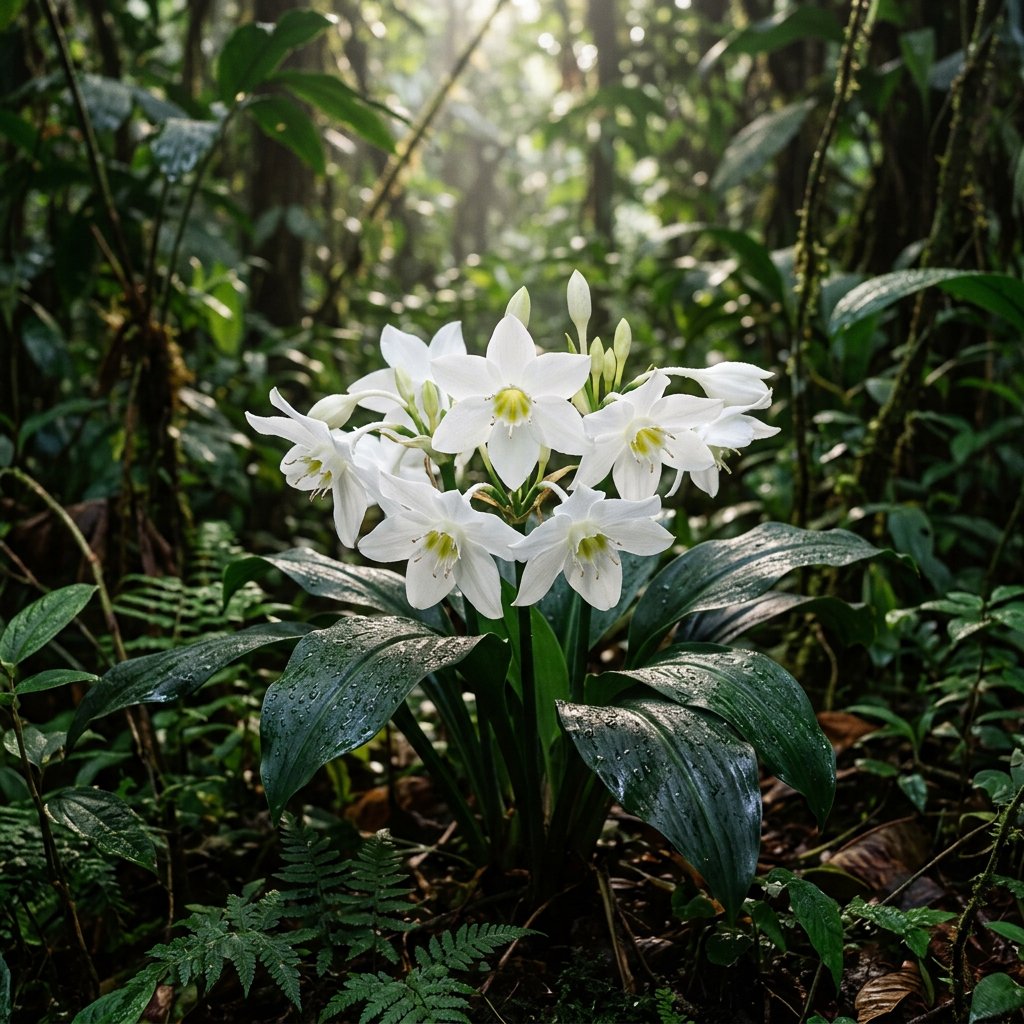
Plant Overview
The "Amazon Lily" is a tropical masterpiece often found gracing shaded verandas and elegant indoor spaces. Despite its common name, it isn’t a true lily but a bulbous herb from the Amaryllis family, known for its intoxicating, sweet scent and pristine white blooms. It’s like a sophisticated tropical cousin to the woodland daffodil, bringing a touch of South American rainforest mystery into the home.
🔍 How to Identify
- 🍃 Lush Foliage: Large, elliptical leaves that are deep emerald green and highly glossy, often reaching up to 20 inches in length.
- ❄️ Star-Shaped Blooms: Clusters of 5–10 waxy, white flowers that "nod" or hang slightly downward, each featuring a distinctive central cup tinged with light green.
- 📏 Sturdy Scapes: The flowers sit atop long, leafless, and fleshy stalks that rise elegantly above the dense foliage.
🏡 In Your Garden
- 🌱 Root Sensitivity: This plant is a bit of a homebody; it hates having its roots disturbed. It blooms best when it is slightly root-bound, so avoid repotting until the bulb is literally pushing against the sides of the container.
- 💧 Tropical Humidity: Coming from the Amazon basin, it thrives in high humidity. If your home is dry, it will appreciate a pebble tray or frequent misting to keep its leaves from browning at the tips.
- ⛅ Shadow Play: Unlike many flowering plants, the Amazon Lily shuns direct sunlight, which can scorch its dark leaves. It is a perfect candidate for that "bright but indirect" spot where other sun-lovers might struggle.
⚠️ Safety & Toxicity
- 🚫 Status: Toxic to humans and pets.
- 🐾 Details: Like many members of the Amaryllis family, the plant contains lycorine. If ingested, it can cause vomiting, diarrhea, and drooling in cats and dogs. The bulbs are the most concentrated source of the toxin, so keep them away from curious diggers.
✨ Fun Fact
The name Eucharis comes from the Greek word "eucharis," which literally translates to "very graceful." This is why it has been a staple in high-end bridal bouquets for over a century, symbolizing elegance and purity.

Detailed Care Instructions
To grow Eucharis X Grandiflora plants, also known as Amazon lilies or lily of the Amazon, follow these steps:
- Choose a suitable location: Eucharis plants prefer bright, indirect sunlight. Find a spot indoors near east or west-facing windows, or outdoors in partial shade. Avoid direct sunlight, as it can scorch the leaves.
- Prepare the soil: The soil should be well-draining and rich in organic matter. A mixture of equal parts potting soil, peat moss, and perlite or sand works well. Make sure the pot or planting area has drainage holes.
- Plant the bulbs: Eucharis X Grandiflora plants are typically propagated through bulbs or seeds. Plant bulbs about 2 inches deep and 6 to 8 inches apart in the soil. If using seeds, follow the instructions provided.
- Watering: Keep the soil moist but not soggy. Water when the top inch of soil feels dry with room temperature water. Ensure the excess water drains out of the pot to prevent waterlogging.
- Temperature and humidity: Eucharis plants thrive at temperatures between 60-70°F (15-21°C). They appreciate higher humidity levels, so placing a tray of water near the plants or using a humidifier can help maintain optimal conditions.
- Fertilizing: Feed plants with a balanced, water-soluble fertilizer once a month during the growing season (spring and summer). Follow the instructions on the fertilizer packaging. Avoid fertilizing during the dormant period in winter.
- Support and grooming: As the plant grows, it may benefit from staking or other support to prevent toppling. Remove any yellow or dead leaves regularly to maintain a tidy appearance.
- Propagation: To propagate Eucharis X Grandiflora plants, divide the bulbs or collect seeds from the flowers. Wait until the bulbs develop enough offsets and separate them carefully. Sow seeds in a seed-starting mix and follow the instructions provided.
- Pests and diseases: Watch out for common pests like aphids, mealybugs, or spider mites. Inspect leaves regularly for signs of damage or infestation, and take appropriate measures using organic insecticides or horticultural soaps if necessary.
Remember to be patient, as Eucharis X Grandiflora plants can take some time to establish and bloom. They generally flower in late spring or early summer with beautiful, fragrant white blooms.

Place in a window with dappled sun or a spot in the middle of a room. Or directly in a window facing west or east.

To water this plant, you should first make sure the soil is dry to the touch before proceeding. Then, slowly pour water into the soil until it begins to leak out of the drainage holes in the bottom of the pot. Be cautious not to water too much, as Eucharis X Grandiflora prefers to be slightly dry rather than overly saturated. Additionally, the plant prefers filtered or distilled water, as tap water may contain chemicals that are harmful to the sensitive roots. Watering frequency will depend on the environment of the plant, but generally, it needs to be watered once a week during the growing season.
To properly fertilize this plant, use a balanced, water-soluble fertilizer with equal amounts of nitrogen, phosphorus, and potassium. Apply the fertilizer once a month, during the growing season (spring and summer). Dilute the fertilizing solution to half strength before application. Avoid over-fertilizing, as this can lead to burning of the plant roots and foliage.
The soil type that is most suitable for growing Eucharis X Grandiflora plant is a well-draining, nutrient-rich soil that is slightly acidic. The type of soil that is recommended is one that is made up of a mixture of peat moss, perlite, and vermiculite or coarse sand. This type of soil will provide good aeration as well as allow for the efficient drainage of water, which is essential for the optimal growth and development of this plant. Additionally, it is important to avoid using soil that is too heavy in clay as this will retain too much moisture and can lead to root rot.
Eucharis X Grandiflora is typically propagated through division of its rhizomes. To do this, gently dig up the plant and carefully separate the rhizomes with a sharp, clean knife or scissors. Make sure each division has several leaves and healthy roots attached.
Plant each division in a well-draining potting mix and keep it in a warm, humid environment with bright indirect light. Water regularly, but do not overwater as the plant can be susceptible to root rot. After a few weeks, the division should begin to root and produce new growth.
Alternatively, Eucharis X Grandiflora can also be propagated through seed. Collect the seed pods from a mature plant and allow them to dry out. Sow the seeds in a well-draining potting mix and keep the soil moist. Germination can take several weeks to months.
Common pests of the amazon lily include Spider mites, thrips. Make a habit of checking your amazon lily frequently for pests so that any infestations can be caught and managed early.








