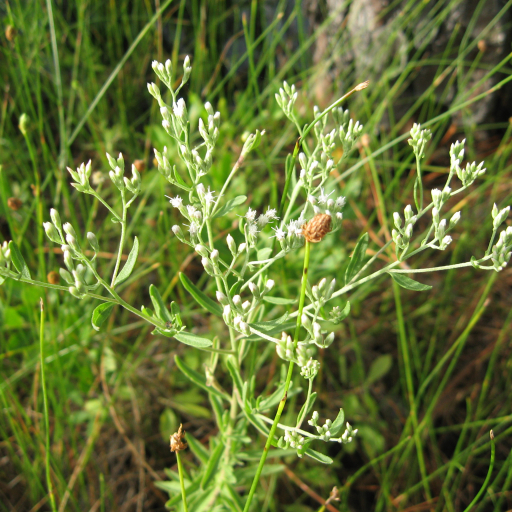
Plant Overview
Often referred to as Mohr’s Thoroughwort, this elegant perennial is a hallmark of the southeastern United States coastal plains. It is named in honor of Charles Mohr, a pioneering pharmacist and botanist who spent his life documenting the lush flora of the Gulf Coast. In the wild, it creates a soft, hazy white "mist" across damp meadows and pine flatwoods, making it a favorite for naturalistic landscape designs.
🔍 How to Identify
- ☁️ The Bloom: It produces flat-topped clusters of tiny, fuzzy white flowers. Unlike daisies, these flowers lack large outer petals, giving them a delicate, "powder puff" appearance.
- 🌿 The Foliage: The leaves are narrow, lance-shaped, and usually grow in opposite pairs or small whorls. They have a slightly rough texture and a soft green hue.
- 📏 The Stem: The plant grows upright, often reaching 2 to 3 feet tall. The stems are notably hairy or "pubescent," which helps distinguish it from some of its smoother-stemmed cousins.
🏡 In Your Garden
- 🦋 Pollinator Magnet: This plant is a high-traffic station for native bees, wasps, and butterflies. If you are building a "living landscape," this is an essential late-summer nectar source.
- 💧 The "Wet Feet" Rule: Mohr’s Thoroughwort thrives in moisture. It is an excellent choice for rain gardens, the edges of ponds, or low-lying areas in your yard where the soil stays consistently damp.
- 🌾 Soil Preference: It prefers sandy or peaty soils that are slightly acidic, mimicking its natural habitat in the southeastern pine savannas.
⚠️ Safety & Toxicity
- 🐾 Status: Low toxicity to humans, but potentially harmful to livestock and pets if consumed in large quantities.
- 🤢 Details: Like many members of the Eupatorium genus, it contains pyrrolizidine alkaloids. While it isn't "touch-sensitive," it should never be ingested. Keep it away from grazing animals like horses or cattle, as it can cause liver issues over time.
✨ Fun Fact
The name "Thoroughwort" comes from an old folk belief that the plant could heal "thoroughly" through the body. While Mohr's Thoroughwort is mostly admired for its beauty today, its relatives were once some of the most common medicinal herbs in early American households.

Detailed Care Instructions
To grow Eupatorium mohrii, also known as Mohr's thoroughwort or Mohr's eupatorium, you can follow these steps:
- Choose the right location: Eupatorium mohrii prefers full sun to partial shade, so find a spot in your garden that provides at least 6 hours of direct sunlight per day.
- Prepare the soil: This plant prefers well-drained soil with a slightly acidic to neutral pH. If your soil is heavy or clayey, amend it with organic matter like compost or well-rotted manure to improve drainage.
- Starting from seeds: You can start Eupatorium mohrii from seeds indoors or sow them directly in the garden. If starting indoors, sow the seeds in seed-starting mix, maintain a temperature of about 70°F (21°C), and keep the soil moist. Transplant the seedlings outdoors after the last frost date.
- Planting: Dig a hole in the prepared soil that is slightly larger than the plant's root ball. Place the plant in the hole, ensuring the top of the root ball is level with the surrounding soil. Backfill the hole and gently firm the soil around the plant.
- Watering: Eupatorium mohrii prefers consistent moisture but does not tolerate waterlogged conditions. Water the plant regularly, especially during prolonged dry spells, and allow the top inch of soil to dry between waterings.
- Mulching: Apply a layer of organic mulch, such as wood chips or bark, around the base of the plant. This will help retain moisture, suppress weed growth, and maintain a more consistent soil temperature.
- Fertilizing: Eupatorium mohrii is not heavy feeders, but you can apply a balanced slow-release fertilizer in spring to promote healthy growth. Follow the manufacturer's instructions for application rates.
- Pruning: In early spring, before new growth emerges, prune back any dead or damaged stems to encourage a compact growth habit and maintain the plant's overall shape.
- Pests and diseases: Eupatorium mohrii is generally resistant to pests and diseases but keep an eye out for common issues like aphids or powdery mildew. If necessary, treat any infestations with organic or chemical controls.
- Division: Over time, Eupatorium mohrii may become crowded. You can divide the plant every 3-4 years in early spring to rejuvenate it. Dig up the entire clump, separate it into smaller sections, and replant in well-prepared soil.
Remember to check local regulations and nursery availability since Eupatorium mohrii may be invasive in some areas.

Place in a bright room that is sun drenched almost all day. Or directly in a south-facing window.

To water this plant, ensure that the soil is completely dry before watering it. The frequency of watering will depend on the environment; the plant will require more water in hot, dry weather. When watering, pour water directly onto the soil, rather than the leaves, and make sure that any excess water drains away. Avoid overwatering, as this can cause the plant to rot.
To fertilize this plant, use an all-purpose fertilizer blend that contains a balanced ratio of nitrogen, phosphorus, and potassium. Apply the fertilizer in accordance with the manufacturer's recommended dosage and frequency. Feed the plant every four to six weeks during the growing season. Water the plant deeply after fertilization to help distribute the nutrients to the roots. Do not over-fertilize, as this can lead to excessive growth and reduced flowering.
Eupatorium Mohrii requires a well-draining soil that is rich in organic matter. The soil should be slightly acidic with a pH range of 6.0 to 6.5. It also prefers a loamy soil texture that is not too heavy or too sandy. It is recommended to mix in a slow-release fertilizer into the soil prior to planting the Eupatorium Mohrii to ensure proper nutrition. Additionally, it is important to avoid using heavy clay soils or soils that are prone to water-logging, as this can lead to root rot and other issues. Overall, a nutrient-rich soil that is well-draining and slightly acidic is ideal for supporting the growth and health of Eupatorium Mohrii.
- Eupatorium Mohrii plant can be propagated from both stem cuttings and seeds.
- To propagate via stem cuttings, select a healthy stem that is 4-6 inches long and has 2-3 nodes. Cut the stem below a node and remove the lower leaves.
- Dip the cut end of the stem in rooting hormone powder and plant it in a pot filled with a well-draining soil mix.
- Cover the pot with a plastic bag to retain moisture and place it in a bright location that receives indirect sunlight.
- Water the cutting regularly to keep the soil moist and mist the leaves occasionally. Within a few weeks, roots will start to form and new growth will appear.
- To propagate via seeds, collect the seeds from mature flowers in the fall. Plant the seeds in a pot filled with a well-draining soil mix and ensure that the soil is moist.
- Cover the pot with a plastic bag and store it in a cool location for 2-3 months to stratify the seeds.
- After stratification, move the pot to a bright location and remove the plastic bag. Water the seedlings regularly to keep the soil moist and fertilize with a balanced fertilizer.
- Once the seedlings have grown strong enough, they can be transplanted into individual pots or directly into the ground.








