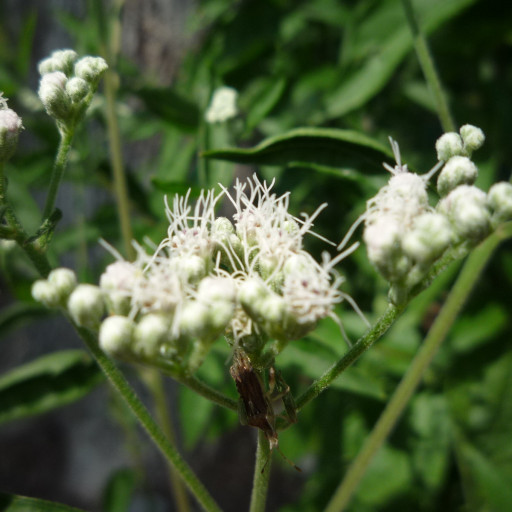
Plant Overview
Commonly known as Late Boneset or Late-flowering Thoroughwort, this tall, airy perennial is the unsung hero of the autumn garden. While other plants begin to fade in the heat of late August, this species bursts into clouds of fuzzy white flowers, acting as a vital "fueling station" for migrating butterflies. Its name "Boneset" stems from an old folk belief that the plant could help heal bone fractures, though today it is far more valued for its rugged beauty and ecological impact.
🔍 How to Identify
- 🌼 The Flowers: Dense, flat-topped clusters of tiny, fringe-like white florets that give the plant a "misty" or "fuzzy" appearance from a distance.
- 🍃 The Foliage: Long, lance-shaped leaves with sharply serrated (saw-toothed) edges. Unlike some of its cousins, these leaves have distinct short stalks (petioles) rather than wrapping around the stem.
- 📏 The Stature: A commanding presence in the landscape, it typically grows between 3 to 6 feet tall with sturdy, grayish-green stems that are often covered in fine, velvety hairs.
🏡 In Your Garden
- 🦋 Pollinator Magnet: This is one of the best plants for supporting local biodiversity. It is a favorite of hairstreak butterflies, beneficial wasps, and native bees who rely on its late-season nectar.
- 💧 The "Problem Area" Solution: Late Boneset loves "wet feet." It is the perfect choice for rain gardens, low spots in the yard that stay damp, or the edges of a pond where other plants might rot.
- 🌾 Naturalizing: Because it can spread via seeds and rhizomes, it is best used in "wilder" parts of the garden or large borders where it has room to lean and mingle with ornamental grasses.
⚠️ Safety & Toxicity
- 🐾 Livestock Warning: Late Boneset contains pyrrolizidine alkaloids, which can be toxic to the liver if consumed in large quantities. This is primarily a concern for horses and cattle if it invades their grazing pasture.
- 👶 General Safety: It is generally not considered a high-risk plant for casual contact in a garden setting, but it should never be ingested by humans or pets.
✨ Fun Fact
- 🧬 What's in a Name? Its species name, serotinum, is Latin for "late-blooming." While most of its Eupatorium relatives finish their show by mid-summer, the Late Boneset waits until the "eleventh hour" of the growing season to provide its essential nectar.

Detailed Care Instructions
To grow Eupatorium serotinum (late boneset) plants, you can follow the following steps:
- Obtain seeds or young plants: You can either collect seeds from existing plants or purchase them from a reputable nursery or online seed supplier. You can also look for young plants at nurseries.
- Choose a suitable location: Eupatorium serotinum prefers full sun to partial shade. Ensure the chosen location has well-draining soil.
- Prepare the soil: Loosen the soil and remove any weeds or debris. Amend the soil with organic matter like compost, if needed, to improve soil fertility and drainage.
- Sow seeds or plant young seedlings: If you are starting from seeds, sow them directly in the planting location following the recommended depth on the seed packet. If using young seedlings, dig a hole slightly larger than the root ball and gently place the plant into the hole.
- Water regularly: Keep the soil evenly moist but not waterlogged. Eupatorium serotinum appreciates regular watering, especially during dry spells or periods of drought.
- Mulch: Apply a layer of organic mulch around the base of the plant to help retain soil moisture, suppress weeds, and regulate soil temperature.
- Monitor and maintain: Regularly monitor the plant for any signs of pests or diseases. Prune or deadhead the plant as needed to promote bushier growth and prevent self-sowing if desired.
- Provide support if needed: Some taller varieties of Eupatorium serotinum may benefit from staking or support to prevent bending or flopping, particularly if grown in windy areas.
- Harvest or deadhead: Harvest flowers or deadhead spent blossoms to promote continuous blooming and prevent self-seeding. Eupatorium serotinum produces clusters of small white flowers from late summer to fall.
By following these steps, you should be able to successfully grow Eupatorium serotinum plants.

Place in a bright room that is sun drenched almost all day. Or directly in a south-facing window.

To properly water the Eupatorium Serotinum plant, ensure that the soil is consistently moist but not waterlogged. Use a watering can or hose with a gentle stream and avoid getting water on the leaves. Water deeply, soaking the soil down to the root zone. Let the soil dry out a bit between waterings, but do not allow it to completely dry out. Water more frequently during hot or dry weather.
To fertilize this plant, begin by selecting a slow-release, balanced fertilizer with equal parts nitrogen, phosphorus, and potassium. Apply the fertilizer in early spring or late fall when the plant is actively growing. Make sure to carefully follow the package instructions for application rates and methods, as over-fertilization can damage the plant. For best results, water the plant deeply before and after fertilizing to ensure that the nutrients are absorbed into the soil. Monitor the plant throughout the growing season and adjust fertilization as needed based on soil conditions and plant health.
The soil that is best suited for the growth of this plant is a well-draining, nutrient-rich soil that has a neutral to slightly acidic pH level. It should also contain adequate organic matter to promote healthy root growth and moisture retention. The ideal soil should not be too compact, as this can lead to poor drainage and root rot. When planting, it is recommended to amend the soil with compost or other organic matter to improve its overall quality and fertility. Additionally, it is important to ensure that the soil is kept consistently moist, but not waterlogged, to avoid stressing the plant and promoting disease.
Propagation of this plant can be achieved through various methods, including seed propagation and vegetative propagation. Seed propagation involves collecting mature seeds from the plant and sowing them in a soil mix to germinate. Seeds require a period of stratification before being sown, which can be achieved by storing them in a cool, dry place for a few weeks.
Vegetative propagation, such as stem cuttings or division of the root ball, is another effective method. To take stem cuttings, select a healthy stem and cut it just below a node. Remove the lower leaves and dip the cutting in rooting hormone before planting it in a rooting medium. Keep the cuttings in a warm, humid environment until roots form.
To divide a mature plant, remove it from its container or ground. Carefully separate the root ball into smaller sections, making sure each section has healthy roots and foliage. Plant each division in a new pot or location, ensuring it receives adequate water and nutrients during the establishment phase.
Common pests of the lateflowering thoroughwort include Spider mites, aphids. Make a habit of checking your lateflowering thoroughwort frequently for pests so that any infestations can be caught and managed early.








