Plant Overview
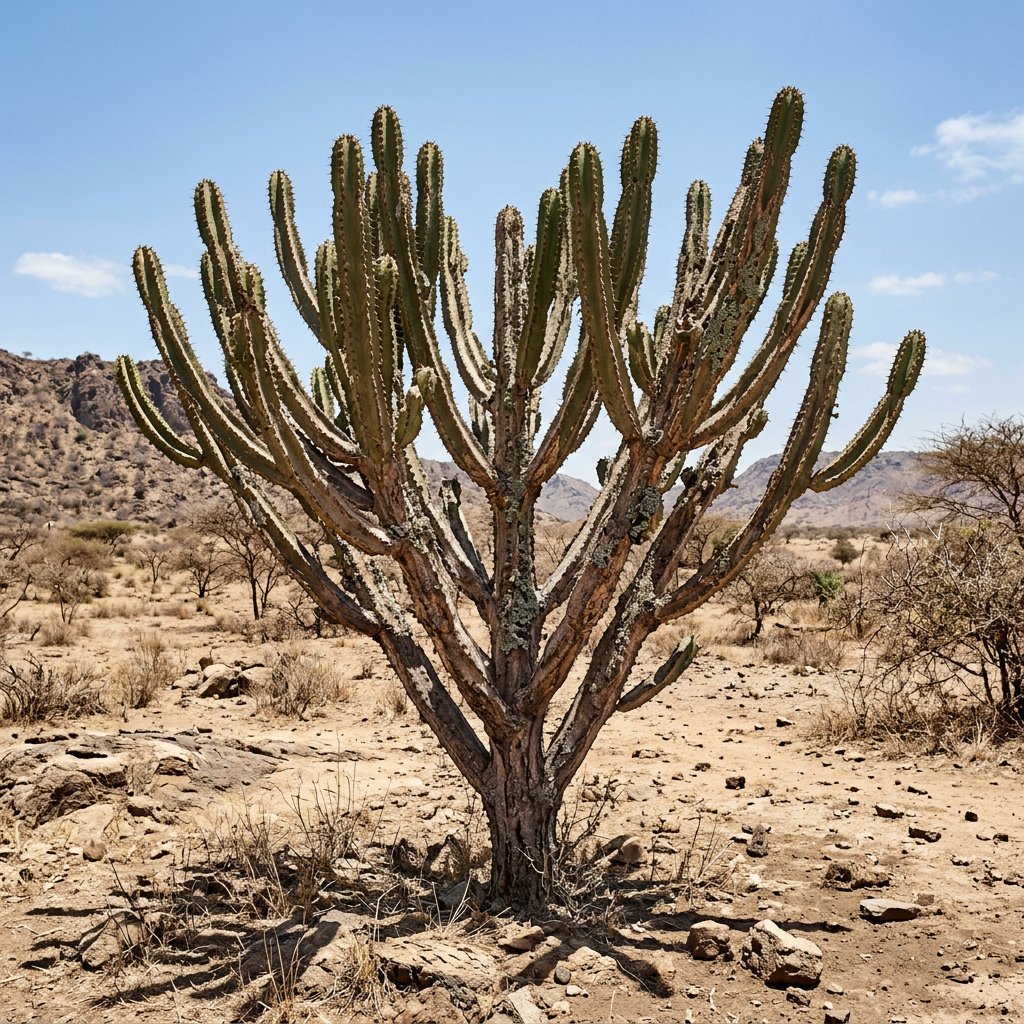
Often called the Candelabra Tree, this striking succulent is nature’s version of a grand chandelier. Native to the dry, rocky regions of East Africa, it mimics the appearance of a cactus despite being a member of the diverse Euphorbia family. In its native habitat, it stands as a massive sentinel on the savannah, often growing tall enough to rival a small building.
🔍 How to Identify
- 🌵 Structural Shape: Its main trunk splits into numerous vertical, upward-curving branches that create a distinct, symmetrical "U" or candelabra-like silhouette.
- 📐 Angular Stems: The dark green branches are typically four-angled (sometimes five), featuring prominent ridges that allow the plant to expand or contract depending on how much water it has stored.
- 🦷 Spiny Ridges: Along the edges of the ribs, you’ll find pairs of short, dark thorns. While it has tiny leaves on new growth, they drop off quickly, leaving the green stems to perform photosynthesis.
🏡 In Your Garden
- ☀️ Sun Seeker: This plant craves direct, intense sunlight. If kept indoors, it must sit in your brightest window; otherwise, the branches will stretch and become weak, losing that iconic architectural form.
- 🏜️ Drainage is Key: Because it is adapted to African slopes, it cannot tolerate "wet feet." Use a gritty, cactus-focused soil mix and a pot with large drainage holes to prevent the roots from suffocating.
- ⚖️ Stability Issues: While often sold as small indoor accents, this is a tree at heart. It grows relatively quickly and can become top-heavy, so it requires a heavy ceramic or stone pot to prevent it from tipping over as it matures.
⚠️ Safety & Toxicity
- 🚫 Toxic Latex: EXTREME CAUTION REQUIRED. All parts of the plant contain a thick, milky white sap (latex) that is highly caustic and poisonous.
- 👀 Severe Irritant: Contact with the skin can cause painful blistering and rashes. If the sap gets into the eyes, it can cause intense pain and even temporary or permanent blindness. Always wear gloves and eye protection when pruning.
- 🐾 Pets & Kids: This plant is dangerous if nibbled. Ingestion causes severe burning of the mouth and throat, swelling, and extreme gastric distress. It should be kept out of reach of curious family members.
✨ Fun Fact
In many parts of Africa, the Candelabra Tree is so culturally significant that it has been featured on postage stamps. While the fresh sap is dangerous, the wood is surprisingly light and tough; once the toxic sap is dried out, the timber is traditionally used to make roofs, doors, and even musical instruments.

Detailed Care Instructions
To grow Euphorbia Candelabrum, also known as the candelabra tree, you can follow these steps:
- Choose the right location: Euphorbia Candelabrum requires a sunny spot with well-draining soil. It can tolerate a wide range of temperatures but prefers warm climates.
- Prepare the soil: Make sure the soil is well-draining by adding organic matter like compost or sand if needed.
- Planting: Dig a hole slightly larger than the plant's root ball. Place the plant in the hole, making sure it is at the same level as in the container. Fill the hole with soil, gently firming it around the plant.
- Watering: Water the plant thoroughly after planting. Then, allow the soil to dry out slightly between waterings. Do not overwater, as Euphorbia Candelabrum is a succulent and is adapted to drought conditions.
- Fertilizer: Euphorbia Candelabrum does not require much fertilizer. You can apply a balanced, slow-release fertilizer once or twice a year during the growing season.
- Pruning: Remove any dead or damaged branches as needed. Additionally, you can prune the plant to maintain its desired shape and size.
- Protect from frost: If you live in a colder climate, provide protection from frost by covering the plant or moving it indoors during winter.
- Pest and disease control: Euphorbia Candelabrum is generally resistant to pests and diseases. However, you should regularly monitor for any issues and take appropriate action if necessary.
Remember to be cautious while handling Euphorbia Candelabrum, as it produces a toxic, milky sap that can cause skin irritation and is harmful if ingested. Wear protective gloves and keep the plant away from children and pets.

Place in a bright room that is sun drenched almost all day. Or directly in a south-facing window.

To water this plant, use a watering can or hose with a nozzle to gently water the soil around the base of the plant. Avoid getting water directly on the leaves or stem as this can cause damage. Allow the soil to dry out slightly between waterings and be careful not to overwater as this can lead to root rot. The frequency of watering will depend on the conditions in your location, such as humidity and temperature. It is best to check the soil moisture level before watering to ensure the plant does not become waterlogged.
For optimal growth of this plant, it is recommended to fertilize it once a month during the growing season. Use a balanced fertilizer with equal parts nitrogen, phosphorus, and potassium. Dilute the fertilizer to half strength and apply it directly to the soil around the plant. Avoid getting the fertilizer on the leaves or stem as it may cause damage. Water the plant after fertilizing. Do not fertilize the plant during the dormant season or if the soil is already rich in nutrients.
The ideal soil for a certain species of succulent plant is a mixture of sand, perlite, and a well-draining potting mix with a low moisture retention capability. This soil mixture replicates the natural habitat of the plant in its native region, ensuring that it receives the necessary amount of water and nutrients to thrive and grow healthily. It is also important to avoid using heavy clay soils, which can retain too much water and cause root rot or other diseases in the plant. Overall, it is essential to choose soil that has a pH level between 5.5 and 6.5 to provide the optimal conditions for growth.
Euphorbia Candelabrum plant can be propagated through stem cuttings. Use a sharp knife or scissors to cut a stem that is at least 4 inches long. Ensure that the stem has no flowers or buds. Allow the cutting to dry for a day or two to prevent it from rotting.
Prepare a well-draining potting soil mix by combining peat moss, perlite, and sand. Moisten the soil mix before planting the cutting. Make a hole in the soil with a pencil or stick and plant the cutting about 1 inch deep. Firmly press the soil around the cutting to ensure it is stable.
Place the pot in a bright but indirect light. Keep the soil moist but not waterlogged to avoid rotting the cutting. After a few weeks, the cutting should start forming roots. You can test for root growth by gently tugging on the cutting. If it resists pulling, it has rooted.
Once the cutting has rooted, it can be transplanted into a larger pot or into the garden. Gradually expose the new plant to more sunlight to avoid sunburn. You can also fertilize the plant every few weeks with a balanced fertilizer to encourage growth.








