Plant Overview
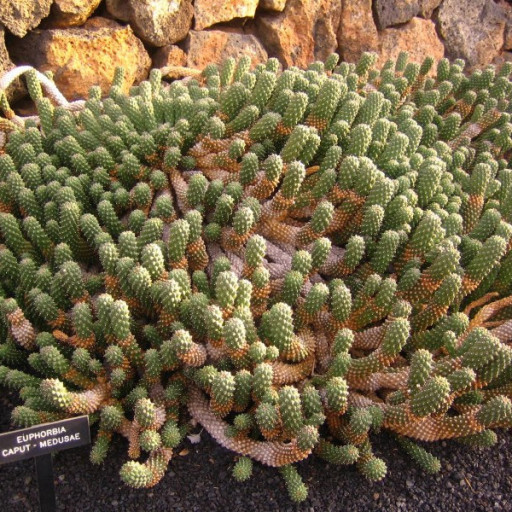
Known as the "Medusa’s Head," this architectural succulent looks like it crawled straight out of a Greek myth. Native to the rocky coastal soil of South Africa, it features a thick central hub from which dozens of snake-like branches emerge and sprawl. It is a favorite for collectors who want a "living sculpture" that demands very little in return for its dramatic, serpentine presence.
🔍 How to Identify
- 🐍 The "Head": A thick, woody central stem known as a caudex that sits partially underground or flush with the soil.
- 🌿 The "Snakes": Numerous long, cylindrical green branches (up to 15 inches) covered in small bumps called tubercles, mimicking the texture of scales.
- 🌼 The Flowers: Tiny, star-shaped yellow-green blooms, called cyathia, that appear in clusters at the very tips of the "snakes" during the spring and summer.
🏡 In Your Garden
- ☀️ Light & Form: This plant thrives in bright, filtered light. Without enough sun, the "arms" will become thin, pale, and stretched out, losing the compact "Medusa" look.
- 💧 Drought Strategy: Because the central caudex stores a massive amount of moisture, the plant is incredibly drought-tolerant. It hates "wet feet," so use a gritty, sandy cactus mix and a pot with excellent drainage to prevent rot.
- 🌬️ Fresh Air: In temperate climates, it loves being outdoors in the summer, but it must be brought inside before the first frost, as it cannot handle freezing temperatures.
⚠️ Safety & Toxicity
- 🚫 Toxic Sap: Like all members of the Euphorbia family, this plant produces a milky white latex sap when cut or bruised.
- 👁️ Severe Irritant: The sap is a known skin irritant and can cause temporary blindness or severe pain if it contacts the eyes. Always wear gloves and eye protection when pruning.
- 🐾 Pet Warning: Keep this plant out of reach of cats, dogs, and children. Ingestion can cause mouth blistering, swelling, and stomach upset.
✨ Fun Fact
🏛️ A Linnaean Legend: The legendary botanist Carl Linnaeus named this species in 1753. He was so struck by its wild, writhing appearance that he chose the Latin name Caput-medusae, which literally translates to "Head of Medusa," the Gorgon of Greek mythology whose hair was made of living snakes.

Detailed Care Instructions
| Humidity | Normal |
| Lighting | Part Sun |
| Difficulty | Easy |
| Hardiness Zones | 9 - 11 |
To grow an Euphorbia caput-medusae plant, also known as the Medusas Head or Octopus Plant, you can follow these steps:
- Choose the right location: Euphorbia caput-medusae plants prefer bright indirect sunlight. Place them near a window that receives bright, filtered light. Avoid direct sunlight as it can scorch the plant.
- Select a well-draining pot: Use a pot with drainage holes to prevent waterlogging. The pot should be appropriately sized for the plant, with enough space for root growth.
- Potting mix: Use a fast-draining cactus or succulent potting mix. You can also create your own mix by combining regular potting soil, perlite, and coarse sand in equal parts.
- Watering: Water the plant thoroughly, allowing water to flow out of the drainage holes. Then allow the soil to dry out between waterings to prevent overwatering. Euphorbia caput-medusae plants are drought-tolerant and can withstand periods of dryness.
- Temperature and humidity: These plants thrive in average room temperatures of around 65-75°F (18-24°C). They can tolerate higher temperatures, but avoid extreme temperature fluctuations. Normal household humidity levels are sufficient for their growth.
- Fertilization: Use a balanced liquid fertilizer diluted to half strength during the growing season, which is typically spring and summer. Apply the fertilizer every 4-6 weeks for optimal growth.
- Propagation: Euphorbia caput-medusae plants can be propagated through stem cuttings. Simply cut a healthy stem, let it dry for a day or two, then plant it in well-draining soil. The cutting should root and produce a new plant.
- Care: Handle the plant with care, as its stems are delicate and can easily break. The sap from the plant can be irritating to the skin and eyes, so it is advisable to wear gloves and protect yourself while handling it.
Remember, Euphorbia caput-medusae plants are succulents and do not require frequent watering or excessive care. Enjoy their unique appearance and watch them grow into beautiful specimens with time.

Place in a window with dappled sun or a spot in the middle of a room. Or directly in a window facing west or east.
- Determine the watering schedule: Euphorbia Caput-medusae should be watered when the top half-inch of soil is dry to the touch. This might require daily watering during the hot summer months or less frequent watering during cooler seasons.
- Use room temperature water: When watering, use room temperature water. Do not use cold water as this can shock the roots and cause stress to the plant.
- Water the soil, not the plant: Direct water to the soil around the base of the plant, avoiding the leaves and stem. This will prevent rot and fungal growth.
- Water until the soil is moist: Water until the soil is moist, but not soaked. Overwatering can lead to root rot, so it’s important to ensure the soil has proper drainage.
- Allow the soil to dry out: Before watering again, allow the soil to dry out. This will prevent waterlogging and ensure the plant has proper oxygenation.
- Adjust watering based on conditions: Adjust watering based on the conditions in your environment. In dry or hot conditions, you may need to water more frequently, whereas in cooler temperatures, less frequent watering may be necessary.
To fertilize this plant, mix a balanced fertilizer (10-10-10) with water according to the package instructions. Apply the fertilizer solution to the plant once a month during the spring and summer growing season, and reduce to every other month during the fall and winter dormant period. Be careful not to over-fertilize, as this can damage the plant's roots.
It is recommended to use a well-draining soil mix with Euphorbia Caput-medusae plant. The soil should be porous and gritty in texture, which would help prevent water from accumulating around the roots and possibly causing root rot. A mixture of coarse sand, perlite, and peat moss would be suitable for this plant. The soil pH levels should be slightly acidic to neutral, ranging from 5.5 to 7.5 pH. Additionally, the soil should be fertilized with a balanced fertilizer that contains equal parts of nitrogen, phosphorus, and potassium. It is important to note that this plant is sensitive to over-fertilization, and the recommended fertilization rate should not be exceeded.
Euphorbia Caput-medusae is a succulent plant that can be propagated through stem cuttings. To propagate the plant, choose a healthy stem and use a sterile, sharp knife to cut a section of the stem that is at least 4 inches long. Remove the lower leaves from the stem cutting and allow the cut area to dry for a few days until a callus forms.
Prepare a well-draining potting mix and make a hole in the soil with a pencil or finger. Insert the stem cutting into the soil and gently tamp the soil around it to hold it in place. Water the cutting lightly to settle the soil around the stem.
Place the potted cutting in a bright, indirect light location and keep the soil moist but not waterlogged. Avoid direct sunlight, which can scorch the plant. Depending on the growing conditions, the stem cutting should root in about four to six weeks.
After the stem cutting has rooted and starts to show new growth, gradually acclimate the plant to more sunlight and drier soil conditions. You can transplant the young plant to a larger container with well-draining soil. With proper care, the propagated Euphorbia Caput-medusae plant will continue to grow and produce its distinct, snake-like stems.








