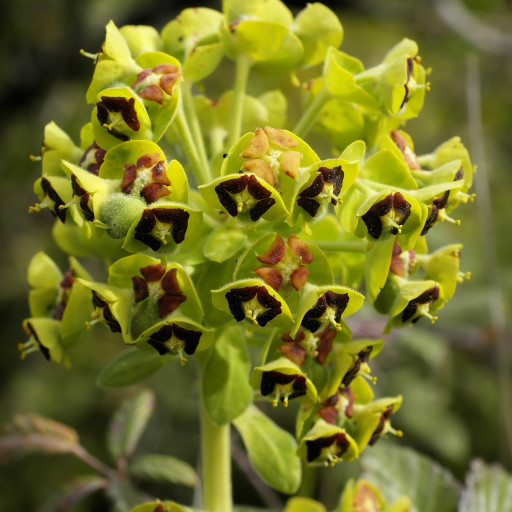
Plant Overview
Known as the Mediterranean Spurge, Euphorbia characias is the architectural superstar of the garden world. With its upright, sturdy stems and otherworldly lime-green "flowers," it looks like something plucked straight from a prehistoric landscape or a sophisticated modern art gallery. It is a tough-as-nails evergreen that brings structure and a cool, blue-green palette to dry, sunny borders year-round.
🔍 How to Identify
- 🌿 Foliage: Densely packed, narrow, linear leaves that spiral around the stems in a "whorled" pattern, typically sporting a waxy, glaucous blue-green hue.
- 🟢 The "Flowers": What look like flowers are actually large, dome-like clusters of chartreuse (yellow-green) bracts. If you look closely, each tiny center has a dark, chocolate-maroon "eye" known as a nectary.
- 🏗️ Growth Habit: It grows as a mounding subshrub, with stems that rise vertically from the base, reaching up to 4 feet tall, creating a distinctively structural, rounded silhouette.
🏡 In Your Garden
- ☀️ Sun & Drainage: This plant is a sun-worshiper from the Mediterranean. While it is incredibly drought-tolerant, it will quickly "pout" and rot if its roots stay wet. It requires gritty, well-draining soil to thrive through the winter.
- ✂️ Pruning Nuances: Unlike many shrubs, individual stems of the Spurge are biennial. Once a stem has finished flowering in its second year, it should be cut all the way back to the base to make room for fresh, new growth. Always wear long sleeves and gloves when doing this!
⚠️ Safety & Toxicity
- 🚫 Status: Highly Toxic / Skin Irritant.
- 🧪 Details: Like all members of the Euphorbia family, this plant contains a thick, milky white sap (latex). This sap is caustic and can cause severe skin rashes, blistering, and intense eye irritation. It is toxic if ingested by humans, cats, dogs, or horses. Keep it away from high-traffic areas where children or pets might snap a stem.
✨ Fun Fact
The "flowers" of the Euphorbia aren't true flowers at all! Botanically, they are called cyathia. The plant uses colorful modified leaves (bracts) to do the visual work of attracting pollinators, while the actual reproductive parts are tiny and tucked away in the center.

Detailed Care Instructions
| Color | Bright Green Foliage With Gold To Yellow Or Green Blooms |
| Soil Ph | 6.0-8.0 |
| Lighting | Full Sun |
| Soil Type | Well-Draining, Clay, Loamy, Sandy |
| Bloom Time | Early Spring To Early Summer |
| Plant Type | Shrub |
| Mature Size | Up To 4 Feet Tall |
| Native Area | Southern Europe, Eastern Turkey, Balkans |
| Sun Exposure | Full Sun |
| Hardiness Zones | 7-10 |
To grow Euphorbia characias, follow these steps:
- Choose a suitable location: Euphorbia characias thrives in a sunny spot with well-draining soil. Select an area with full sun exposure for at least six hours per day.
- Prepare the soil: Loosen the soil in the chosen location using a garden fork or tiller. Amend the soil with organic matter, such as compost or well-rotted manure, to improve drainage and fertility.
- Planting: Dig a hole slightly larger than the root ball of the Euphorbia characias plant. Place the plant in the hole, ensuring that the top of the root ball is level with the soil surface. Backfill the hole with soil, firming it gently around the roots.
- Watering: Water the newly planted Euphorbia characias thoroughly after planting to settle the soil and eliminate any air pockets. Afterward, water the plant deeply but infrequently, allowing the soil to dry out slightly between waterings. Avoid overwatering, as the plant prefers a slightly drier environment.
- Mulching: Apply a layer of organic mulch, such as bark chips or straw, around the base of the plant. This helps retain soil moisture, suppresses weed growth, and insulates the roots during extreme temperatures.
- Pruning: Euphorbia characias does not require extensive pruning, but you may remove any dead or damaged stems as needed. Wear gloves while pruning because the milky sap of Euphorbias can irritate the skin and eyes.
- Fertilizing: Euphorbia characias generally does not require regular fertilization. However, you can apply a balanced, slow-release fertilizer in early spring to boost growth if desired.
- Propagation: Euphorbia characias can be propagated by collecting and planting seeds, or by taking stem cuttings. Seeds should be sown in well-draining soil in early spring, while stem cuttings can be taken during the summer months and rooted in a well-draining potting mix.
- Pest and disease management: Euphorbia characias is generally resistant to pests and diseases. However, keep an eye out for aphids or mealybugs and treat if necessary. Avoid overwatering, as it can create favorable conditions for root rot.
Remember to research any specific requirements for your particular variety of Euphorbia characias, as different cultivars may have slightly different care needs.

Place in a bright room that is sun drenched almost all day. Or directly in a south-facing window.

The best way to water this plant is to wait until the topsoil has dried out and then water it thoroughly, making sure that there is good drainage and that the excess water can flow out of the pot or soil. It is important not to overwater the plant, as this can cause root rot and other problems. It is also important to avoid getting the leaves wet when watering, as this can cause sunburn and other damage. If the plant has been sitting in direct sunlight for a while, it may need more water than usual, so keep an eye on it and adjust your watering schedule accordingly.
To fertilize this plant, use a balanced fertilizer with a ratio of 10-10-10, or one specially formulated for flowering perennials. Apply the fertilizer in early spring when new growth appears, and again in mid-summer. Follow the manufacturer's instructions for dosage and application method. Water the plant thoroughly after fertilizing to help the nutrients absorb into the soil. Avoid fertilizing in late fall or winter when the plant is dormant.
The soil to use with this plant should be well-draining and loamy, with a pH level that is slightly acidic. It should contain a balanced mixture of organic matter such as compost, peat moss, and sand. Additionally, the soil should be fertile and able to hold moisture without becoming too waterlogged, which can result in root rot. When planting, it is important to ensure that the soil is not too compacted, as this can hinder root growth. Adding slow-release fertilizer to the soil can also help promote healthy growth and flowering.
- Obtain a mature Euphorbia Characias plant and locate a healthy shoot or stem.
- Using a clean, sharp knife or shears, make a clean cut at an angle about 5-10cm from the top of the shoot or stem.
- Remove any leaves or side shoots from the lower 2/3 of the cutting.
- Dip the cut end of the cutting into a rooting hormone powder, tapping off any excess.
- Prepare a pot with well-draining potting soil, and make a hole in the center.
- Insert the cutting into the hole and gently firm the soil around it.
- Water the soil well, making sure it is evenly moist but not saturated.
- Cover the pot with a clear plastic bag or create a greenhouse using a clear plastic bottle, to maintain humidity around the cutting.
- Place the pot in a bright but indirect light location, out of direct sunlight.
- Keep the soil moist and mist the cutting occasionally.
- After around 3-4 weeks, check for roots by gently tugging on the cutting. If it has rooted, you will feel some resistance.
- Once rooted, gradually acclimate the plant to lighter conditions over several days, then transfer to its permanent pot or planting location.








