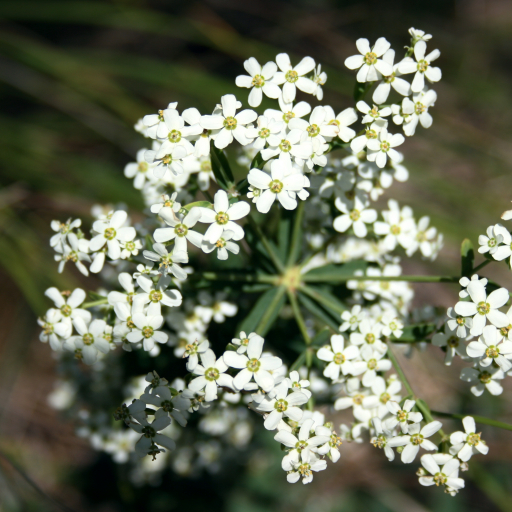
Plant Overview
Often called the "Prairie Baby’s Breath," Euphorbia corollata is a resilient North American native that dots summer meadows with airy clouds of white. While it looks delicate, this plant is a rugged survivor of the wild prairie, known for its ability to thrive in scorched earth where other flowers wilt. Its common name "Spurge" comes from the Old French word espurge, hinting at its historical—and quite intense—medicinal past.
🔍 How to Identify
- 🌼 The "False" Petals: What appear to be five snowy-white petals are actually modified leaves called bracts. The true flowers are tiny, yellowish structures nestled in the very center.
- 🌿 Whorled Foliage: The smooth, toothless leaves are arranged alternately along the slender, upright stem, but they form a distinctive circular whorl just below the flower clusters.
- 💧 Milky Latex: A signature of the Euphorbia family, the stem contains a thick, bright white sap that leaks out immediately if the plant is broken or cut.
🏡 In Your Garden
- ☀️ The Taproot Secret: This plant develops a deep, woody taproot that can extend several feet underground. This makes it incredibly drought-tolerant, but it also means it hates being transplanted. Once you plant it, it’s best to leave it where it is.
- 🦋 Pollinator Landing Pad: Because the flower clusters are flat and open, they serve as a perfect "helicopter pad" for beneficial insects with short mouthparts, such as small native bees, hoverflies, and predatory wasps.
⚠️ Safety & Toxicity
- 🚫 Irritant Status: The milky sap is a known irritant. It contains latex that can cause redness, itching, or even blistering (dermatitis) upon contact with the skin.
- 👁️ Eye Warning: Be extremely careful not to touch your eyes after handling this plant. The sap can cause severe inflammation and temporary vision impairment.
- 🐾 Pets & Livestock: It is toxic if ingested. Most animals instinctively avoid it due to the bitter, burning taste of the sap, but it should be kept away from curious pets and grazing livestock.
✨ Fun Fact
- ✨ Historical Purgative: In the 19th century, doctors used the roots of Flowering Spurge as a powerful emetic and laxative. It was so effective at "purging" the body that it earned the nickname "Wild Hippo," a reference to Ipecacuanha (Ipecac).

Detailed Care Instructions
To grow Euphorbia corollata, also known as flowering spurge, follow these steps:
- Choose the right location: Euphorbia corollata prefers full sun to partial shade. Select an area in your garden that receives at least 6 hours of direct sunlight per day.
- Prepare the soil: Ensure the soil is well-drained and has a pH level of 6.0 to 7.5. If the soil is heavy and compacted, consider adding organic matter such as compost or well-rotted manure to improve drainage.
- Planting: Dig a hole slightly larger than the root ball of the plant. Place the plant in the hole and backfill with soil, gently firming it around the roots. Water thoroughly after planting to help settle the soil.
- Watering: Euphorbia corollata is drought-tolerant once established but will appreciate regular watering during its early growth stage. Water deeply, allowing the soil to dry between watering sessions.
- Mulching: Apply a layer of organic mulch, such as bark chips or straw, around the base of the plant. This will help conserve moisture, suppress weed growth, and keep the roots cool.
- Fertilizing: Euphorbia corollata generally doesn't require much fertilization. However, if your soil is poor, you can apply a balanced, slow-release fertilizer in the spring.
- Pruning: Prune any dead or damaged stems in late winter or early spring before new growth appears. This will keep the plant healthy and maintain its shape.
- Pest and disease control: Euphorbia corollata is generally pest and disease resistant. However, it is susceptible to root rot if the soil is poorly drained. To prevent this, ensure the soil has good drainage and avoid overwatering.
- Propagation: Euphorbia corollata can be propagated from seeds. Collect mature seeds in late summer or early fall and sow them in the desired location. They may take a few weeks to germinate.
Remember that Euphorbia corollata is toxic if ingested, so take precautions to keep it away from children and pets. Enjoy the beautiful white flowers that appear in late spring and early summer, attracting pollinators to your garden.

Place in a bright room that is sun drenched almost all day. Or directly in a south-facing window.

Euphorbia Corollata is a plant that requires regular watering to thrive. When watering, it is important to ensure that the soil is completely saturated but not waterlogged, as this can cause root rot. It is recommended to water Euphorbia Corollata deeply and infrequently, allowing the top layer of soil to dry out before watering again. This will encourage the plant to develop strong roots and promote healthy growth. It is also important to water the plant at the base and avoid getting water on the foliage, as this can cause bacterial or fungal diseases. In addition, it is recommended to use room temperature water, as cold water can shock the roots and cause stress to the plant. Overall, proper watering is essential for the health and longevity of Euphorbia Corollata.
Euphorbia Corollata requires fertilization with a balanced, slow-release fertilizer in the early spring, just as new growth begins. Avoid using high-nitrogen fertilizers as they can encourage excessive foliage growth at the expense of flower production. Water the plant well before fertilizing to ensure the nutrients are transported to the roots effectively. Apply the fertilizer according to the package instructions and avoid over-fertilizing, as this can damage the plant's roots and leaves.
The best soil to use with this specific plant species should be well-draining and slightly acidic, with a pH range of 5.5 to 6.5. It is important to avoid using heavy clay soils that might cause waterlogging and root rot. Instead, a light, sandy soil mixed with organic matter such as compost or peat moss would be ideal. The plant also prefers a soil that is rich in nutrients, so adding a slow-release fertilizer can help promote healthy growth. Overall, the soil should be kept moist but not wet, and the plant should be allowed to dry out slightly between waterings.
To propagate this plant, first choose a healthy stem and make a clean cut just below a node. Dip the cut end in rooting hormone to encourage root growth. Then, plant the stem in a pot of well-draining soil and keep the plant in bright, indirect sunlight. Water the plant regularly, but be careful not to overwater as this could cause root rot. After a few weeks, the stem should start to develop roots and new growth. Once the plant is established and growing well, it can be transplanted into a larger pot or outdoors in a suitable location.








