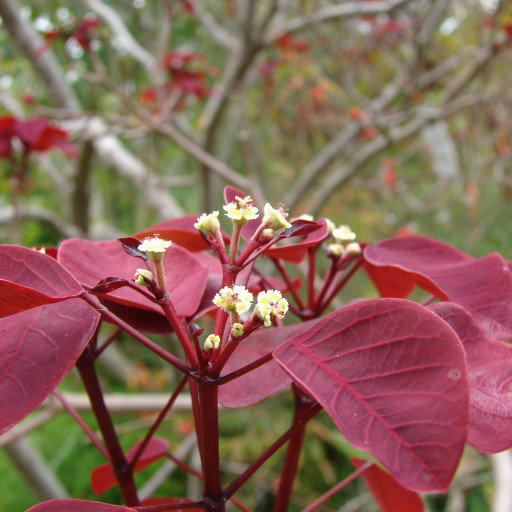
Plant Overview
Often called the Caribbean Copper Plant or the Tropical Smoke Bush, this striking shrub is a dramatic showstopper in any landscape. Native to Mexico and South America, it is prized for its rounded, deep burgundy foliage that mimics the appearance of a traditional Smoke Tree. In tropical regions, its vibrant color makes it a favorite for "living fences" and high-contrast garden beds.
🔍 How to Identify
- 🍂 Foliage: The leaves are heart-shaped or nearly round, held on long stems, and feature a rich, smoky-purple to copper-red color that persists year-round.
- 🥛 Milky Sap: Like most members of its family, the stems and leaves contain a thick, white, latex-like sap that leaks immediately if the plant is wounded.
- 🌼 Flowers: It produces clusters of tiny, inconspicuous cream-colored flowers at the ends of its branches, though they are often secondary to the beauty of the leaves.
🏡 In Your Garden
- ☀️ Light for Color: To maintain that intense copper-burgundy hue, this plant requires full sun. If grown in too much shade, the leaves will fade to an uninspiring greenish-bronze.
- ✂️ Growth Habit: While it can be trained into a small tree, most hobbyists keep it as a mid-sized shrub through regular pruning. Be sure to clean your shears immediately after use to prevent the sticky sap from hardening on the blades.
- 💧 Drainage is Key: It is highly sensitive to "wet feet." Ensure your soil is well-draining, as it prefers to dry out between waterings once it has established its root system.
⚠️ Safety & Toxicity
- 🚫 Toxic Irritant: The milky sap is a potent skin irritant. Contact can cause redness, itching, or even blistering (dermatitis). It is particularly dangerous if it comes into contact with the eyes.
- 🐾 Pets & Kids: The plant is toxic if ingested. It can cause severe mouth irritation and digestive upset in dogs, cats, and horses. Always wear gloves when pruning and keep it away from play areas.
✨ Fun Fact
In its native Central American habitats, the potent sap of the Euphorbia cotinifolia was historically used as a traditional fishing poison; when added to small bodies of water, the toxins would stun fish, allowing them to be gathered easily by hand.

Detailed Care Instructions
To grow a Euphorbia cotinifolia plant, also known as the Caribbean Copper plant, you can follow these steps:
- Temperature and sunlight: Ensure you provide the plant with a warm climate and plenty of sunlight. Euphorbia cotinifolia thrives in full sun but can tolerate some shade.
- Soil: Plant the Euphorbia cotinifolia in a well-draining soil mix. Ensure the soil is rich in organic matter and has good drainage to prevent waterlogging.
- Watering: Water the plant regularly, keeping the soil moist but not soggy. Avoid overwatering as it can lead to root rot. During the growing season, water when the top inch of soil feels dry.
- Fertilization: Apply a balanced, slow-release fertilizer once every two to three months during the growing season. Avoid fertilizing during winter when the plant is dormant.
- Pruning: Prune the plant to maintain its shape and remove any dead or damaged branches. Euphorbia cotinifolia can be pruned heavily in spring to promote bushier growth.
- Propagation: Euphorbia cotinifolia can be propagated through stem cuttings or by seed. For stem cuttings, take 4-6 inch long cuttings from healthy stems and root them in well-draining soil. Seeds can be sown in a seed-starting mix and kept warm until they germinate.
- Pest and disease control: Monitor the plant for any pests such as aphids or mealybugs. If infested, treat with insecticidal soap or neem oil. The plant is relatively disease-resistant but may be susceptible to root rot if overwatered.
- Winter care: In areas with frost or cold winters, bring the plant indoors or provide protection to prevent damage. Euphorbia cotinifolia is not frost-tolerant.
By following these steps, you should be able to successfully grow the Euphorbia cotinifolia plant. Just remember to provide it with adequate sunlight, well-draining soil, regular watering, and occasional fertilization.

Place in a bright room that is sun drenched almost all day. Or directly in a south-facing window.

To properly water this plant, you should first check the soil moisture level by sticking your finger about one inch into the soil. If the soil feels dry to the touch, it is time to water. Use room temperature water and pour slowly onto the soil, avoiding getting water on the leaves or stem of the plant. Allow excess water to drain away, and do not let the plant sit in standing water. Water only when the soil begins to feel dry again. During winter months, you may need to water less frequently.
To fertilize this plant, use a balanced fertilizer with equal amounts of nitrogen, phosphorus, and potassium. Apply the fertilizer every six months, being careful not to over-fertilize as it can lead to burnt leaves. Water the plant deeply after fertilization to help the nutrients penetrate the soil and reach the roots. Avoid fertilizing during the plant's dormant period.
To cultivate Euphorbia Cotinifolia successfully, it is essential to choose the appropriate soil type. The preferred soil for this plant should be well-draining with a loamy, sandy, or gravelly texture. It should have a slightly acidic to neutral pH level of 6.0-7.5.
To enhance the drainage capacity of the potting mix, one should add coarse sand, perlite, or any other porous materials. Euphorbia Cotinifolia loves moisture, but it should not sit submerged in water for long periods, which can lead to root rot.
The soil should be enriched with organic matter-rich soil additives such as compost, composted manure, or mushroom compost. These materials will provide slow-release nutrients and a boost of beneficial microorganisms to the soil.
It is crucial to ensure that the soil is not compacted and allows for proper aeration. The plant's roots require oxygen, so the soil must be porous enough to enable the roots to take in oxygen. To prevent soil compaction, avoid walking on soil beds where plants grow, and mulch the soil with a layer of organic matter.
In summary, the best soil for Euphorbia Cotinifolia should have a loamy, sandy, or gravelly texture that drains well, slightly acidic to neutral pH level, enriched with organic matter, and provides proper aeration to the roots.
To propagate this particular plant, one can take stem cuttings during the growing season. It is recommended to use a sharp, clean pair of scissors or pruning shears to cut off a section of the stem, making sure to remove any leaves or buds from the bottom of the cutting. The cutting should be around 3-4 inches in length.
After taking the cutting, it is important to let it dry for a few hours to prevent any moisture entering the stem. Once it is dry, the cutting can be planted into a well-draining potting mix. It is recommended to use a mix of perlite and peat, or a cactus or succulent mix.
Water the cutting thoroughly and place it in a bright, indirect sunlight. The cutting will start to grow roots within a few weeks. Once it has established roots, it can be transplanted into a larger pot or outside into the garden.
Common pests of the tropical smokebush include Mealybugs, spider mites, aphids. Make a habit of checking your tropical smokebush frequently for pests so that any infestations can be caught and managed early.








