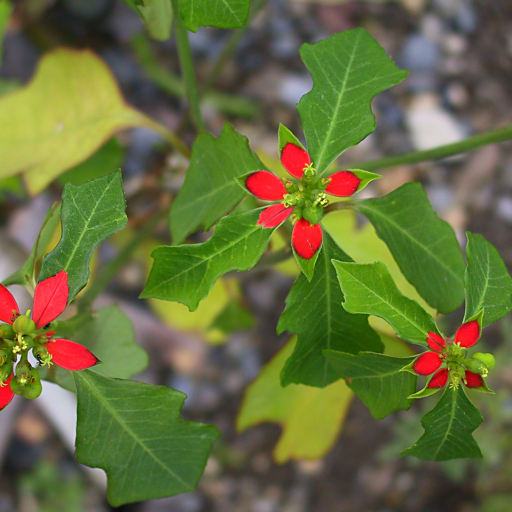
Plant Overview
Often called "Fire-on-the-Mountain" or the "Painted Leaf," this vibrant relative of the Christmas Poinsettia brings a splash of wild color to any landscape. Unlike its pampered greenhouse cousins, this plant has a rebellious streak, sporting striking red splotches on its upper leaves that look as if they were hastily touched up with a paintbrush. It is a hardy, sun-loving native of the Americas that thrives on neglect and adds a touch of "organized chaos" to naturalistic gardens.
🔍 How to Identify
- 🎨 The "Painted" Bracts: The most distinctive feature is the bright scarlet or orange-red patches at the base of the upper leaves, which serve to attract pollinators to the tiny flowers.
- 🎻 Fiddle-Shaped Foliage: The lower leaves are typically a rich green and often feature a unique "lobed" or fiddle-like shape, though leaf shape can vary significantly even on the same plant.
- 🥛 Milky Latex: If a leaf or stem is broken, the plant immediately exudes a thick, white, sticky sap characteristic of the Spurge family.
🏡 In Your Garden
- 🌱 The Great Escapist: This plant is a prolific self-seeder. It uses "explosive dehiscence," meaning its seed pods literally pop open and fling seeds several feet away. You may find it "wandering" to different parts of your garden each year.
- ☀️ Tough as Nails: It prefers "lean" soil and lots of sunshine. If you give it too much fertilizer or water, it tends to grow very tall and floppy. It is best used in rock gardens or wildflower meadows where it can stand its ground against heat and drought.
⚠️ Safety & Toxicity
- 🚫 Irritant Status: Like most members of the Euphorbia genus, the milky sap is a known skin and eye irritant.
- 🐾 Pet & Child Safety: The sap can cause blistering or rashes on contact and digestive upset if ingested. It is best to wear gloves when pruning and keep it out of reach of curious pets or toddlers who might be attracted to its bright "painted" leaves.
✨ Fun Fact
The "flowers" of the Euphorbia cyathophora are not actually the red leaves, nor are they traditional petals. They are specialized structures called cyathia—tiny, cup-like organs that hold the actual reproductive parts, appearing as small green and yellow nodules at the very center of the red bracts.

Detailed Care Instructions
| Humidity | Normal |
| Lighting | Full Sun |
| Toxicity | Poisonous |
| Difficulty | Easy |
| Hibernation | Cold Period |
To grow Euphorbia Cyathophora, commonly known as firecracker plant or Mexican fire plant, follow these steps:
- Climate and Location: Firecracker plants thrive in warm climates, preferably USDA hardiness zones 9-11. They can also be grown as an annual in cooler regions. Choose a location with full sun or partial shade.
- Soil: Firecracker plants prefer well-draining soil that is slightly acidic to neutral. Add organic matter like compost or peat moss to improve drainage and fertility if needed.
- Planting: Start by preparing the planting area. Remove any weeds or grass and loosen the soil. Dig a hole twice as wide and as deep as the root ball of the plant. Place the plant in the hole, ensuring it sits at the same depth as it was in the nursery container. Backfill the soil, gently firming it around the root ball.
- Watering: Water the plant thoroughly after planting to settle the soil. Firecracker plants require regular watering, so make sure the soil stays evenly moist. However, avoid overwatering as it can lead to root rot.
- Fertilizing: Apply a balanced slow-release fertilizer in the spring, following the package instructions. This will provide the necessary nutrients to support healthy growth. You can also supplement with liquid fertilizers throughout the growing season to encourage more robust flowering.
- Pruning: Regularly remove spent flowers to promote continuous blooming and prevent self-seeding. Additionally, pruning straggly or unruly branches can help maintain a more compact and attractive plant.
- Pests and Diseases: Firecracker plants are generally disease and pest-resistant. However, keep an eye out for common garden pests, such as aphids or spider mites. If detected, treat them using suitable insecticides or natural remedies like neem oil.
- Mulching: Apply a layer of organic mulch around the base of the plant to conserve moisture, suppress weed growth, and regulate soil temperature.
- Overwintering: In colder regions, firecracker plants may not survive frost or freezing temperatures. Consider growing them in containers that can be moved indoors during winter or treat them as annuals.
By following these guidelines, you can successfully grow Euphorbia Cyathophora and enjoy its vibrant red and green foliage throughout the growing season.

Place in a bright room that is sun drenched almost all day. Or directly in a south-facing window.

Water the plant by pouring water directly onto the soil, avoiding the leaves and stem. Make sure the soil is moist but not waterlogged. Allow the soil to dry out slightly between waterings and reduce watering during the winter months when the plant is not actively growing. Avoid overwatering as this can lead to root rot. Watering frequency may vary depending on the climate and environment the plant is in.
- Choose a balanced fertilizer with equal amounts of nitrogen, phosphorus, and potassium.
- Mix the fertilizer according to the manufacturer's instructions, typically at a ratio of 1 tablespoon per gallon of water.
- Water the plant thoroughly before applying fertilizer to avoid burning the roots.
- Apply the fertilizer evenly around the base of the plant, being careful not to get any on the leaves.
- Water the plant immediately after fertilizing to help distribute the nutrients through the root system.
- Repeat the fertilization process every 4-6 weeks during the growing season (spring and summer) to ensure healthy growth and blooms.
- Stop fertilizing in the fall to allow the plant to go dormant and prepare for winter.
The ideal soil for Euphorbia Cyathophora should be well-draining, loamy or sandy soil with low to average fertility. It should have a slightly acidic to neutral pH level. The soil should be rich in organic matter, with good water-holding capacity. The plant prefers soil that is moist but not waterlogged and can tolerate drought-like conditions. Avoid heavy clay soils that retain water for extended periods. Residual nitrogen and phosphorus in soil may cause plants to flop or produce excess foliage, so avoid using fertilizer. Instead, mulching the soil around the plant with a layer of organic material can help retain moisture and maintain soil quality.
To propagate this plant, start by gently separating a mature stem from the parent plant. Cut the stem at a 45-degree angle and remove the lower leaves to expose a node. Dip the bottom of the stem in rooting hormone and plant it in a well-draining potting mix. Water lightly and place in a bright, indirect light location.
Keep the soil consistently moist and in about two to four weeks, roots should begin to form. Once the roots are established, a new plant has been propagated. Gradually acclimate the new plant to direct sunlight and increase watering as needed.








