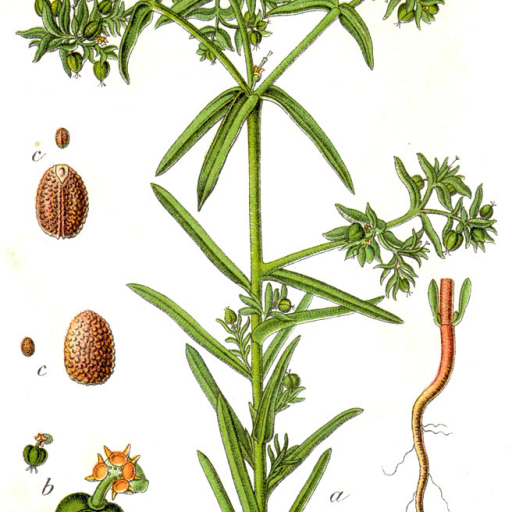
Plant Overview
Often called the Dwarf Spurge, this tiny, architectural wonder is a master of minimalism. Native to Europe, North Africa, and West Asia, it is frequently found dancing between the cracks of sun-baked fields or nesting in disturbed garden soil. While many gardeners view it as a mere "arable weed," its geometric precision and blue-green hues make it a darling for those who appreciate the subtle beauty of wild flora.
🔍 How to Identify
- 🌿 The Foliage: Look for slender, linear leaves that are a distinct glaucous (blue-grey) green. They are arranged densely along the stem, giving it the appearance of a miniature, prehistoric pine tree.
- 🌼 The Flowers: The "flowers" are actually specialized structures called cyathia. They are tiny, yellowish-green, and heart-shaped, featuring distinctive pointed "horns" on the glands that require a close look to truly appreciate.
- 📏 The Stature: True to its name, exigua (meaning small or meager) rarely grows taller than 5 to 20 centimeters. It often branches out from the very base, creating a dainty, upright cluster.
🏡 In Your Garden
- 🌱 Soil Preference: This plant is a "calcicole," meaning it has a deep love for lime-rich, chalky, or alkaline soils. If it pops up in your garden, it’s a living sign that your soil is likely high in calcium.
- ☀️ Sun Seeker: It thrives in the "pioneer" lifestyle, occupying open, sunny patches of bare earth where other plants haven't yet taken hold. It isn't a fan of shade or being crowded out by lush, leafy neighbors.
⚠️ Safety & Toxicity
- 🚫 Toxic Milky Sap: Like all members of the Euphorbia family, the Dwarf Spurge contains a caustic, milky-white latex. This sap is a defense mechanism against herbivores.
- 👁️ Irritant Alert: Contact with the sap can cause skin rashes or significant eye irritation. Always wear gloves if you are weeding it out, and keep curious pets or children away, as ingestion can cause stomach upset and swelling of the mouth.
✨ Fun Fact
The Dwarf Spurge uses "ant-power" to travel! Its seeds have a tiny, oily attachment called an elaiosome. Ants find this treat irresistible, dragging the seeds back to their nests to eat the oil and leaving the seed behind in nutrient-rich soil to germinate.

Detailed Care Instructions
To grow Euphorbia Exigua (also known as the slender spurge), follow these steps:
- Choose a suitable location: Euphorbia Exigua thrives in full sun to partial shade, so choose a spot that receives at least 4-6 hours of direct sunlight each day. The soil should be well-draining, as this plant cannot tolerate waterlogged conditions.
- Prepare the soil: Before planting, prepare the soil by loosening it with a garden fork or tiller. Remove any weeds or debris and amend the soil with organic matter such as compost or well-rotted manure. This will improve drainage and provide essential nutrients.
- Planting: Dig a hole slightly larger than the root ball of the Euphorbia Exigua plant. Place the plant in the hole at the same depth it was growing in its nursery container. Gently fill the hole with soil, firming it gently around the plant to remove any air pockets.
- Watering: After planting, water the plant thoroughly to help settle the soil. Euphorbia Exigua does not require heavy watering, as it is drought-tolerant. Water deeply but infrequently, allowing the top few inches of soil to dry out between waterings.
- Mulching: Apply a layer of organic mulch around the base of the plant to help maintain soil moisture, suppress weed growth, and regulate soil temperature. Avoid applying the mulch directly against the stem to prevent rot.
- Maintenance: Euphorbia Exigua is a low-maintenance plant. Prune back any dead or damaged stems in early spring to promote new growth. Be careful when handling this plant as it produces a milky sap that may cause skin irritation or is toxic if ingested. Always wear protective gloves and handle with care.
- Propagation: Euphorbia Exigua can be propagated from stem cuttings. Take 3-4 inch long cuttings of healthy stems in spring or summer. Dip the cut ends in rooting hormone and plant them in a well-draining potting mix. Keep the soil moist until roots develop, then transplant them into the garden.
By following these steps, you can successfully grow and care for Euphorbia Exigua.

Place in a bright room that is sun drenched almost all day. Or directly in a south-facing window.

Euphorbia Exigua is a succulent plant that requires very little water. It is important to allow the soil to dry completely between watering, as overwatering can lead to root rot. When watering, it is best to do so sparingly, ensuring that only the soil is wet and not the leaves or stem of the plant. The amount and frequency of watering will depend on the climate and location of the plant, so it is important to monitor the soil moisture level and adjust accordingly. In general, it is recommended to water Euphorbia Exigua once every two weeks during the growing season, and once a month during the dormant period. It is also important to use well-draining soil to avoid waterlogging.
To properly fertilize this particular plant, it is recommended to use a balanced, water-soluble fertilizer every two weeks during the growing season, which is typically in the spring and summer. It is essential to dilute the fertilizer appropriately and avoid over-fertilization, as this may cause damage to the roots and foliage. Additionally, it is advisable to water the soil thoroughly before and after fertilizing. Finally, it is important to follow the manufacturer's instructions carefully and avoid using any fertilizers that are specifically designed for other plant species.
When choosing soil for the Euphorbia Exigua plant, it is important to consider its natural habitat and growing conditions. This plant is native to sandy or rocky regions and thrives in well-draining soil that is not too rich in nutrients. Therefore, a suitable soil mix for the Euphorbia Exigua plant should contain a combination of sandy soil, perlite, and gravel to ensure good drainage and aeration. The soil pH should be slightly acidic to neutral, with a range of 6.0 to 7.0. It is important to avoid using heavy loam or clay soils, as these can hold too much moisture and lead to root rot. Additionally, organic matter such as compost should be used sparingly, as the Euphorbia Exigua plant prefers lean soil. Overall, a well-draining soil mix with minimal organic matter is ideal for growing a healthy Euphorbia Exigua plant.
Propagating Euphorbia Exigua can be done through stem cuttings.
- Choose a healthy stem that is free of any diseases or damages.
- Use a sharp, sterile cutting tool to cut a stem that is at least 2-3 inches long.
- Remove the leaves from the bottom inch of the stem.
- Dip the cut end into rooting hormone.
- Plant the cutting in a pot filled with well-draining soil.
- Water the soil thoroughly and place the pot in a bright, indirect light location.
- Keep the soil moist but not waterlogged and mist the cutting with water regularly.
- After a few weeks, the cutting should start to produce new roots and leaves.








