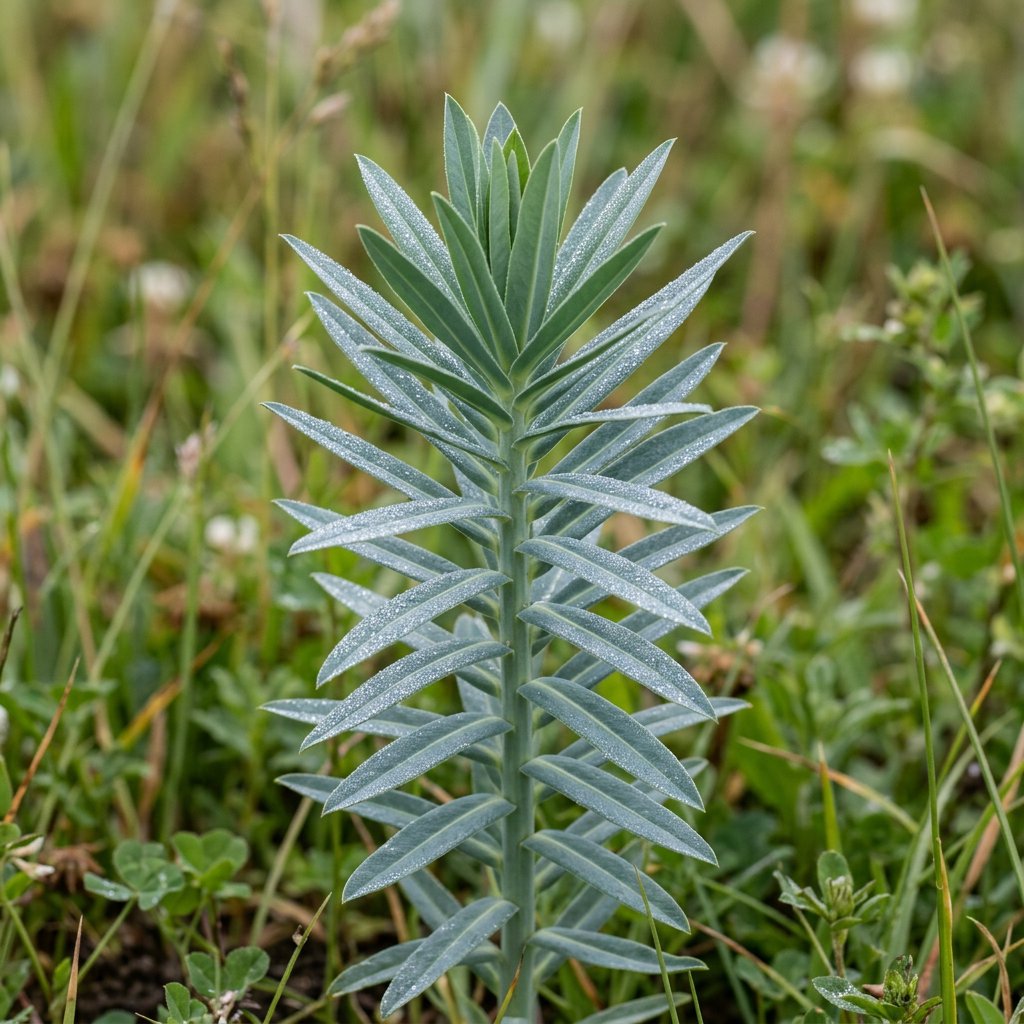
Plant Overview
Known by the quirky nicknames Mole Plant or Caper Spurge, Euphorbia lathyris is a geometric masterpiece of the plant world. While it stands tall with architectural precision, it carries a mysterious reputation in folklore as a natural guardian against underground garden pests. Whether it arrived in your garden by design or as a wandering volunteer, its striking blue-green silhouette and "X" shaped leaf pattern are impossible to miss.
🔍 How to Identify
- 🌿 Geometric Symmetry: The long, narrow, blue-green leaves are arranged in four perfect vertical rows along a central stem, creating a distinct cross-like pattern when viewed from above.
- 🎨 Glaucous Texture: The foliage has a waxy, matte finish with a prominent white central vein, giving the plant a modern, almost metallic appearance that stands out in a green landscape.
- 🟢 Caper-like Fruits: In its second year, the plant bolts and produces three-lobed green seed pods. These pods look remarkably like culinary capers, though they are strictly for looking, not eating.
🏡 In Your Garden
- 🌱 The Mole Myth: Many gardeners welcome this plant in hopes of deterring moles and gophers. While folklore suggests the toxic roots keep pests away, it is more likely that the plant simply thrives in the disturbed soil where moles like to dig.
- ☀️ The Biennial Journey: This is a biennial species, meaning it spends its first year building a beautiful architectural rosette and its second year flowering and self-seeding. It is a "wanderer" and will often pop up in unexpected corners of your yard.
⚠️ Safety & Toxicity
- 🚫 High Toxicity: WARNING. Every part of this plant is toxic if ingested. The common name "Caper Spurge" is a dangerous misnomer; eating the seed pods can cause severe nausea, vomiting, and internal damage.
- 🧤 Caustic Sap: The plant contains a thick, milky white latex that is highly irritating to the skin. It can cause blistering or "phytophototoxicity" (skin sensitivity to sun), and extreme care should be taken to keep the sap away from the eyes. Always wear gloves and long sleeves when handling.
✨ Fun Fact
In centuries past, the seeds were used in traditional medicine as a "purgative" to induce violent vomiting. However, because the plant is so toxic, the "medicine" was often more dangerous than the original illness!

Detailed Care Instructions
| Lighting | Full Sun |
| Hardiness Zones | 6A - 9B |
To grow Euphorbia Lathyris, also known as caper spurge, you can follow these steps:
- Choose a suitable location: Euphorbia Lathyris prefers full sun to partial shade. Ensure the area has well-draining soil.
- Prepare the soil: Loosen the soil and amend it with compost or organic matter to improve fertility and drainage.
- Sow the seeds: Plant the seeds in the desired location. The best time to sow is in spring after the last frost. You can sow them directly in the ground or start them indoors and transplant later. Space the seeds around 1-2 feet apart.
- Watering: Initially, keep the soil moist, but not waterlogged, until the plant establishes. Once established, Euphorbia Lathyris is drought-tolerant and doesn't require much watering unless experiencing extended dry periods.
- Fertilization: Euphorbia Lathyris doesn't require a lot of fertilizer. However, a light application of balanced slow-release fertilizer in spring can support growth.
- Weed control: It's important to keep the area around Euphorbia Lathyris free of weeds, especially when the plant is young. Mulching can help suppress weed growth.
- Maintenance: Euphorbia Lathyris is generally low-maintenance. However, you may need to stake the plants if they become top-heavy or prone to flopping.
- Harvesting: Euphorbia Lathyris produces small green or brown capsules in summer. These capsules contain seeds and can be harvested when they turn brown and dry. Use caution when handling the plant as it contains a toxic sap.
Remember to wear gloves and avoid contact with eyes or mouth when handling Euphorbia Lathyris.

Place in a bright room that is sun drenched almost all day. Or directly in a south-facing window.

To properly water this plant, it is recommended to use a watering can or hose with a gentle nozzle to avoid disturbing the soil too much. Ensure that the soil is completely dry to the touch before watering and be sure to allow excess water to drain from the container or bed. Avoid splashing water on the leaves or stem of the plant. Watering should be done infrequently, allowing the soil to dry out between watering sessions. Overwatering can lead to root rot and other plant diseases. It is important to note that Euphorbia Lathyris plants are drought-tolerant and prefer well-draining soil.
To fertilize the Euphorbia Lathyris plant, use a balanced fertilizer with an N-P-K ratio of 10-10-10. Apply the fertilizer once every two weeks during the growing season, which is from spring through summer. Reduce the frequency to once a month during fall and stop fertilizing during winter when the plant is dormant. Make sure to dilute the fertilizer as directed on the package and avoid over-fertilizing, which can damage the plant's roots.
The soil suitable for Euphorbia Lathyris plant should be well-drained and have good aeration. The soil pH should be neutral to slightly alkaline (between 6.0-8.0). It requires a soil that is rich in organic matter, and therefore, compost or well-rotted animal manure should be mixed into the soil. The soil should be loose and friable to allow for proper drainage and oxygen access to the roots. The plant prefers sandy or loamy soil with a good amount of drainage. The soil should not be too heavy or clayey, as it can prevent proper drainage and cause waterlogging. The plant is also sensitive to salty soil, so it is best to avoid using soil that has a high salt content.
To propagate this plant, collect its seeds in the fall after the seed pods have turned brown and split open. Soak the seeds in warm water for 24 hours before sowing them in a well-draining potting mix. Cover the seeds with a thin layer of soil and keep the soil moist until they germinate. The plant can also be propagated through stem cuttings, taken in the summer when the plant is actively growing. Cut a stem with a sharp, sterilized knife and remove the lower leaves. Dip the cut end in rooting hormone and insert it into a well-draining potting mix. Keep the soil moist and warm until roots develop, and the cutting begins to put out new growth.
Common pests of the caper spurge include Scale insect, mealybugs, spider mites. Make a habit of checking your caper spurge frequently for pests so that any infestations can be caught and managed early.








