Plant Overview
Commonly known as the Madagascar Jewel, Euphorbia lophogona is a striking architectural plant that looks like a cross between a palm tree and a cactus. Hailing from the coastal forests of Madagascar, this succulent is famous among collectors for its geometric stem and its peculiar habit of "shooting" seeds across a room. It’s a resilient survivor that brings a touch of prehistoric flair to any indoor jungle.
🔍 How to Identify
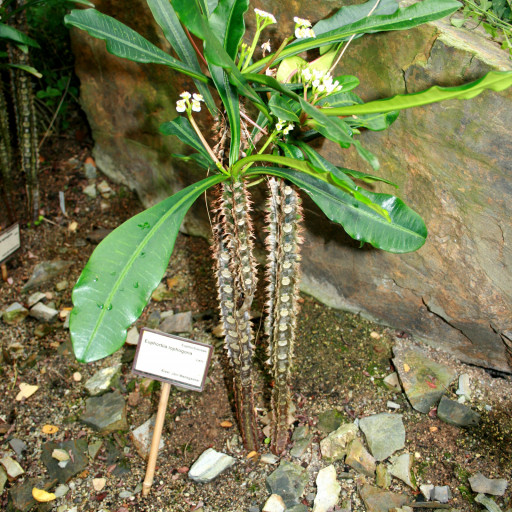
- 🌵 The Stem: The most distinct feature is its upright, dark green to brown stem which has four or five distinct "ribs" fringed with soft, brownish bristles or "cilia."
- 🍃 The Foliage: Lush, oval-shaped leaves grow primarily at the top of the stem. They are a vibrant emerald green, often featuring striking white veins when the plant is young.
- 🌸 The "Flowers": It produces small, white or pinkish structures called cyathia. While modest, they sit on top of the ribs and eventually produce the plant’s famous seed pods.
🏡 In Your Garden
- ☀️ Light & Placement: Unlike many desert cacti, the Madagascar Jewel prefers bright, indirect light rather than scorching direct sun. In the wild, it grows in the understory, so a spot near an east-facing window is usually its "sweet spot."
- 💧 Watering Nuance: Because it is a succulent, it stores water in its thick stem. It is very sensitive to "wet feet," so it's vital to let the soil dry out significantly between waterings to prevent root rot.
- 🌱 The Seed Surprise: Don't be surprised if you find baby plants growing in nearby pots! When the seed pods ripen, they literally explode, launching seeds several feet away from the parent plant.
⚠️ Safety & Toxicity
- 🚫 Status: Toxic & Irritant. Like all members of the Euphorbia family, this plant contains a thick, milky white sap (latex).
- 🖐️ Details: The sap is highly irritating to the skin and eyes and can cause temporary blindness if rubbed into the eyes. It is toxic if ingested, making it a plant that should be kept far out of reach of curious cats, dogs, and small children. Always wear gloves when pruning.
✨ Fun Fact
The Madagascar Jewel is a master of "ballochory"—the botanical term for seed dispersal via explosion. A single plant can effectively colonize an entire greenhouse bench by "firing" its offspring into every neighboring pot!

Detailed Care Instructions
| Humidity | Normal |
| Lighting | Part Sun |
| Toxicity | Poisonous |
| Difficulty | Medium |
| Temperature | 18°C - 25°C |
| Hardiness Zones | 9A - 11B |
To grow Euphorbia Lophogona, also known as "Candelabra Cactus," follow these steps:
- Choose a suitable location: Euphorbia Lophogona thrives in bright, indirect sunlight. Select a spot where it receives several hours of sunlight per day.
- Select a well-draining pot: Use a pot or container with drainage holes to avoid waterlogging the roots. The pot should be large enough to accommodate the plant's growth.
- Soil and potting mix: Use a well-draining soil mix specially formulated for cacti and succulents. These mixes typically contain a combination of sand, perlite, and peat moss.
- Planting: Gently place the plant into the pot, ensuring its roots are covered with soil. Do not bury the stem too deep; it should be slightly above the soil level to avoid rotting.
- Watering: Allow the soil to dry out completely between waterings. Euphorbia Lophogona is drought-tolerant and prefers infrequent watering. Overwatering can lead to root rot, so be cautious. During the winter months, reduce the watering frequency.
- Fertilization: During active growth from spring to summer, you can fertilize the plant with a diluted cactus or succulent fertilizer. Follow the instructions on the fertilizer's label for proper dilution ratio and frequency.
- Temperature and humidity: Euphorbia Lophogona prefers a warm environment. It thrives at temperatures between 65-85°F (18-29°C). It does well in average humidity levels but can tolerate lower humidity.
- Pruning: If the plant becomes leggy or misshapen, you can prune it back in early spring to promote bushier growth. Wear gloves and protect your skin as the plant's sap is toxic and can cause skin irritation.
- Pests: Euphorbia Lophogona is relatively resistant to pests. However, keep an eye out for common succulent pests such as mealybugs and scale insects. If you notice any infestation, promptly treat it with an appropriate insecticidal soap or horticultural oil.
- Propagation: Euphorbia Lophogona can be propagated by stem cuttings. Take a cutting with a clean, sharp knife and let it dry for a few days before planting it in a well-draining potting mix. Place the cutting in a bright spot without direct sunlight and lightly water it every two weeks until new growth appears.
Remember to handle Euphorbia Lophogona with caution as the milky sap it releases is toxic and can cause skin and eye irritation.

Place in a window with dappled sun or a spot in the middle of a room. Or directly in a window facing west or east.

To water this particular plant, it is important to closely observe the soil moisture level. Euphorbia Lophogona plants prefer soil that is slightly dry, so it is best to avoid over-watering. A good way to check the soil moisture level is to stick your finger in the soil up to the second knuckle. If the soil feels dry at that level, it is time to water the plant. When watering, take care to avoid getting water on the leaves and stem of the plant as this can cause damage. Instead, water the soil directly around the base of the plant. It is also important to make sure the plant has good drainage so that excess water can flow out of the pot or container. Overall, the key to watering Euphorbia Lophogona is to be cautious and mindful of the soil moisture level and to avoid over-watering.
To fertilize this plant, you should use a balanced fertilizer with a ratio of 20-20-20. Apply the fertilizer every two weeks during the growing season, which typically runs from spring to fall. Be sure to dilute the fertilizer according to the package instructions, as applying too much can harm the plant. Water the plant thoroughly after fertilizing to distribute the nutrients evenly throughout the soil. Avoid fertilizing during the winter months when the plant is dormant.
The ideal soil for the Euphorbia Lophogona plant should be well-draining and have a slightly acidic to neutral pH level. It should be composed of a mixture of sand, loam, and peat moss to provide the plant with the necessary nutrients and moisture retention. The soil should also not contain any heavy clay or be excessively sandy. It is recommended to plant the Euphorbia Lophogona in a pot with drainage holes and to water it sparingly, allowing the soil to dry out between waterings.
To propagate this plant, first select a healthy stem cutting that is about 3-4 inches long and has no signs of disease or damage. Using a sharp, clean knife or scissors, make a clean cut at a 45-degree angle at the base of the stem.
Next, allow the cutting to dry out in a cool, dry place for a few days until a callus forms over the cut end. This will prevent the cutting from rotting during propagation.
Once the callus has formed, plant the cutting in a well-draining soil mix. Water the soil until it is moist, but not soggy, and place the cutting in a warm and bright location, but out of direct sunlight.
It may take a few weeks for roots to form on the cutting, so be patient and avoid moving or disturbing it during this time. Once roots have formed and the plant has established itself, it can be transplanted into a larger pot or planted outdoors.
Common pests of the crown of thorns include Scale insect, mealybugs, spider mites. Make a habit of checking your crown of thorns frequently for pests so that any infestations can be caught and managed early.








