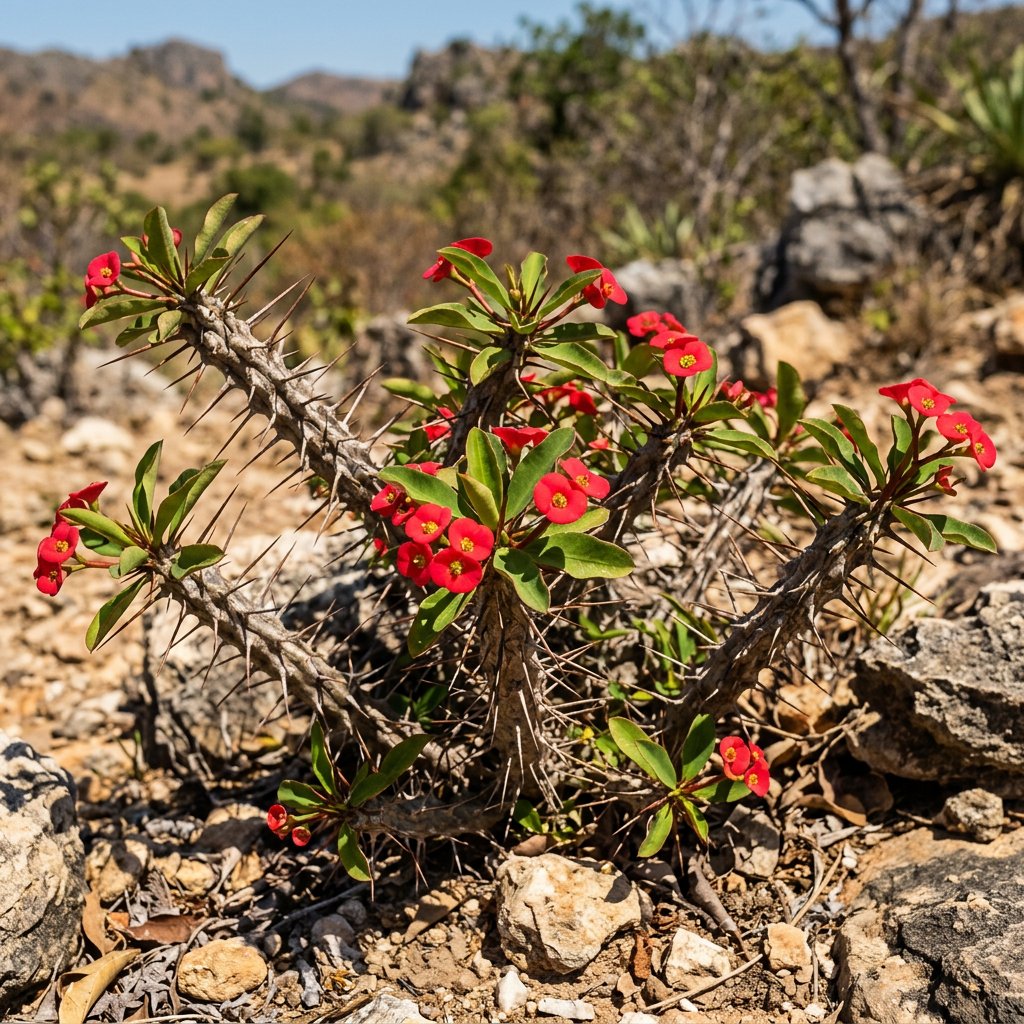
Plant Overview
Often called the Crown of Thorns, this resilient succulent is a staple in sunny windowsills and tropical gardens worldwide. Native to the dry plateaus of Madagascar, it earned its name from the legendary belief that its thorny stems were used for the crown worn by Jesus Christ. Despite its intimidating spikes, it is a remarkably durable houseplant that rewards owners with vibrant, "flowers" that can bloom almost year-round.
🔍 How to Identify
- 🌵 Spiny Stems: Thick, woody, grayish-brown stems heavily armed with sharp, prominent thorns that store water to survive long droughts.
- 🌸 Colorful Bracts: The "flowers" are actually modified leaves called bracts, typically appearing in pairs of red, pink, yellow, or white, surrounding tiny, inconspicuous true flowers in the center.
- 🍃 Teardrop Leaves: Bright green, fleshy leaves usually cluster at the tips of new growth; they are sensitive to environmental changes and may drop if the plant is stressed.
🏡 In Your Garden
- ☀️ Light Seeker: This plant is a sun-worshiper. To keep it blooming consistently, it needs at least 3–4 hours of direct sunlight daily. In low light, it will survive but become "leggy" and stop flowering.
- 🪴 Drought Specialist: It thrives on a "soak and dry" routine. Because it stores water in its stems, overwatering is its biggest enemy, often leading to root rot. Use a porous cactus or succulent potting mix to ensure fast drainage.
⚠️ Safety & Toxicity
- 🧪 Irritating Sap: Like all members of the Euphorbia family, it contains a milky white latex sap. This sap is a potent irritant that can cause skin rashes and severe eye inflammation upon contact.
- 🐾 High Risk: The plant is toxic to cats, dogs, and horses. If ingested, the sap causes mouth blistering and stomach upset. Due to the sharp thorns and toxic sap, it should be kept well out of reach of children and pets.
✨ Fun Fact
✨ The "False" Flower: What we admire as the "petals" of the Crown of Thorns are actually cyathophylls. These are specialized leaves designed to attract pollinators to the tiny, nectar-rich true flowers hiding in the middle!

Detailed Care Instructions
| Humidity | Normal |
| Lighting | Full Sun |
| Toxicity | Poisonous |
| Bloom Time | Throughout The Year |
| Difficulty | Medium |
| Mature Size | Outdoors - 3 - 6 Ft. Tall. As A Houseplant - About 2 Ft. In Height |
| Temperature | 18°C - 25°C |
| Sun Exposure | Full Sun |
| Hardiness Zones | 9-11 |
Here are some steps to help you grow Euphorbia Milii plants:
- Choose the right location: Euphorbia Milii plants require bright, indirect sunlight. Place them near a window that receives bright light for most of the day.
- Use well-draining soil: Euphorbia Milii plants prefer well-draining soil. You can mix regular potting soil with sand or perlite to ensure good drainage.
- Water sparingly: These plants are succulent and can tolerate dry conditions. You should water them sparingly, allowing the soil to dry out between watering sessions. Overwatering can lead to root rot.
- Fertilize occasionally: Use a balanced, water-soluble fertilizer for succulent plants. Apply it during the growing season, usually from spring to fall. Follow the instructions on the fertilizer packaging for dosage and frequency.
- Prune regularly: Euphorbia Milii plants can develop long, trailing stems. Prune them back to maintain a compact shape and encourage bushier growth. Use sharp, clean pruning shears and be careful as the plant has thorny stems.
- Provide support: Euphorbia Milii plants tend to be climbing plants. You can provide a trellis or support to help them climb and spread out. This will also enhance their appearance.
- Watch for pests: Keep an eye out for common houseplant pests such as mealybugs or spider mites. Regularly inspect the leaves and stems, and treat any infestations promptly with insecticidal soap or neem oil.
- Be cautious with sap: Euphorbia Milii plants have a milky sap that can irritate the skin and eyes. When pruning or handling the plant, wear gloves and be careful not to touch your face or eyes until you have thoroughly washed your hands.
Remember, Euphorbia Milii plants are tropical and prefer warmer temperatures. Aim to keep the plant in an environment with temperatures ranging from 60-80°F (15-27°C). With proper care and attention, your Euphorbia Milii plant should thrive and grow.

Place in a bright room that is sun drenched almost all day. Or directly in a south-facing window.

The best way to water this plant is to thoroughly soak the soil and then allow it to dry out slightly before watering again. It is important not to overwater, as too much water can lead to root rot. This plant prefers well-draining soil and should not be sitting in standing water. Additionally, it is best to water this plant from the bottom, by placing the pot in a tray of water, rather than watering from the top and getting water on the leaves and stems. This will help prevent fungal or bacterial growth on the plant. When watering, it is important to avoid getting water on the stems or leaves, as this can cause the plant to rot.
- Use a balanced fertilizer with a 10-10-10 N-P-K ratio.
- Dilute the fertilizer to half its recommended strength.
- Apply fertilizer every two weeks during the growing season (spring and summer).
- Water the plant well before fertilizing to avoid root burn.
- Do not fertilize in the winter when the plant is dormant.
- Stop fertilizing if you notice any signs of fertilizer burn, such as yellowing leaves.
- Follow all label instructions when using fertilizer.
The best soil type to use for planting the Euphorbia Milii plant is a well-draining soil mixture that has a good balance of organic matter and mineral nutrients. It is recommended to use a soil mixture that is composed of sandy loam, perlite, and peat moss in a ratio of 2:1:1, respectively. The soil should have a pH level of around 6.0 to 7.0 and should be kept moist, but not too wet or dry. It is important to ensure that the soil is free from any pests or diseases that may cause harm to the plant. Additionally, it is recommended to fertilize the soil with a slow-release fertilizer, every 4-6 months.
Euphorbia Milii can be propagated through stem cuttings. Select a healthy stem that is at least 6 inches long and has several leaves. Use a sharp, clean knife or pruning shears to make a clean cut just below a node (the point where a leaf attaches to the stem). Remove the lower leaves from the cutting, leaving only 1-2 leaves at the top.
Dip the cut end of the cutting in a rooting hormone powder to help stimulate root growth. Fill a small pot with well-draining soil and make a small hole in the center. Insert the cutting into the hole and gently press the soil around it to hold it in place. Water the cutting thoroughly.
Cover the pot with a clear plastic bag or plastic wrap to create a humid environment. Place the pot in bright, indirect light and keep the soil moist but not waterlogged. After a few weeks, the cutting should start to develop new roots. You can check by gently tugging on the stem – if there is resistance, roots have begun to grow.
Once the cutting is well-established (usually after a few months), you can transplant it into a larger pot or outdoors in a sunny location.
Common pests of the crown-of-thorns include Mealybugs, spider mites, fungus gnats, thrips. Make a habit of checking your crown-of-thorns frequently for pests so that any infestations can be caught and managed early.








