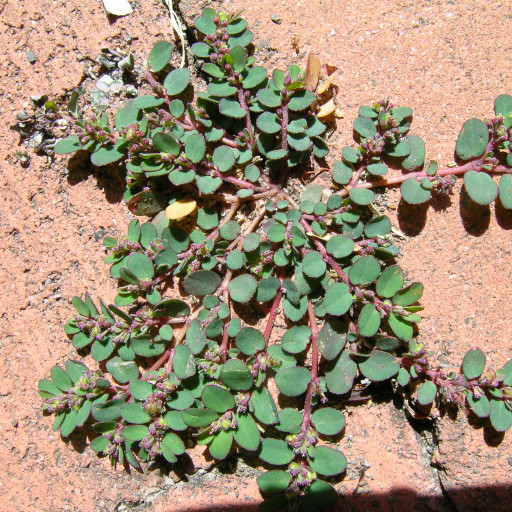
Plant Overview
Commonly known as the "Prostrate Spurge" or "Sandmat," this low-profile rebel is a master of the "flat-lay" lifestyle. Often found hugging the concrete in driveway cracks or garden edges, it is native to the Americas but has successfully hitchhiked across the entire globe. While many gardeners view it as a persistent weed, it’s actually a fascinating example of botanical resilience, thriving where other plants would wither.
🔍 How to Identify
- 👣 Growth Habit: It forms dense, flat mats that radiate outward from a central taproot, rarely rising more than an inch off the ground.
- 🪵 Reddish Stems: The wiry, delicate stems often have a distinct burgundy or pinkish-red hue and are covered in fine, tiny hairs.
- 🍃 Oval Leaves: The leaves are small, rounded, and grow in opposite pairs; they are typically dull green, sometimes featuring a faint purple spot in the center.
- 💧 Milky Latex: If you break a stem, the plant immediately bleeds a thick, white, milky sap—a signature trait of the Euphorbia family.
🏡 In Your Garden
- ☀️ Sun Seeker: This plant loves the heat and is usually the first thing to pop up in sun-scorched, compacted soil or gravel paths during the peak of summer.
- 🌱 Opportunistic Spreader: It produces a massive amount of seeds that can remain dormant in the soil for years. If you see one, you likely have hundreds of seeds waiting for the next rain.
- ✂️ Control Method: Because of its central taproot, it is easy to pull by hand, but it’s best to do so before the tiny, hairy seed capsules mature and "pop."
⚠️ Safety & Toxicity
- 🚫 Skin Irritant: The milky white sap contains latex that can cause redness, itching, or even blisters on sensitive skin (contact dermatitis).
- 🐾 Pet Warning: It is considered toxic to cats, dogs, and horses. Ingestion can lead to oral irritation, drooling, and digestive upset.
- 🧤 Protection: Always wear gardening gloves when weeding Prostrate Spurge to avoid getting the "burning" sap on your fingers or near your eyes.
✨ Fun Fact
Despite its reputation as a garden nuisance, Euphorbia prostrata has been studied in pharmacology for its potential anti-inflammatory properties, particularly in treating certain skin conditions—though you should never try this at home due to its caustic raw sap!

Detailed Care Instructions
| Humidity | High |
| Lighting | Part Sun |
| Difficulty | Easy |
| Hardiness Zones | 11A - 11B |
To grow an Euphorbia Prostrata plant, also known as "Baby's Breath", you can follow these steps:
- Gather the necessary materials: You will need a pot with drainage holes, well-draining soil (such as a mix of potting soil and sand), Euphorbia Prostrata seeds or an established plant, and sunlight.
- Prepare the pot: Fill the pot with the well-draining soil mixture, leaving about an inch of space at the top. Make sure the pot has drainage holes to prevent water from pooling and causing root rot.
- Planting seeds: If you are starting from seeds, spread them evenly across the soil surface and gently press them down. Do not bury the seeds, as they need light to germinate. Water the soil thoroughly but gently.
- Planting an established plant: If you have an established Euphorbia Prostrata plant, dig a hole in the soil large enough to accommodate the plant's root ball. Place the plant in the hole and backfill with soil, pressing it gently to remove any air pockets. Water the plant thoroughly after planting.
- Provide sunlight: Euphorbia Prostrata plants prefer bright, indirect sunlight. Place the pot in an area that receives plenty of natural light, such as near a window or on a balcony.
- Watering: Euphorbia Prostrata plants are drought-tolerant and do not require frequent watering. Allow the soil to dry out between watering sessions. Overwatering can lead to root rot. Test the soil moisture level by inserting your finger about an inch into the soil. If it feels dry, it's time to water. Water thoroughly and allow excess water to drain out of the pot.
- Temperature and humidity: Euphorbia Prostrata plants prefer warm temperatures between 60-85°F (15-29°C). They can tolerate slightly lower temperatures but should be protected from frost. Humidity is not a major concern, as they can adapt to various humidity levels.
- Pruning and care: As the plant grows, you may trim back any leggy or overgrown stems to maintain a compact shape. Euphorbia Prostrata plants are relatively low-maintenance, requiring minimal care beyond occasional watering and monitoring for pests or diseases.
Remember to wear gloves or protect your hands when handling Euphorbia Prostrata plants, as some species produce a white, milky sap that can be irritating to the skin and eyes. Wash your hands thoroughly after handling the plant.

Place in a bright room that is sun drenched almost all day. Or directly in a south-facing window.

To properly water this plant, you need to first assess the soil moisture levels. Stick your finger into the soil up to the second knuckle. If the soil feels dry, it's time to water.
When watering, use room temperature water and thoroughly soak the soil until water runs out of the drainage holes. Make sure to remove any excess water from the saucer under the pot to prevent root rot.
Allow the top inch of soil to dry out before watering again, as overwatering can lead to root rot. During the winter months, water less frequently as the plant enters dormancy.
It is important to note that this plant is drought tolerant and can survive long periods without water. However, it is always best to provide adequate water to promote healthy growth.
To fertilize Euphorbia Prostrata, a low-growing plant with small green leaves and yellow-green flowers, use a balanced fertilizer with equal amounts of nitrogen, phosphorus, and potassium. Apply the fertilizer once a month during the growing season, from spring to fall. Be sure to water the plant before and after fertilizing, and avoid getting fertilizer on the foliage or stem, as it can cause damage. Follow the instructions on the fertilizer package carefully.
When selecting soil for the Euphorbia Prostrata plant, it is important to consider its unique needs. This plant requires well-draining soil that is rich in nutrients and has a slightly acidic pH level. A mix of sandy soil, perlite, and peat moss can provide the right balance of drainage and nutrition for the plant. Additionally, it is recommended to avoid using heavy soils that may retain too much water and lead to root rot. The soil should also be allowed to dry out slightly between watering to prevent over-watering and fungal growth.
To propagate this plant, first, select a healthy stem with plenty of leaves and cut it off just below a node or joint. Allow the cut end to dry out for a few hours before planting.
Prepare a well-draining soil mix and fill a small pot or container with it. Use a stick or pencil to make a small hole in the center of the soil.
Place the cut end of the stem into the hole and gently pack the soil around it to hold it in place.
Water the soil lightly to keep it slightly moist but not waterlogged.
Place the pot in a bright, indirect light location and keep it warm. It is important to avoid direct sunlight or excessive heat, which can harm the delicate cutting.
After a few weeks, new growth should begin to appear at the base of the stem. This indicates that the plant has taken root and is establishing itself.
Once the new plant has grown roots and is stable, it can be transplanted into a larger container or an outdoor bed.








