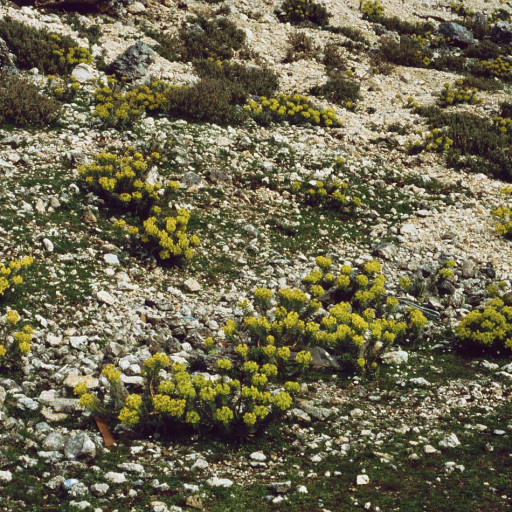
Plant Overview
Commonly known as the Gopher Spurge or Silver Spurge, Euphorbia rigida is a living architectural sculpture straight from the sun-drenched Mediterranean. Often nicknamed the "Upright Myrtle Spurge," this plant is a favorite among xeriscape enthusiasts for its metallic, blue-gray foliage and its ability to thrive where other plants wither. In late winter, it provides a dramatic "neon" wake-up call to the garden with its luminous chartreuse bracts.
🔍 How to Identify
- 🌿 Spiral Foliage: The most striking feature is the thick, lance-shaped leaves that wrap around the stems in a perfect, geometric spiral pattern.
- 🎨 Metallic Hue: The leaves possess a distinct waxy, glaucous coating, giving the entire plant a shimmering silver or blue-green appearance.
- 🟡 Neon Bracts: While the actual flowers are tiny, they are surrounded by large, cup-shaped bracts that glow in a brilliant lime-yellow, eventually fading to a rustic tan or reddish-orange as they age.
- 📏 Growth Habit: It typically grows in stiff, upright clumps that reach about 1 to 2 feet in height, with stems that radiate outward from the base.
🏡 In Your Garden
- ☀️ Sun & Drainage: This plant is a true sun-worshiper. While it is incredibly hardy, it has a "fatal flaw": wet feet. It must be planted in gritty, well-draining soil, or the crown will rot during the winter months.
- ✂️ Post-Bloom Grooming: To keep the plant looking tidy and to prevent it from becoming "leggy," gardeners should cut the flowered stems back to the base once the blooms fade. This encourages fresh, vigorous new growth from the center.
- 🦌 Natural Deterrent: Because of its bitter sap, it is virtually immune to deer and rabbits, making it an excellent choice for rural gardens or areas with heavy wildlife pressure.
⚠️ Safety & Toxicity
- 🚫 Toxic Status: High. Like all members of the Euphorbia family, this plant contains a thick, milky white latex sap that is highly irritating.
- 🧤 Skin & Eyes: The sap can cause painful blistering or a burning rash (dermatitis) upon contact with skin. Extreme care must be taken to keep the sap away from the eyes, as it can cause temporary blindness.
- 🐾 Pets & Children: If ingested, it causes severe stomach upset, vomiting, and swelling of the mouth. Always wear gloves when pruning and keep it away from curious pets or play areas.
✨ Fun Fact
- 🔫 The Seed Cannon: Euphorbia rigida doesn't just drop its seeds; it launches them! When the seed pods dry out, they explode with a distinct "pop," shooting seeds several feet away from the mother plant to colonize new territory.

Detailed Care Instructions
To grow Euphorbia rigida plants, you can follow these steps:
- Choose a suitable location: Euphorbia rigida prefers full sun but can also tolerate partial shade. Ensure that the soil is well-draining and not too rich in organic matter.
- Prepare the soil: If your soil is heavy or compacted, you can amend it by adding some sand or gravel to improve drainage. Euphorbia rigida can tolerate poor soil conditions but will thrive in well-draining soil.
- Propagate the plant: Euphorbia rigida can be propagated from seeds or cuttings. If using seeds, sow them in a well-draining potting mix and keep them warm and moist until they germinate. For cuttings, take stem cuttings in spring or summer and allow them to dry out for a few days before planting them in well-draining soil.
- Plant the seedlings or cuttings: If growing from seedlings, plant them at the same depth they were in the nursery container. If using stem cuttings, bury them just deep enough to support them, ensuring that the soil is not covering the cut edges.
- Watering: Euphorbia rigida is drought-tolerant, so it is important not to overwater. Water sparingly, allowing the soil to dry out between waterings. During the cooler months, reduce watering frequency to avoid root rot.
- Fertilization: Euphorbia rigida does not require much fertilization. You can use a general-purpose slow-release fertilizer in spring, but avoid over-fertilizing as it can lead to weak, leggy growth.
- Pruning: Euphorbia rigida does not require extensive pruning but can benefit from occasional maintenance trimming to maintain its shape and remove dead or damaged parts.
- Pests and diseases: Euphorbia rigida is generally resistant to pests and diseases. However, watch out for mealybugs or aphids, and treat them early with insecticidal soap or a neem oil solution if necessary.
Remember to always wear gloves when handling Euphorbia rigida as its sap can be irritative to the skin and eyes.

Place in a window with dappled sun or a spot in the middle of a room. Or directly in a window facing west or east.

To water this plant, observe the soil moisture first. Wait until the soil has completely dried out before watering again. It is important not to over-water this plant as it may cause root rot. When watering, it is recommended to use room temperature water and avoid getting the leaves and stem wet. To avoid waterlogging, ensure that the soil is well-draining. Watering once a week in the growing season is usually sufficient, but adjust the frequency according to the climate and exposure to sunlight. In the dormant season, reduce watering.
To fertilize this type of plant, choose a balanced fertilizer with equal amounts of nitrogen, phosphorus, and potassium. Apply the fertilizer once every two weeks during the plant's growing season, which typically occurs in the spring and summer months. Be sure to dilute the fertilizer with water according to the instructions on the packaging before applying it to the soil. Avoid fertilizing during the winter months, as the plant is typically dormant at this time and does not require as much nutrients.
The ideal soil to use for the plant in question should be well-draining with a slightly acidic to neutral pH. It should also contain a balanced mix of organic matter, sand, and perlite, in order to provide good fertility, drainage, and aeration for the plant's roots. Additionally, the soil should be kept moist, but not waterlogged, to prevent root rot and other fungal diseases. It is important to ensure that the soil is not too rich in nutrients, as this can cause the plant to grow too quickly and become leggy. Overall, a well-draining, slightly acidic to neutral soil with balanced levels of organic matter, sand, and perlite is the best choice for this plant.
To propagate this plant, you will need to take stem cuttings from healthy and mature plants. It is important to ensure that the cuttings are taken from a plant that is disease-free and has good vegetative growth. Using a clean and sharp pair of shears, cut several stems from the parent plant, making sure that each cutting has at least two nodes. The nodes are where the leaves attach to the stem.
After taking the cuttings, allow them to dry and callous over for a few days. This step helps to prevent rot and infection in the cutting once it's planted.
When calloused, fill small pots or seed trays with a well-draining soil mix and insert the cuttings about halfway into the soil. Water the cuttings gently and place them in a bright location, but keep them out of direct sunlight. If desired, you can cover the pots with plastic to help with humidity and moisture retention.
After a few weeks, you should start to see small roots forming at the base of the cuttings. At this point, you can remove the plastic cover and continue to care for the plants as you would with mature Euphorbia Rigida plants. They should be kept in a warm, bright location with well-draining soil and minimal water. Over-watering can cause the cuttings to rot, so be sure to allow the soil to dry out slightly between watering.
Common pests of the upright myrtle spurge include Mealybugs, aphids. Make a habit of checking your upright myrtle spurge frequently for pests so that any infestations can be caught and managed early.








