Plant Overview
Known as the "Tubed-Gland Spurge," Euphorbia tubiglans is a master of disguise from the dry, rocky regions of South Africa. This architectural succulent is a "geophyte," meaning it spends much of its life hiding a massive, water-storing root system underground to survive droughts. In the collector's world, it is prized for its strange, alien-like appearance and its ability to be "trained" into a stunning specimen plant.
🔍 How to Identify
- 🌵 The Caudex: It possesses a thick, fleshy underground stem (caudex) that acts as a water reservoir; in cultivation, this is often raised slightly above the soil line to show off its rugged, bark-like texture.
- 🌿 The Branches: Short, cylindrical, and leafless branches emerge from the top of the rootstock, featuring a distinct "knobby" surface arranged in geometric rows.
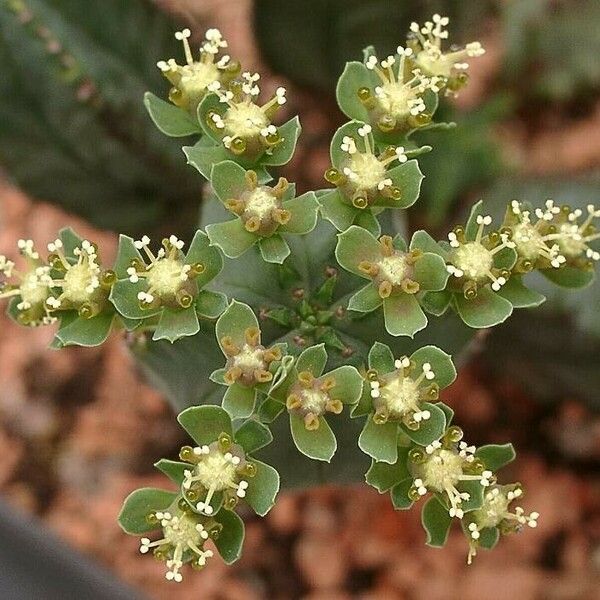
- 🌼 The Cyathia: The flowers are small and greenish-yellow, characterized by unique, tube-shaped nectar glands—the very feature that gives the plant its specific name, tubiglans.
🏡 In Your Garden
- 🏜️ Mimicking the Scrubland: In its natural habitat, it often grows tucked under the shade of larger bushes. To keep it happy at home, provide bright, filtered light rather than harsh, direct afternoon sun, which can scorch its delicate stems.
- 🏺 The "Deep Pot" Rule: Because this species develops a long, carrot-like taproot, it requires a deeper pot than most succulents. Use a very gritty, fast-draining mineral mix to prevent the root from rotting, as it is highly sensitive to lingering moisture.
⚠️ Safety & Toxicity
- 🚫 Toxic Latex: Like all Euphorbias, this plant contains a sticky, milky-white sap (latex) that is highly caustic.
- 🐾 Irritant Warning: The sap can cause painful skin inflammation (dermatitis) and is dangerous if it comes into contact with the eyes. It is toxic if swallowed by pets or children. Always wear gloves when handling or repotting, and wash your tools immediately after use.
✨ Fun Fact
The name tubiglans is a literal description of its biology—derived from the Latin "tubus" (tube) and "glans" (gland). These tiny "pipes" on the flowers secrete a specialized nectar to attract specific South African pollinators that other plants can't reach!

Detailed Care Instructions

Place in a bright room that is sun drenched almost all day. Or directly in a south-facing window.

When the top few inches of soil dry out, water your plants. If the top few inches of soil are still moist, do not water your plant. Wait a few days, then poke your finger into the soil to see if anything has changed. Overwatering poses a disease risk, such as the development of fungal diseases in the roots. These plants have adaptations in there leaves that allow them to survive in low water supply.
Without the need of fertilizer, these plants can thrive and bloom. If a plant requires fertilization, it will display indicators of nutrient insufficiency, such as yellowing leaves. It is safe to apply slightly diluted fertilizers in these circumstances. Over fertilizing, on the other hand, should be avoided because excess nutrients might cause plant mortality. Slow-release fertilizers are therefore advised for these plants.
You may use All Purpose Plant Food or Cactus Fertilizer for your Euphorbia Tubiglans
Common pests of the euphorbia tubiglans include Scale insect, mealybugs, spider mites. Make a habit of checking your euphorbia tubiglans frequently for pests so that any infestations can be caught and managed early.








