Plant Overview
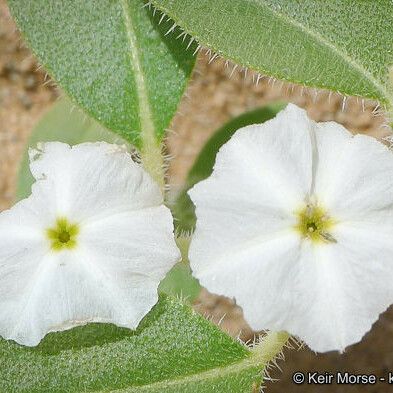
Euploca convolvulacea, commonly known as the Bindweed Heliotrope or Trumpet Heliotrope, is a desert-dwelling master of disguise. While its large, white, funnel-shaped flowers often lead hikers to mistake it for a Morning Glory (from the family Convolvulaceae), it actually belongs to the Borage family. This resilient annual is a specialist of the sandy dunes and arid plains of the Southwestern United States and Northern Mexico, where it transforms harsh landscapes into carpets of white after seasonal rains.
🔍 How to Identify
- 🌼 Showy Blooms: The flowers are brilliant white, five-lobed, and trumpet-shaped with a distinct yellow "eye" or throat. They are significantly larger and more "crinkled" than those of its close cousins.
- 🍃 Bristly Foliage: The leaves and stems are covered in stiff, appressed hairs (strigose), giving the plant a slightly rough, silvery-green texture that helps it retain moisture in the heat.
- 📐 Sprawling Habit: It typically grows low to the ground in a rounded, bushy mound, rarely exceeding a foot in height but spreading wide to capture as much sun as possible.
🏡 In Your Garden
- 🏜️ The Sand Lover: This plant has a very specific "niche"—it thrives in deep, loose sand or unstable dunes. In a garden setting, it requires extremely well-draining soil; it will suffer from root rot if kept in heavy clay or damp loam.
- 🐝 Pollinator Oasis: Despite its rugged lifestyle, it is a high-value plant for native bees and butterflies. Because it blooms most vigorously after summer monsoons, it provides a critical nectar source during the hottest months of the year.
⚠️ Safety & Toxicity
- 🐾 Caution Recommended: Like many members of the Boraginaceae family, this species contains pyrrolizidine alkaloids. These compounds are a natural defense against herbivores.
- 🧪 Toxicity Details: While generally safe to touch, it can be toxic to livestock (especially horses and cattle) if consumed in large quantities over time, as the toxins accumulate in the liver. Keep it away from curious pets who enjoy "grazing" on garden greenery.
✨ Fun Fact
The name "Heliotrope" comes from the Greek words helios (sun) and trepein (to turn). Ancient Greeks believed these plants would physically turn their flower heads throughout the day to follow the sun’s path across the sky!

Detailed Care Instructions
To grow Euploca Convolvulacea, also known as the bush morning glory, you can follow these steps:
- Obtaining seeds or plants: You can find seeds or young plants from local nurseries, plant stores, or online seed suppliers.
- Choosing a suitable location: Euploca Convolvulacea prefers a location with full sun exposure, receiving at least 6-8 hours of sunlight per day. Make sure the soil is well-draining, as the plant does not tolerate standing water.
- Preparing the soil: Before planting, amend the soil with organic matter like compost or well-rotted manure to improve fertility and drainage. This plant can tolerate a wide range of soil pH levels, but neutral to slightly acidic soil is preferred.
- Planting seeds or young plants: If using seeds, sow them in the prepared soil, following the package instructions on depth and spacing. If using young plants, dig a hole slightly larger than the root ball and gently place the plant in, backfilling the hole and firming the soil around it.
- Watering: Water the plant thoroughly after planting and keep the soil consistently moist until the plant becomes established. Once established, Euploca Convolvulacea is relatively drought-tolerant and requires watering only when the top inch of soil becomes dry.
- Mulching: Apply a layer of organic mulch, such as wood chips or straw, around the base of the plant to help retain moisture and suppress weed growth.
- Pruning and training: Euploca Convolvulacea tends to grow as a sprawling, bushy plant. You can train it to grow on a trellis or support structure if desired, or you can prune it to maintain a more compact shape. Regularly remove any dead, damaged, or overgrown branches to promote healthy growth.
- Fertilizing: While Euploca Convolvulacea can grow well without much fertilizer, you can apply a balanced, slow-release fertilizer in early spring to provide essential nutrients.
- Pest and disease control: Keep an eye out for common garden pests like aphids or spider mites. If necessary, treat with appropriate organic or chemical insecticides. Ensure good air circulation around the plant to prevent fungal diseases.
- Harvesting seeds: If you want to collect seeds for future propagation, allow the flowers to wither and produce seed pods. When the seed pods turn brown and start to open, collect the seeds and store them in a cool, dry place until planting season.
By following these steps, you can successfully grow Euploca Convolvulacea in your garden or landscape.

Place in a bright room that is sun drenched almost all day. Or directly in a south-facing window.

Euploca Convolvulacea plant requires regular watering to thrive. The best practice is to water the plant deeply and allow the soil to dry slightly between watering intervals. Overwatering may cause root rot, which can be detrimental to the plant's health. It is best to water the plant at the base and avoid getting water on the leaves, as this can cause fungal diseases. The frequency of watering may vary depending on the environment the plant is in, such as humidity and temperature. It is important to monitor the plant regularly and adjust watering accordingly. In summary, watering should be done deeply and infrequently, ensuring that the soil is allowed to dry slightly in between, whilst avoiding water on the leaves.
To fertilize this plant, use a balanced fertilizer with equal amounts of nitrogen, phosphorus, and potassium. Apply the fertilizer at a rate of one tablespoon per gallon of water, and water the plant thoroughly after fertilizing. Fertilize once every two to four weeks during the growing season, which is typically from spring to fall. Avoid over-fertilizing, as this can cause damage to the plant.
The suitable type of soil for this plant is a well-draining soil mix that is rich in organic matter. It needs a soil that is slightly acidic, with a pH range of 5.5 to 7.0. The soil should also be able to retain moisture but not be waterlogged. It is recommended to mix perlite or sand to the soil to improve drainage. The soil should be loose, fluffy, and light for optimal root growth. Avoid using heavy clay soils or soils that are too compacted as they can cause root rot and other problems.
To propagate this plant, begin by collecting seeds from mature plants in the fall. After collecting the seeds, clean them to remove any debris or damaged seeds. Next, prepare a seed starting mix of equal parts peat moss, perlite, and coarse sand. Place the mix into seed trays or pots, and then sow the seeds about 1/8 inch deep. Water the seeds gently but thoroughly, and then cover the tray or pots with a plastic dome or wrap to create a humid environment.
Once the seeds have germinated, remove the plastic covering and move the seedlings into a bright location. The plants should be kept moist but not soggy, and should be given a balanced fertilizer every 2-3 weeks until they are established. After several months, the plants can be repotted into larger containers or transplanted outdoors into a sunny location.
Another method of propagation is to take stem cuttings from mature plants. Select a stem that is about 4-6 inches long, and cut it just below a node. Remove the leaves from the bottom half of the stem, and dip the cut end into rooting hormone. Plant the cutting into a moist rooting medium, such as vermiculite or perlite, and cover it loosely with plastic wrap. Keep the cutting in a bright location out of direct sunlight, and mist it regularly to keep it moist. After a few weeks, the cutting should begin to develop roots and can then be transplanted into a pot or outdoors.








