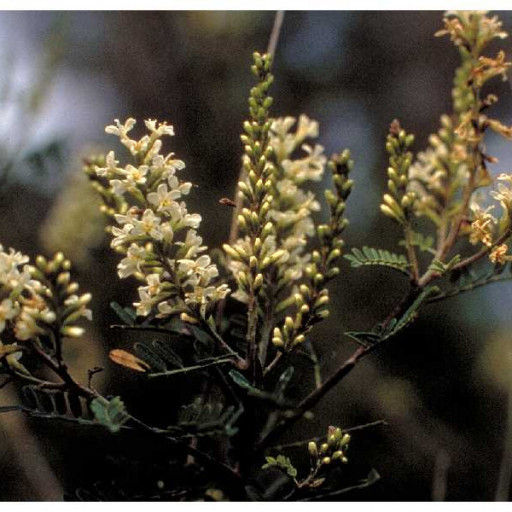
Plant Overview
Commonly known as Texas Kidneywood or "Bee-brush," this airy, deciduous shrub is a hidden gem of the Chihuahuan Desert and Texas Hill Country. It is beloved by landscapers for its delicate, lacy appearance and a sweet, vanilla-tangerine fragrance that intensifies after summer rains. In folklore, it earned its name because extracts from its wood were historically used in traditional remedies for kidney ailments.
🔍 How to Identify
- 🌿 Lacy Foliage: The leaves are pinnately compound, meaning they consist of many tiny, oblong leaflets arranged along a central stalk, giving the plant a soft, fern-like texture.
- 🍦 Cylindrical Blooms: It produces slender, 1-to-3-inch spikes of small, creamy-white flowers that look like tiny bottle brushes at the ends of the branches.
- 🪵 Multi-Trunked Form: Naturally growing as an irregular, open-branched shrub, its bark is smooth and gray when young, becoming slightly fissured as it matures.
🏡 In Your Garden
- 🦋 The Pollinator Party: True to its "Bee-brush" nickname, this plant is a magnetic force for honeybees, native bees, and butterflies. It is also a larval host for the Dogface Butterfly.
- ☀️ Sun-Drenched Resilience: Because it has a deep taproot, Kidneywood is incredibly drought-tolerant once established. It thrives in rocky, limestone-rich soils where other plants might struggle, but it demands excellent drainage to avoid root rot.
- 🌬️ Aromatic Privacy: While it has an open habit, planting several together creates a fragrant, dappled-sun screen. The scent is most potent on warm, humid evenings or immediately following a thunderstorm.
⚠️ Safety & Toxicity
- ✅ Generally Safe: Eysenhardtia texana is considered non-toxic to humans and common household pets like dogs and cats.
- 🦌 Wildlife Forage: In the wild, the protein-rich leaves are frequently browsed by deer and livestock, which may necessitate a wire cage if you are trying to establish a young plant in an area with high deer traffic.
✨ Fun Fact
If you place a piece of Kidneywood heartwood in a glass of water, the water will gradually turn a beautiful golden yellow. However, when held up to the light or viewed under UV light, it exhibits a stunning fluorescence, glowing with an ethereal blue or opal tint. This "magic" wood was once highly prized in Europe for this unique optical property!

Detailed Care Instructions
To grow Eysenhardtia texana, also known as Texas kidneywood, follow these steps:
- Climate and soil requirements: Eysenhardtia texana is native to the arid regions of Texas, so it prefers hot and dry conditions. It can tolerate a variety of soil types, including sandy or rocky soil, as long as it is well-draining.
- Location: Choose a spot in your garden that receives full sun or partial shade. This plant cannot tolerate heavy shade.
- Planting: Eysenhardtia texana is usually propagated from seeds. You can purchase seeds from a reputable nursery or collect them from existing plants. Scarify the seeds by nicking or scratching the hard seed coat to increase germination. Plant the scarified seeds directly in the prepared soil, about 1/8 inch deep. Water the area lightly after planting.
- Watering: Once the seeds have germinated, water the young plants sparingly. Texas kidneywood is drought-tolerant, so it does not require frequent watering. Allow the soil to dry out between watering sessions.
- Mulching: Apply a layer of organic mulch around the base of the plants to help retain moisture and suppress weed growth. Be careful not to pile the mulch against the stem, as it can cause stem rot.
- Pruning: Eysenhardtia texana may benefit from light pruning to maintain its shape and promote bushier growth. Prune dead or damaged branches, as well as any crossing or crowded branches. It is best to prune in late winter or early spring before new growth emerges.
- Fertilizing: Texas kidneywood generally does not require regular fertilization. If the soil is poor, you can apply a balanced slow-release fertilizer once a year in early spring.
- Pests and diseases: Eysenhardtia texana is relatively resistant to pests and diseases. Ensure good air circulation around the plants to prevent fungal diseases. Watch out for any signs of aphids, spider mites, or leafhoppers and treat them accordingly with organic insecticides or by introducing beneficial insects.
- Be patient: Eysenhardtia texana is a relatively slow-growing plant. It may take a few years for it to reach its full height and develop a dense canopy.
Remember to check any local regulations or guidelines regarding the cultivation of this plant, as it may be considered invasive in some regions.

Place in a bright room that is sun drenched almost all day. Or directly in a south-facing window.

To water this specific plant, it is recommended to do so deeply but infrequently. This means watering the plant to saturate the soil until it starts draining, and then waiting for the soil to dry out partially before watering again. This plant prefers to dry out slightly between watering sessions. It is important to avoid overwatering as this can lead to root rot and other issues. Additionally, the plant should be watered at its base rather than overhead to prevent water from sitting on the leaves and causing damage.
To fertilize this plant well-balanced slow-release fertilizer is ideal. Apply it during the growing season, which is typically from early spring to late fall. Make sure to follow the instructions on the fertilizer packaging for the right amount and frequency of application. After fertilizing the plant, water it thoroughly to help the nutrients reach the roots. It is best to avoid fertilizing during winter or dormancy period because the plant is not actively growing during this time.
It is recommended to use well-draining, nutrient-rich soil that is slightly acidic to grow this plant. The ideal soil pH should be between 5.5 and 6.5. A mixture of sand, loam, and peat moss can be used to create the appropriate soil. It is also recommended to incorporate organic matter, such as compost or aged manure, into the soil to enhance its fertility. Additionally, adding a layer of mulch on top of the soil can help to retain moisture and suppress the growth of weeds.
To propagate the plant, you can use both seeds and cuttings. If using seeds, they should be collected from the mature plant and sown in early spring. The seeds should be soaked in water for 24 hours before planting and then sown in well-draining soil. Keep the soil moist and in a warm, bright location until the seeds germinate.
If using cuttings, select a healthy, mature stem from the plant and cut it at a 45-degree angle using sterile pruning shears. Remove any leaves from the lower one-third of the stem and dip the cut end in rooting hormone. Plant the cutting in a pot filled with well-draining soil, covering the cut end and pressing the soil around the stem. Keep the soil moist and in a warm, bright location until the cutting roots and begins to grow.








