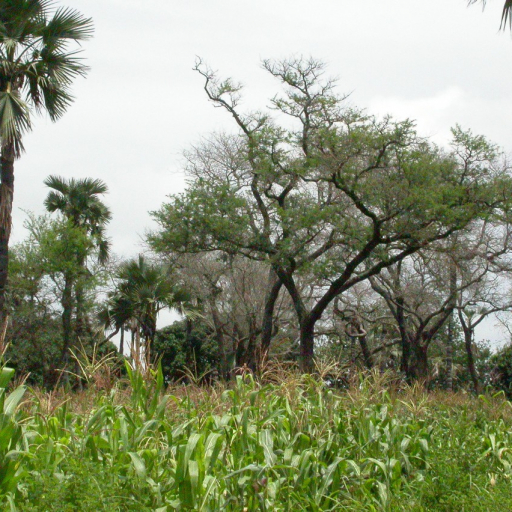
Plant Overview
Known as the Winter Thorn or the Apple-ring Acacia, Faidherbia albida is a botanical rebel of the African savannah. While most trees flourish when the rains arrive, this giant sheds its leaves and goes dormant, choosing instead to bloom and grow during the scorching dry season. This "reverse phenology" makes it a legendary life-giver, providing shade and food when the rest of the landscape is parched and brown.
🔍 How to Identify
- 🎨 Bark & Structure: It features a distinctive whitish-grey bark that can appear almost silver or ghostly from a distance. It is a massive tree, often reaching up to 30 meters with a wide, spreading canopy.
- 🍃 Feathery Foliage: The leaves are bi-pinnate (feathery) and have a soft, blue-green tint. You will notice they are noticeably absent during the rainy season, which is the easiest way to confirm the species.
- 🍩 Apple-Ring Pods: The most iconic feature is the fruit—bright orange-to-reddish-brown seed pods that twist and curl into circular shapes, looking remarkably like dried apple rings.
🏡 In Your Garden & Ecology
- 🔄 The Farmer’s Friend: Because it loses its leaves during the rainy season, it allows sunlight to reach crops planted beneath it while dropping nitrogen-rich leaf litter that acts as a natural fertilizer.
- 💧 Deep Hydration: This tree is a master of survival; it grows an incredibly deep taproot (sometimes reaching 40 meters down) to access groundwater, allowing it to stay lush and green throughout the hottest droughts.
- 🦒 Wildlife Buffet: The "apple ring" pods are highly nutritious and protein-packed. They are a favorite snack for elephants, giraffes, and livestock, who often congregate under the tree during the dry season.
⚠️ Safety & Toxicity
- 🟢 Non-Toxic: The tree is generally safe for humans and pets. In its native range, the pods are even used as high-quality fodder for cattle and goats.
- ⚔️ Sharp Thorns: Beware of the "thorns of the acacia." It possesses paired, straight, whitish spines at the base of the leaves that can easily puncture skin or thin-soled shoes.
✨ Fun Fact
In many African cultures, Faidherbia albida is considered a "Fertilizer Factory." A single mature tree can provide the equivalent of several bags of nitrogen fertilizer to the soil surrounding it, simply through its natural leaf-drop cycle!

Detailed Care Instructions
To grow Faidherbia Albida (also known as ana tree or winter thorn), follow these steps:
- Climate: Make sure you are in an appropriate climate for Faidherbia Albida. It is native to sub-Saharan Africa and can tolerate both arid and semi-arid conditions. It prefers warm temperatures of around 77°F (25°C).
- Soil: Faidherbia Albida can grow in a variety of soil types, but it prefers well-draining soils. It can tolerate sandy, loamy, or clayey soils. Perform a soil test to ensure the pH is between 6.0-7.5.
- Seed collection: Collect seeds from mature Faidherbia Albida trees during the dry season. Look for pods that have naturally fallen to the ground. Remove the seeds from the pods and dry them for a few weeks.
- Pre-treatment: Faidherbia Albida seeds have a hard outer shell, which can hinder germination. To improve germination rates, scarify the seeds by soaking them in hot water (around 167°F or 75°C) for 24 hours. Alternatively, you can carefully nick the seed coat with a knife or use sandpaper to create a small opening.
- Planting: Once seeds have been scarified, plant them in seed trays or directly into the ground during the rainy season. Choose a location that receives full sun. If planting in trays, use a well-draining potting mix. Plant the seeds approximately 0.5-1 inch deep and water thoroughly.
- Watering: During the early stages, keep the soil consistently moist but not waterlogged. Once the seedlings are established, reduce watering frequency and allow the soil to dry slightly between waterings.
- Transplantation: If you started the seeds indoors, transplant the seedlings outdoors once they have developed a few sets of true leaves and the weather is favorable.
- Maintenance: Monitor the plants for pests and diseases. Provide occasional watering during dry periods to promote healthy growth. Prune away any dead or damaged branches to maintain the plant's shape.
- Growth: Faidherbia Albida grows relatively slowly. It may take several years for the tree to reach maturity. Ensure the tree has enough space to spread out and develop its characteristic umbrella-shaped canopy.
- Conservation: Due to its environmental benefits, Faidherbia Albida is widely planted to combat desertification and improve soil fertility. Consider planting it as part of a larger reforestation or conservation effort.
Remember, Faidherbia Albida is a tree found in its native range, so make sure to check its invasive potential in your specific region and follow any local regulations or guidelines.

Place in a bright room that is sun drenched almost all day. Or directly in a south-facing window.

Faidherbia Albida is a plant that needs to be watered regularly to thrive. When watering, it is important to ensure that the soil is moist but not overly saturated. Over-watering can lead to root rot and ultimately kill the plant.
To water Faidherbia Albida, first, check the soil moisture by inserting a finger into the soil up to the first knuckle. If the soil feels dry, it is time to water.
Next, use a watering can or a hose with a gentle spray to water the plant. Be sure to water around the base of the plant to ensure that the water reaches the roots. Avoid getting the leaves wet as this can lead to fungal diseases.
Water the plant until you see water seeping out from the drainage holes at the bottom of the pot or until the soil feels evenly moist.
During the hot summer months, Faidherbia Albida may require watering more frequently to prevent the soil from drying out. In contrast, during colder months, the plant may not require as much water.
In conclusion, Faidherbia Albida should be watered regularly, ensuring the soil is moist but not overly saturated, to keep it healthy and thriving.
To fertilize this plant, use a balanced fertilizer with equal amounts of nitrogen, phosphorus, and potassium. Apply the fertilizer once a year during the growing season and follow the label instructions for the appropriate amount of fertilizer to use per plant. Avoid over-fertilization as this can lead to excessive growth and potential harm to the plant. Use a slow-release fertilizer for best results, and water the plant deeply after applying the fertilizer to help it absorb the nutrients.
Faidherbia Albida is a type of shrub or tree that is native to Africa. It has specific soil requirements to thrive, which makes it important to select the right type of soil when planting it.
The soil that is best suited for Faidherbia Albida is one that is well-draining with a pH level between 6.0 and 7.5. It should be rich in organic matter, nutrients and minerals essential for healthy growth and development. The soil must have a sandy-loamy texture, which will help it retain some moisture while allowing for sufficient aeration, to prevent waterlogging of the roots.
It's recommended to avoid soils that are too heavy, such as clay, as they tend to retain water which can lead to water-logged roots and adversely affect the plant's growth.
Adding organic matter such as well-decomposed compost, leaf mold, animal manure or bone meal can help improve the soil texture, fertility, and nutrient value.
When planting Faidherbia Albida, it's essential to prepare the soil and ensure it has the right composition and pH level to promote healthy growth. Proper soil preparation can help prevent nutrient deficiencies, diseases, and pests, and ultimately pave the way for a healthy, thriving plant.
To propagate this plant, you will need to collect seeds from mature pods that have fallen from the tree. The seeds should be cleaned thoroughly and then soaked in water for several hours.
Next, plant the seeds in a well-draining soil mix in a container or directly in the ground. The seeds should be covered with a thin layer of soil and kept consistently moist.
Keep the container or planting area in a warm and sunny location, and regularly water and fertilize the seedlings to encourage healthy growth.
Once the seedlings are large enough, they can be transplanted into their final growing location. Make sure to space the plants out appropriately and provide proper care to ensure their survival.








