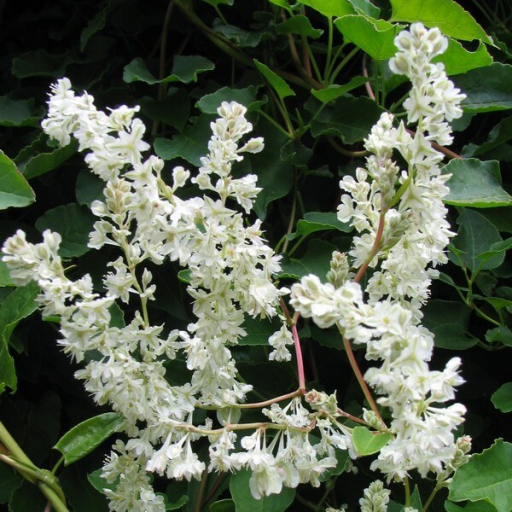
Plant Overview
Known as the "Houdini of the botanical world," the Fallopia genus contains some of the most resilient and controversial plants on the planet. Whether you call it Japanese Knotweed, Mexican Bamboo, or the Silver Lace Vine, these plants are famous for their architectural beauty and their sheer, unyielding determination to grow anywhere. While they are members of the Buckwheat family, they are best known for their bamboo-like stems and their ability to thrive in the most challenging urban environments.
🔍 How to Identify
- 🎋 The Stems: Look for hollow, upright stems that resemble bamboo. They are often green with distinct reddish-purple speckles and swollen nodes where the leaves attach.
- 🍃 The Leaves: Most species feature broad, shield-shaped or heart-shaped leaves. They are typically smooth with a flat base and a pointed tip, arranged in a zigzag pattern along the branch.
- ☁️ The Flowers: In late summer and autumn, the plant produces airy, lace-like clusters of tiny, creamy-white or greenish flowers that drape elegantly from the leaf axils.
🏡 In Your Garden
- 🏗️ Unstoppable Growth: Be cautious with this genus! The most famous member, Fallopia japonica, is notorious for its ability to grow through cracks in concrete and asphalt. Its root system (rhizomes) can extend deep underground, making it incredibly difficult to remove once established.
- 🌿 Vine Varieties: The "Silver Lace Vine" (Fallopia baldschuanica) is a popular ornamental cousin used to quickly cover fences or pergolas. However, even the "tame" versions are fast-growing and require frequent pruning to prevent them from smothering nearby plants.
⚠️ Safety & Toxicity
- 🟢 Non-Toxic to Touch: Fallopia species are generally safe to handle and are not known to be toxic to humans or pets if touched or accidentally brushed against.
- 🚜 Herbicide Warning: Because these plants are often targeted as invasive weeds, they are frequently sprayed with heavy industrial herbicides. Never forage or allow pets to play near Fallopia in public spaces or along roadsides, as the chemical residue can be dangerous.
- 🌎 Ecological Danger: The primary "safety" concern is for your local ecosystem. In many regions, planting certain species is restricted because they can outcompete native flora and damage property foundations.
✨ Fun Fact
Fallopia japonica is one of the richest natural sources of resveratrol, the same healthy antioxidant found in red wine! In its native Japan, the young, crunchy shoots are foraged in the spring and eaten like rhubarb or asparagus, known locally as "itadori," which translates to "remove pain."

Detailed Care Instructions

To water this plant, allow the soil to dry out slightly in between watering. When watering, thoroughly saturate the soil and allow excess water to drain out of the bottom of the pot. Avoid letting the plant sit in standing water, as this can lead to root rot. Watering frequency will depend on factors such as temperature and humidity, so be sure to monitor the plant closely and adjust your watering schedule accordingly.
Fallopia plants prefer soil that is rich in organic matter and well-draining. The ideal soil for these plants is slightly acidic with a pH range between 5.5-6.5. The soil should be loose, not compacted, and have good aeration for root development. Avoid heavy clay soils or soils that dry out quickly.
Adding compost or aged manure to the soil mix will help improve soil fertility and provide necessary nutrients for Fallopia plants. It is also recommended to add a slow-release fertilizer to the soil before planting.
Mulching around the plants will help conserve moisture, control weeds and provide additional nutrients for the soil. Organic mulches like shredded bark, leaves, or straw are ideal.
Regular watering is important for Fallopia plants, especially during dry spells. However, be careful not to overwater as it can lead to root rot. Allow the top inch of soil to dry out before watering again.
Overall, Fallopia plants require a well-draining, fertile soil that is rich in organic matter and with a slightly acidic pH range.







