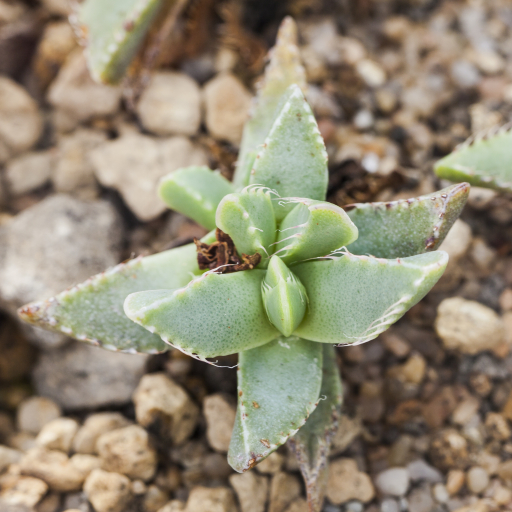
Plant Overview
Known as the "Tiger Jaws," Faucaria felina is a small but fierce-looking succulent that hails from the dry, rocky plains of South Africa. Despite its predatory nickname and the "teeth" lining its leaves, it is a gentle and rewarding plant for indoor enthusiasts. It is a master of disguise, often blending perfectly with the surrounding pebbles until it bursts into brilliant golden bloom.
🔍 How to Identify
- 🦷 The "Jaws": The most striking feature is the array of soft, white, hair-like "teeth" (called marginal cilia) lining the edges of the triangular leaves.
- 📐 Geometric Growth: The fleshy, boat-shaped leaves grow in opposite pairs, creating a compact rosette that resembles a wide-open animal mouth.
- 🌼 Golden Flowers: It produces large, silky yellow flowers that look like daisies. These typically bloom in autumn and have a unique habit of opening only in the bright afternoon sun.
🏡 In Your Garden
- 🌵 The Taproot Secret: This plant develops a thick, fleshy taproot. Because of this, it hates being moved frequently and requires deep, gritty soil to allow that root to anchor properly without rotting.
- ☀️ Light and Texture: To keep its "jaws" looking sharp and compact, it needs intense light. In low light, the plant will stretch out, losing its fierce shape and turning a pale, dull green.
- 💧 Dry Spells: In the wild, the "teeth" actually help the plant survive by Funneling morning dew and mist down toward the center of the plant and into the soil.
⚠️ Safety & Toxicity
- 🐾 Non-Toxic: Faucaria felina is generally considered non-toxic to cats, dogs, and humans, making it a "safe" fierce friend for your windowsill.
- 🌵 Soft Touch: Unlike a cactus, the teeth are usually soft to the touch and won't draw blood, though older specimens can develop firmer points that might cause a minor prickle.
✨ Fun Fact
The "teeth" of the Tiger Jaws aren't just for defense; they are an evolutionary marvel that traps fog and moisture from the air, allowing the plant to "drink" even when it hasn't rained for months!

Detailed Care Instructions
To grow Faucaria Felina plants, also known as tiger's jaws, follow these steps:
- Choose a suitable location: Faucaria Felina plants thrive in bright, indirect sunlight. Select a spot where the plant can receive at least 4-6 hours of sunlight each day.
- Planting medium: Use a well-draining soil mix suitable for cacti and succulents. You can either purchase a pre-mixed succulent soil or make your own by combining regular potting soil with sand or perlite.
- Container: Choose a shallow pot or container with drainage holes to prevent waterlogging. A wider container will be better than a deep one, as Faucaria Felina has a shallow root system.
- Watering: Allow the soil to dry out completely between watering sessions. During the growing season (spring and summer), water the plant thoroughly and then wait until the soil is dry before watering again. Reduce watering during the winter months.
- Humidity and temperature: Faucaria Felina plants prefer drier environments with low humidity levels. They can handle temperatures between 50-85°F (10-29°C). Protect them from frost or extreme heat.
- Fertilizer: Feed your Faucaria Felina with a balanced succulent fertilizer diluted to half strength during the growing season (spring and summer). Avoid fertilizing during winter months.
- Propagation: Faucaria Felina can be propagated through stem cuttings or leaf cuttings. Allow the cuttings to dry for a day or two before planting them in a well-draining succulent soil mix. Keep the soil slightly moist until roots form.
- Pruning: Trim off any dead or withered leaves or stems to maintain the plant's appearance and remove any potential disease or pests.
- Pests and diseases: Faucaria Felina plants are generally resistant to pests and diseases. However, occasionally, they can be susceptible to mealybugs or fungal infections. Ensure good airflow around the plant and treat any pests or diseases promptly.
By following these guidelines, you can successfully grow and care for your Faucaria Felina plant. Remember to provide it with the necessary sunlight, well-draining soil, and appropriate watering to promote healthy growth.

Place in a bright room that is sun drenched almost all day. Or directly in a south-facing window.

To water this plant, you should check the soil to see if it is dry before providing water. If the soil is dry, you should water the plant thoroughly until the excess water starts to drain from the bottom of the pot. It is important to avoid over-watering as this can lead to root rot. You should also avoid spraying water on the leaves as this may cause damage. The plant prefers well-draining soil and should be watered less frequently during the winter months, when it is dormant.
To fertilize this plant, use a balanced liquid fertilizer every two weeks during the growing season (spring and summer). Dilute the fertilizer to half-strength and apply it to moist soil, taking care not to get it on the plant's leaves. Do not fertilize during the dormant season (fall and winter).
The ideal soil to use for the plant species in question is a well-draining mixture that is composed of coarse sand, perlite or pumice, and a small amount of organic matter such as peat moss or coconut coir. The pH should be slightly acidic to neutral (around 6.0 to 7.0). This type of soil is suitable for the species because it allows excess water to drain away quickly, preventing the roots from being waterlogged. Additionally, the coarse texture of the soil mixture allows for adequate air circulation around the roots, which is essential for good root growth and health. The added organic matter will provide some nutrients for the plant, but additional fertilization may be necessary. It is also important to note that this species requires a period of dryness between waterings, so the soil should not remain consistently moist.
To propagate this plant, you will need to carefully remove offsets (small, independent plants that grow off of the main plant) from the parent plant. Make sure to use clean and sharp gardening scissors to avoid damaging both the parent plant and the offsets. Once the offsets are removed, let them dry for a day or two to prevent rotting.
Prepare a well-draining soil mix that is composed of mainly sandy soil. You may mix perlite or pumice to ensure that it is porous to prevent waterlogging.
Place the offsets on top of the soil mix and press them gently into the soil, making sure that they are stable and secure. Water the newly planted offsets sparingly to avoid rotting.
Place the container in a bright area but avoid direct sunlight. Keep the soil barely moist and avoid overwatering. Over time, the offsets will develop their own root system and grow larger.








