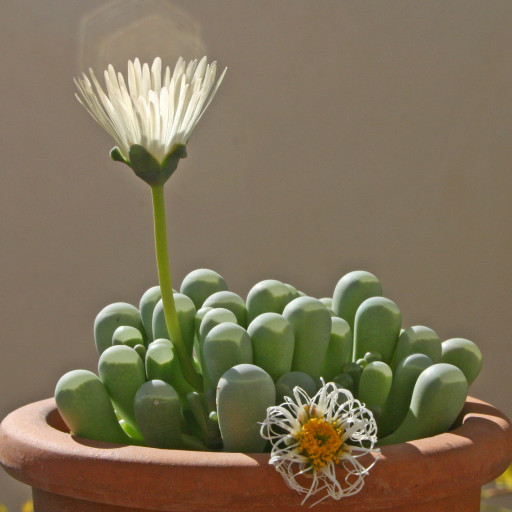
Plant Overview
Commonly known as "Baby Toes," this quirky succulent looks like a cluster of tiny, upright feet peeking out from the desert sand. Native to the arid coastal regions of South Africa and Namibia, it has evolved a clever "hide and seek" strategy to survive the harsh sun. It belongs to the Aizoaceae family, making it a distant cousin to Living Stones (Lithops).
🔍 How to Identify
- 🪟 Leaf Windows: The flattened, translucent tops of the leaves act like organic skylights. These "fenestrations" allow sunlight to enter the body of the plant for photosynthesis while the rest of the leaf remains safely buried or shaded.
- 🦶 Club-Shaped Growth: Each leaf is thick, fleshy, and shaped like a club (the name rhopalophylla literally means "club-shaped leaf"). They grow in tight, upright clumps.
- 🌼 Daisy-like Blooms: In late winter or early spring, large white or golden-yellow flowers emerge on long stalks, often appearing surprisingly large compared to the tiny plant.
🏡 In Your Garden
- 🏜️ The Buried Life: In their natural habitat, these plants grow almost entirely underground with only the "windows" exposed. In a home setting, they need a very gritty, sandy potting mix to mimic this well-draining environment.
- 💧 The "Bursting" Risk: Because they are designed to soak up every drop of desert mist, they are prone to "splitting" if overwatered. If the leaves look extremely plump and start to crack, it’s a sign the plant has had too much to drink.
- ☀️ Light Seekers: They crave bright light. Without enough sun, the "toes" will stretch out (etiolate) and lose their compact, charming shape.
⚠️ Safety & Toxicity
- 🐾 Non-Toxic: Baby Toes are generally considered safe and non-toxic for cats, dogs, and humans.
- 👶 Fragile Texture: While not poisonous, the leaves are quite brittle. They can snap off easily if handled roughly by children or curious pets, which can stress the plant and lead to rot.
✨ Fun Fact
The "windows" on top of the leaves aren't just for show—they contain specialized cells that filter out the most intense, damaging UV rays, acting like a built-in pair of sunglasses for the plant's internal tissues!

Detailed Care Instructions
| Color | Green With White Or Yellow Blooms |
| Soil Ph | 6.1 - 6.5 |
| Humidity | Normal |
| Lighting | Full Sun |
| Soil Type | Well-Draining, Sandy Soil, Or Cactus/Succulent Mix |
| Bloom Time | Autumn To Spring |
| Difficulty | Medium |
| Plant Type | Perennial |
| Mature Size | Up To 1.6-Inches Tall Per Leaf |
| Native Area | South Africa |
| Temperature | 18°C - 25°C |
| Sun Exposure | 6 Hours Of Bright Sunlight Each Day |
| Hardiness Zones | 10-11 |
To grow Fenestraria Rhopalophylla (commonly known as "Baby Toes" or "Window Plant"), follow these steps:
- Start with a suitable pot: Choose a shallow dish or a pot with good drainage holes, as these plants have shallow roots and do not like to sit in water.
- Soil: Use a well-draining succulent mix or make your own by combining equal parts of potting soil, sand, and perlite. This will ensure good drainage and prevent waterlogged roots.
- Planting: Gently remove the plant from its nursery pot and place it in the new pot. Ensure that the roots are covered with soil but avoid burying the stem. Leave the top of the plant exposed, including the small translucent windows (hence the name "window plant").
- Light: Fenestraria Rhopalophylla requires bright, indirect sunlight. Place the pot near a south-facing or east-facing window where it can receive a few hours of sunlight each day. Too much direct sunlight, especially during hot summer months, can scorch the leaves.
- Watering: These plants are adapted to arid conditions, so water them sparingly. Allow the soil to dry out completely between watering. Stick your finger about an inch deep into the soil – if it feels dry, it's time to water. Overwatering can lead to root rot or fungal diseases.
- Humidity: Fenestraria Rhopalophylla prefers low humidity. Avoid placing the plant in a humid or poorly ventilated area, as it may cause the leaves to rot.
- Temperature: These plants prefer warm temperatures between 60-85°F (15-29°C). Protect them from extreme cold or frost, as they are susceptible to damage in freezing temperatures.
- Fertilizer: Fenestraria Rhopalophylla does not require frequent fertilization. Feed them sparingly with a diluted succulent fertilizer during the growing season (spring and summer) only.
- Propagation: You can propagate Fenestraria Rhopalophylla through stem cuttings or leaf cuttings. Allow the cuttings to dry for a few days before planting them in well-draining soil. Keep the soil lightly moist until new growth appears.
- Maintenance: Keep an eye out for pests like mealybugs or scale insects. If you notice any infestation, gently wipe the affected areas with a cotton ball soaked in rubbing alcohol.
By following these guidelines, you should be able to successfully grow and care for your Fenestraria Rhopalophylla plant.

Place in a bright room that is sun drenched almost all day. Or directly in a south-facing window.

To water this plant, it is important to use a well-draining soil mixture that will allow excess water to drain away from the root system. Watering should be done sparingly, taking care not to over-water as this can lead to root rot. This plant should be watered when the top inch of soil has become dry to the touch, typically once every two weeks during the growing season. When watering, be sure to avoid getting water on the leaves as this can cause damage.
To properly fertilize this plant, it is recommended to use a balanced fertilizer with equal parts nitrogen, phosphorus, and potassium. Fertilize once a month during the growing season and reduce fertilization during the dormant period. Dilute the fertilizer to half the recommended strength and water the plant before applying the fertilizer. Apply the fertilizer to the base of the plant and avoid getting it on the leaves or flowers.
The ideal soil for this plant should be well-draining and porous. The soil mixture should consist of a combination of perlite, sand, and loamy soil. It is important to ensure that the soil is not compacted and allows for proper airflow to the plant roots. Additionally, the soil pH should be around 6.5 to 7.5, slightly on the alkaline side. The plant also prefers dry soil, so it is important to allow the soil to completely dry out before watering. Avoid using heavy soils or soil that retains too much moisture, as it can lead to root rot and other issues.
Fenestraria Rhopalophylla is a succulent plant that can be propagated through stem cuttings or leaf cuttings. To propagate this plant, first select a healthy parent plant with no signs of disease or stress. Using a clean, sharp cutting tool, take a stem or leaf cutting from the parent plant. If taking a stem cutting, allow it to dry and callous over for a few days before planting it in well-draining soil. If taking a leaf cutting, allow it to callous over for a few days before placing it on top of well-draining soil and lightly pressing it into the soil. Water the soil lightly to provide moisture without creating waterlogging. Place the cutting in a bright, warm location where it can receive indirect sunlight. Check the soil often and water lightly as needed to keep it just moist during the propagation process. With proper care, the cutting should begin to develop roots and grow into a new Fenestraria Rhopalophylla plant.
Common pests of the baby toes include Mealybugs. Make a habit of checking your baby toes frequently for pests so that any infestations can be caught and managed early.








