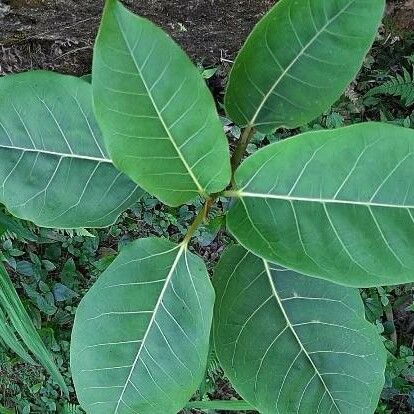
Plant Overview
Known as the "Higuera Brava" or Luschnath's Fig, this South American native is a master of adaptation. In the wild, it often begins its life as an "epiphyte," growing high in the canopy of another tree before sending long, rope-like roots down to the forest floor. It is a symbol of the lush, subtropical landscapes of Brazil and Argentina, prized for its dense, cooling shade and sculptural trunk.
🔍 How to Identify
- 🍃 Leathery Foliage: The leaves are thick, glossy, and elliptical. They have a distinct "stiff" feel compared to other figs, helping the plant retain moisture in varied climates.
- 🧱 Architectural Roots: As the plant matures, it develops impressive aerial roots. These can eventually wrap around structures or fuse together to create a massive, buttressed base.
- 🍒 Axillary Figs: It produces small, stalkless fruits (syconia) that grow in pairs where the leaf meets the stem. These turn from a pale green to a spotted yellow or reddish-purple when ripe.
🏡 In Your Garden
- 🌳 Root Awareness: If you are planting this in the ground, give it a wide berth. Its root system is incredibly vigorous and "thirsty," meaning it can easily interfere with garden walls, pipes, or pathways if planted too close.
- ✂️ Bonsai Potential: Because it responds so well to pruning and naturally develops interesting trunk shapes, it is a favorite for bonsai enthusiasts. It tolerates "root crowding" well when kept in a container.
⚠️ Safety & Toxicity
- 🧪 Sap Warning: This species contains a white, milky latex (sap) common to the Ficus family. This sap can cause itchy skin irritation or "phytophototoxicity" in sensitive individuals when exposed to sunlight.
- 🐾 Pet Safety: The plant is considered mildly toxic to cats and dogs. Ingesting the leaves or stems can lead to gastrointestinal distress, drooling, or vomiting.
✨ Fun Fact
This tree has a "secret marriage" with a specific species of tiny Agaonid wasp. The flowers of the Ficus luschnathiana are actually hidden inside the fruit; the wasp must crawl through a tiny hole at the bottom of the fig to pollinate them, a process so specialized that the tree and the wasp cannot survive without each other.

Detailed Care Instructions
Ficus Luschnathiana, also known as the Shaggy Leaf Fig, is a beautiful and relatively low-maintenance plant that can be grown indoors or outdoors in a warm climate. Here are some tips on how to grow and care for your Ficus Luschnathiana plant:
- Light: Ficus Luschnathiana plants prefer bright, indirect sunlight. Avoid placing them in direct sunlight as this can cause their leaves to burn. If you are growing the plant indoors, place it near a window where it can receive adequate sunlight.
- Watering: Water your Ficus Luschnathiana plant thoroughly when the top inch of soil feels dry to the touch. Make sure to allow any excess water to drain out of the pot to prevent root rot. In the winter months, reduce the frequency of watering as the plant's growth slows down.
- Humidity: Ficus Luschnathiana plants thrive in a humid environment. To increase humidity levels around the plant, you can mist the leaves with water or place a humidifier nearby.
- Temperature: Keep your Ficus Luschnathiana plant in a warm environment with temperatures between 60-85°F (15-29°C). Avoid placing the plant in drafty areas or near air conditioning vents.
- Fertilization: Feed your Ficus Luschnathiana plant with a balanced liquid fertilizer every 4-6 weeks during the growing season (spring and summer). Be sure to dilute the fertilizer to half strength to prevent over-fertilization.
- Pruning: Regularly prune your Ficus Luschnathiana plant to maintain its shape and promote new growth. Remove any dead or yellowing leaves and trim back leggy stems to encourage bushier growth.
- Repotting: Repot your Ficus Luschnathiana plant every 2-3 years or when it outgrows its current container. Use a well-draining potting mix and choose a pot that is slightly larger than the current one.
By following these care tips, you can help your Ficus Luschnathiana plant thrive and grow into a beautiful and healthy specimen.
Ficus Luschnathiana should be watered thoroughly but allow the top few inches of soil to dry out between watering. This plant prefers to be kept moist but not waterlogged. Water should be applied directly to the base of the plant, avoiding wetting the foliage. It is important to ensure proper drainage to prevent root rot. During the growing season, watering frequency may need to be increased, while in the winter months, it may need less frequent watering. Be sure to monitor the moisture levels in the soil and adjust watering accordingly.
To fertilize the Ficus Luschnathiana plant, use a balanced liquid fertilizer diluted to half strength. Apply the fertilizer every 4-6 weeks during the growing season, which is typically spring and summer. Avoid over-fertilizing as it can harm the plant. Water the plant thoroughly after fertilizing to help nutrients reach the roots. Do not fertilize during the winter months when the plant is dormant.
Ficus Luschnathiana plants thrive in well-draining soil that is slightly acidic to neutral in pH. A suitable soil mix for this plant would consist of a combination of peat moss, perlite, and coarse sand or pine bark. This type of soil allows for proper aeration and drainage, which helps prevent root rot and other moisture-related issues. It is important to avoid using heavy or compacted soil, as this can lead to waterlogging and suffocation of the plant's roots. Additionally, adding organic matter such as compost or leaf mold can help provide essential nutrients for healthy growth. Overall, the ideal soil for Ficus Luschnathiana plants should be light, loose, and well-aerated to support their growth and development.
To propagate Ficus Luschnathiana plants, you can use either stem cuttings or air layering methods.
For stem cuttings, select a healthy, mature stem from the plant and cut it just below a node. Remove any lower leaves to prevent them from rotting in the soil. Place the cutting in a well-draining potting mix and keep it consistently moist. It is ideal to use a rooting hormone to encourage root growth. Place the cutting in a warm, brightly lit location, but avoid direct sunlight. Roots should begin to form within a few weeks.
Another method for propagating Ficus Luschnathiana plants is air layering. To do this, select a healthy, mature stem and make a small incision about halfway through the stem. Apply rooting hormone to the incision. Wrap the incised area with moist sphagnum moss and cover it with plastic wrap to retain moisture. Roots should begin to form in the moss within a few weeks. Once roots have formed, cut the stem below the root ball and plant it in a well-draining potting mix.
Both methods of propagation can be successful with proper care and attention to the needs of the plant.








