Plant Overview
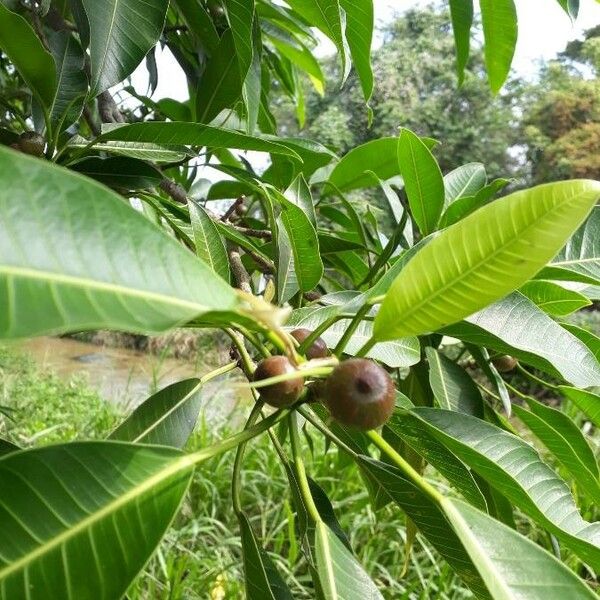
The Ficus maxima, grandly known as the Great Fig, is a towering monarch of the tropical Americas. Often starting its life as an "accidental" resident in the crook of another tree's branch, it eventually sends down massive aerial roots to claim the forest floor. While it lacks the aggressive "strangling" reputation of some of its cousins, its sheer scale and broad, leafy canopy make it a cornerstone of the Amazonian ecosystem.
🔍 How to Identify
- 🍃 The Foliage: Look for large, leathery leaves that are elliptical or oblong in shape. They possess a deep, glossy green hue and can grow quite large, providing dense shade.
- 🌳 The Bark: The trunk is remarkably smooth and ranges from a pale gray to a ghostly white, which stands out vividly against the dark forest understory.
- 🍒 The Fruit: Unlike many figs that grow in clusters, the Ficus maxima usually produces its green, spherical syconia (figs) solitary or in pairs tucked right where the leaf meets the stem.
- 💧 The Sap: If a leaf is broken, the plant exudes a thick, milky white latex, a classic signature of the Ficus family.
🏡 In Your Garden
- 🌱 Space Requirements: In a domestic setting, this "Great Fig" lives up to its name. It is rarely kept as a permanent indoor plant because its root system is incredibly vigorous and can easily overwhelm pots or damage nearby pavement and pipes.
- ☀️ Light & Humidity: This species thrives on "high energy." It craves bright, indirect light and high humidity levels. If the air gets too dry, it may prematurely drop its leaves as a defense mechanism to conserve moisture.
- ✂️ Pruning Nuance: Because it is a rapid grower, regular pruning is necessary if you are keeping it in a large container. However, be mindful that it hates being moved; once it finds a "happy spot" with consistent light, try to leave it there to avoid shock.
⚠️ Safety & Toxicity
- 🐾 Pet Warning: Like most members of the Moraceae family, this plant is toxic to dogs and cats. If ingested, the sap can cause gastrointestinal distress and drooling.
- 🧤 Skin Irritant: The milky latex sap contains enzymes that can cause "ficus dermatitis"—an itchy, red rash—if it gets on your skin. Always wear gloves when pruning or cleaning up fallen leaves.
✨ Fun Fact
The Great Fig has a "soulmate." It relies entirely on a single, specific species of tiny wasp (Tetrapus americanus) for pollination. The wasp enters a small hole in the fig to lay its eggs, and in return, it ensures the tree can produce seeds—a perfect example of a biological "handshake" that has lasted millions of years!

Detailed Care Instructions
To grow Ficus Maxima plant, also known as the Giant-Leaved Fig, you can follow these steps:
- Climate and soil requirements: Ficus Maxima thrives in tropical and subtropical climates. It prefers well-draining soil rich in organic matter.
- Choose a suitable location: Select a spot that receives bright, indirect sunlight to partial shade. It should be protected from strong winds and extreme temperatures.
- Propagation: You can propagate Ficus Maxima through stem cuttings or air layering. Stem cuttings are easier and quicker. Take a cutting of around 6-8 inches in length from the main stem of a healthy plant. Remove the lower leaves and plant the cutting in a container with moist potting soil.
- Watering: Keep the soil consistently moist but not overly saturated. Allow the top inch of soil to dry out between waterings. Avoid overwatering, as it can lead to root rot.
- Fertilization: Apply a balanced, slow-release fertilizer or a liquid fertilizer diluted to half strength once a month during the growing season (spring and summer). Follow the instructions on the fertilizer packaging.
- Pruning: Regular pruning can help maintain the desired shape and size of the plant. Remove any dead or diseased branches. Prune in early spring before new growth begins.
- Support: As Ficus Maxima can grow large and become heavy, you might need to provide support such as stakes or trellises to help it grow upright.
- Pests and diseases: Ficus Maxima is generally resilient to pests and diseases. However, keep an eye out for common houseplant pests like spider mites, mealybugs, or aphids. Treat any infestation promptly with insecticidal soap or neem oil.
- Repotting: Repot the plant when it outgrows its current container. Choose a pot that is 1-2 inches larger in diameter, use fresh potting soil, and ensure proper drainage.
- Care during winter: Ficus Maxima is not frost-tolerant. If you live in a region with cold winters, bring the plant indoors or protect it with frost blankets or other insulation.
Remember to research and understand the specific care requirements of Ficus Maxima to ensure its optimal growth and health.

Place in a window with dappled sun or a spot in the middle of a room. Or directly in a window facing west or east.

To properly water this particular plant, it is important to take into account the specific needs of its species. The plant should be watered deeply, but infrequently, to avoid over-saturating the soil and drowning its roots. The soil should be allowed to dry out almost completely between waterings, but the plant should not be left to completely wilt before being watered again. To determine when the plant needs watering, it is best to check the soil with a finger or moisture meter, and only water when the soil is dry to a depth of one to two inches. When watering, it is important to avoid getting water on the leaves or trunk of the plant, and to use room-temperature water to avoid shocking the roots. Additionally, it is often beneficial to provide drainage holes in the pot or planter where the plant is growing, to prevent water from pooling and causing root rot.
To fertilize this plant, first dilute a water-soluble, balanced fertilizer to half strength. Apply the fertilizer to the soil around the plant once a month during the growing season. Avoid over-fertilizing as it may lead to leaf drop and root damage. Make sure to water the plant thoroughly after fertilizing.
The ideal soil for Ficus Maxima should be well-draining and rich in nutrients. It should have a pH level between 5.5 and 7.5, which is slightly acidic to neutral. Organic matter such as compost, peat moss, or coconut coir can be added to improve soil fertility and moisture retention. The soil should have good aeration to prevent waterlogging and root rot. Avoid using heavy clay soils or those that are prone to compacting, as they can suffocate the roots. The plant prefers slightly moist soil but does not tolerate standing water. It is essential to ensure the soil stays evenly moist to prevent drying out or over-watering.
Ficus Maxima plant can be propagated through a method called air layering. This process involves cutting a small section of the stem of the plant's parent plant, and then applying rooting hormone to the cut area. The stem is then wrapped in moist sphagnum moss and covered with plastic wrap. After several weeks, roots will begin to grow from the cut area and the new plant can be cut away from the parent plant. Another method, propagation through stem cuttings, can also be done by taking a cutting from the parent plant and placing it in water or rooting hormone before planting it in soil. The cutting should be kept moist until roots develop and the new plant can be potted or planted outside.








