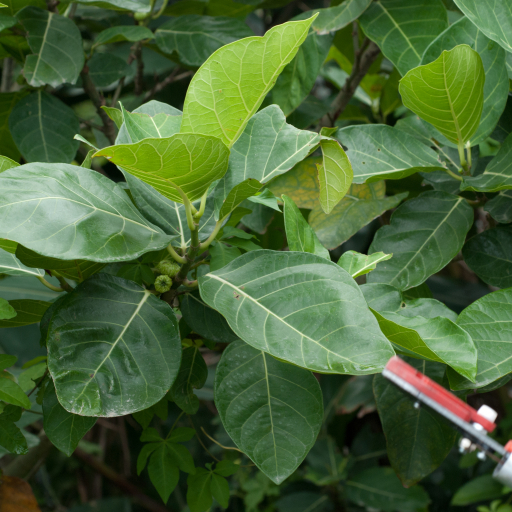
Plant Overview
The Ficus genus, commonly known as "Figs," is a massive family of trees, shrubs, and vines that are the undisputed crown jewels of the indoor plant world. From the massive Banyan trees of the tropics to the architectural Fiddle-leaf Fig found in modern lofts, these plants have been symbols of peace and wisdom for millennia. Whether they are climbing walls or standing tall as floor plants, they bring an undeniable sense of "jungle luxury" to any space.
🔍 How to Identify
- 🍃 Leaf Variety: Depending on the species, leaves can be tiny and heart-shaped (Creeping Fig), thick and rubbery (Rubber Plant), or giant and violin-shaped (Fiddle-leaf Fig).
- 🪵 The "Milk" Test: Almost all Ficus species contain a sticky, white milky sap (latex) that is visible immediately if a leaf is plucked or the bark is nicked.
- 🌳 Growth Habit: Most indoor varieties grow with a distinct woody trunk, often featuring smooth, light-gray bark. Some species even produce "aerial roots" that hang from branches like organic curtains.
🏡 In Your Garden & Home
- ☀️ The "Drama Queen" Reputation: Ficus plants are notorious for being sensitive to change. If you move them to a new room or expose them to a cold draft, they may drop a large portion of their leaves in "protest" before eventually stabilizing.
- 🪴 Humidity Lovers: Because they originate in tropical climates, they crave moisture in the air. Misting their leaves or using a pebble tray helps prevent the leaf tips from turning brown and crispy.
⚠️ Safety & Toxicity
- 🐾 Toxic to Pets: Most Ficus species are toxic to cats and dogs. Ingestion can cause gastrointestinal upset, drooling, and mouth irritation.
- 🧴 Skin Irritant: The milky sap contains enzymes that can cause skin irritation or "phytophotodermatitis" in humans. It is always a good idea to wear gloves when pruning these plants to avoid an itchy rash.
✨ Fun Fact
The "fruit" of a Ficus tree is not actually a fruit in the traditional sense—it is an "inverted flower." The blossoms grow inside the pod, and in the wild, they rely on tiny, specialized wasps to crawl inside a small hole at the base to pollinate them!

Detailed Care Instructions
To grow a Ficus spp. plant, follow these steps:
- Choose the right variety: Ficus plants come in various species, such as Ficus benjamina (Weeping Fig), Ficus elastica (Rubber Plant), Ficus lyrata (Fiddle-Leaf Fig), and more. Research the specific care requirements and choose a variety suitable for your environment.
- Light requirements: Most Ficus plants prefer bright, indirect light. Place them near a window where they can receive filtered sunlight. Avoid direct sunlight as it can scorch the leaves.
- Temperature and humidity: Ficus plants thrive in warm temperatures between 60-75°F (15-24°C). Ensure the plant is protected from drafts and cold air. Higher humidity levels are beneficial, so mist the leaves or use a humidifier if the air is dry.
- Watering: Water the plant when the top inch of soil feels dry. Avoid overwatering as it may lead to root rot. Ensure proper drainage in the pot, and if water accumulates at the bottom, empty the excess.
- Fertilizer: Feed your Ficus plant with a balanced, water-soluble fertilizer every 2-4 weeks during the growing season (spring and summer). Reduce fertilization in fall and winter when growth slows down.
- Pruning and shaping: Prune your Ficus plant to maintain its desired shape and size. Remove any dead or yellowing leaves, and trim leggy branches to encourage fuller growth. You can also shape the plant with regular pruning.
- Repotting: Ficus plants generally require repotting every 2-3 years when they outgrow their current container. Choose a pot slightly larger than the current one, and use well-draining potting soil.
- Pests and diseases: Keep an eye out for common ficus pests like whiteflies, scale insects, and spider mites. Regularly inspect the leaves and treat infestations with appropriate insecticidal soap or oil.
Remember, different species of Ficus may have specific care requirements, so it's advisable to research and understand the needs of your particular plant.
The Ficus Spp. plant should be watered thoroughly, ensuring that the soil is moist but not waterlogged. Allow the top layer of soil to dry out before watering again, as the plant does not tolerate overwatering. Emphasis should be placed on avoiding waterlogging, as standing water in the soil can lead to root rot, stunting growth and eventually killing the plant. Water less frequently during cooler months and increase watering during warm periods, while avoiding wetting the foliage.
To fertilize this plant, use a balanced fertilizer with equal parts nitrogen, phosphorus, and potassium. Apply the fertilizer once a month during the growing season, which is typically spring and summer. Mix the fertilizer with water according to the package directions and pour it over the soil. Be sure not to over-fertilize, as this can lead to burn or damage to the roots. In the winter months, reduce or stop fertilization altogether as the plant goes into a period of rest.
Ficus spp. plants thrive in well-draining soil that is rich in organic matter. The soil should have good aeration to allow for proper root growth and should also be able to retain moisture without becoming waterlogged. A soil mixture that is composed of equal parts peat moss, perlite, and coarse sand works well for Ficus spp. plants. The peat moss provides organic matter and helps retain moisture, while the perlite and sand provide good drainage. It is also recommended to use a slightly acidic soil with a pH between 6.0 and 7.0. The soil should be kept consistently moist, but not waterlogged, and the plant should be fertilized regularly during the growing season to promote healthy growth.
Propagation method for Ficus Spp. plant can be done through stem cutting, air layering or seed germination.
For stem cutting, cut a section of the stem about 6 inches long from a parent plant. Remove the lower leaves and any flowers or buds. Dip the cut end of the stem in rooting hormone powder. Plant the stem cutting in a pot filled with a well-draining soil mix, and keep the soil moist. Place the pot in a well-lit area, but not in direct sunlight. In about three to four weeks, roots should start to form. Once the roots are visible, the plant can be transplanted into a larger pot or into the ground.
Air layering is another propagation method that can be used for Ficus Spp. plant. Select a healthy stem and make two cuts, about an inch apart and one-third of the way through the stem. You want a groove big enough to accommodate some rooting hormone powder. Dust the cut groove with rooting hormone powder and wrap it in plastic wrap, sealing the plastic wrap tightly around the stem. After a few weeks, roots should form in the groove. Cut the stem just below the groove and plant it in a pot filled with a well-draining soil mix. Keep the soil moist until established.
Seed germination is another propagation method used for Ficus Spp. plant. Collect ripe fruit and remove the pulp from around the seeds. Rinse the seeds with water and let them dry on a paper towel. Once dry, plant them in a pot filled with a well-draining soil mix, and keep the soil moist. Place the pot in a well-lit area but not in direct sunlight. After a few weeks, seedlings should appear, and they can be transplanted into a larger pot or into the ground once they have grown a few leaves.







