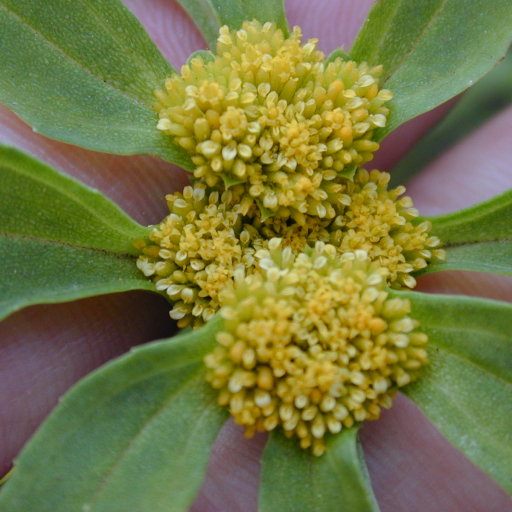
Plant Overview
Often called the Clustered Yellowtop or "Speedyweed," Flaveria trinervia is a sun-loving pioneer known for its ability to colonize disturbed ground in the blink of an eye. Native to the Americas, it tells a story of survival, using advanced biological "engines" to thrive in intense heat where other plants might wilt. While it might look like a simple wildflower, it is a master of efficiency.
🔍 How to Identify
- 🍃 The Three Veins: As the name trinervia suggests, the most reliable way to identify this plant is by looking at the leaves. Each leaf features three very distinct, prominent veins running from the base toward the tip.
- 🌼 Clustered Blooms: Unlike a typical daisy, its flowers are tiny, vibrant yellow heads packed tightly together in dense, flat-topped clusters at the ends of the branches.
- 🌿 Saw-Toothed Edges: The leaves grow opposite one another along the stem and feature small, sharp "teeth" along the margins, giving the foliage a rugged, serrated texture.
🏡 In Your Garden
- ☀️ The Sun Specialist: This plant is a "C4 plant," meaning it has a specialized internal metabolism to handle extreme heat and dry spells. If it’s popping up in your yard, it’s likely claimed the sunniest, most exposed spot where the soil gets baked.
- 🌱 The Opportunist: You’ll rarely find it in a thick, established forest. It prefers "new" or disturbed soil—think garden edges, gravel paths, or freshly tilled beds. Because it grows so fast, it can quickly crowd out smaller, slower-growing seedlings.
⚠️ Safety & Toxicity
- 🐾 Low Risk / Non-Edible: Flaveria trinervia is generally not considered highly toxic to humans or common household pets. However, it is not a culinary herb and should not be consumed.
- 🚜 Agricultural Nuisance: While safe to touch, it is often labeled a "noxious weed" in farming communities because it can outcompete crops for nitrogen and water. If you have a vegetable patch, it’s best to remove it before it goes to seed.
✨ Fun Fact
Scientists view the Flaveria genus as an "evolutionary laboratory." Because different species within this family are at different stages of evolving more efficient photosynthesis, researchers study them to learn how we might "supercharge" food crops like rice to grow better in a warming world!

Detailed Care Instructions
To grow Flaveria trinervia, also known as three-vein yellowtops or coyote tobacco, follow these steps:
- Climate and soil requirements: Flaveria trinervia prefers warm climates and well-draining soil. It grows well in regions with full sun exposure.
- Selecting seeds: Obtain Flaveria trinervia seeds either from a nursery or through online sources. If collecting seeds from the wild, ensure it is legal and follow local regulations.
- Seed propagation: Start by scarifying the seeds, which involves scratching the hard seed coat gently to promote germination. Then, soak the seeds overnight in water to aid in softening the coat further. This mimics natural processes that occur in the wild. Alternatively, seeds can be planted without scarification, but they may take longer to germinate.
- Germination: Plant the scarified seeds in a small pot or seed tray filled with a well-draining, sandy soil mix. Cover the seeds lightly with soil and water gently. The optimal germination temperature is around 70°F (21°C).
- Transplanting: Once the seedlings are about 2-3 inches (5-7.5 cm) tall, transplant them into individual pots or directly into the garden. Ensure there is enough space between plants to allow for their growth.
- Watering: Flaveria trinervia prefers moderate watering. Water the plant whenever the top inch of soil feels dry. Avoid overwatering to prevent root rot.
- Fertilization: Apply a balanced, slow-release fertilizer according to the manufacturer's instructions. However, Flaveria trinervia can typically survive in nutrient-poor soils as well.
- Pruning: Flaveria trinervia may benefit from occasional pruning to maintain its shape and encourage branching. Prune after flowering has finished, cutting back any dead or damaged growth.
- Pest management: Keep an eye out for common pests such as aphids or whiteflies. If necessary, use organic or chemical insecticides to control infestations.
- Harvesting seeds: Flaveria trinervia produces seeds after flowering. Allow the flowers to dry out completely, and then collect the seeds. Store them in a cool, dry place or propagate them for future plantings.
Remember to research specific growing requirements for your specific geographic location, as conditions may vary.

Place in a bright room that is sun drenched almost all day. Or directly in a south-facing window.

To water this plant, you should first check the soil moisture by inserting your finger about 1-2 inches into the soil. If it feels dry, it's time to water. Give the plant a thorough watering, making sure the soil is evenly saturated. Avoid getting water on the leaves as this can cause damage and encourage fungal growth. Water less frequently during cooler months and increase frequency during warmer months. Overwatering can lead to root rot, so be sure to allow the soil to dry out slightly between waterings.
- Choose a balanced fertilizer with equal amounts of nitrogen, phosphorus, and potassium.
- Dilute the fertilizer by half according to the package instructions.
- Water the plant thoroughly before applying the fertilizer.
- Apply the diluted fertilizer around the base of the plant, avoiding contact with the foliage.
- Repeat the application once a month during the growing season, typically spring to fall.
- Water the plant after fertilizing to ensure the nutrients reach the roots.
- Avoid fertilizing during the dormant season, typically winter, as the plant will not be actively growing.
For optimal growth and development for the plant, it is recommended to use a well-draining soil mix that is slightly acidic with a pH range between 6.0-6.8. The soil should be rich in organic matter and have good moisture-holding capacity to support the growth of the plant's roots. A soil mix that contains peat moss, perlite, and vermiculite is ideal for this plant. Additionally, adding a slow-release fertilizer to the soil mix will provide the necessary nutrients for the plant's growth. It is also important to avoid using soil mixes that contain high levels of salts or heavy metals, as these can be harmful to the plant's growth and health.
Flaveria Trinervia plant can be propagated through stem cuttings. To do this, select a healthy stem and cut a section about 4-6 inches long. Remove all the leaves from the lower half of the stem.
Dip the cut end of the stem into rooting hormone powder to encourage root growth. Then, plant the stem cutting in a pot filled with a well-draining soil mixture. Make a hole in the soil with a pencil and place the stem cutting in the hole, ensuring that at least half the stem is buried in the soil.
Water the soil well and cover the pot with a plastic bag or plastic wrap to create a humid environment. Place the pot in a bright location but not direct sunlight.
Keep the soil moist and check for visible roots in a few weeks. Once the roots have formed, remove the plastic bag and move the plant to a larger pot or outside to a garden bed if desired.








