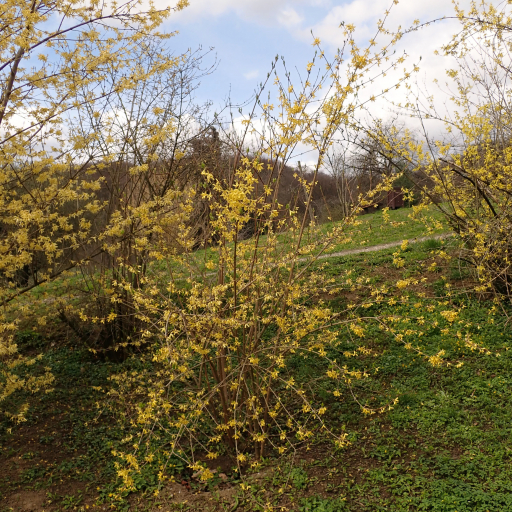
Plant Overview
Known as the Early Forsythia or Korean Forsythia, this cheerful shrub is often the very first herald of spring in temperate gardens. While other plants are still shivering in their winter dormancy, Forsythia ovata explodes into a cloud of sunshine-yellow blossoms. Native to the Korean Peninsula, it is prized by gardeners for being significantly more cold-hardy than its larger, more common relatives.
🔍 How to Identify
- 🌼 Golden Blooms: It features small, four-petaled, bell-shaped flowers that appear in early spring before the leaves even emerge.
- 🍃 Ovate Leaves: True to its name (ovata), the leaves are broader and more egg-shaped than other Forsythia varieties, often featuring sharply serrated edges.
- 🌿 Compact Habit: Unlike the wild, sprawling branches of the F. x intermedia, this species stays more rounded and bushy, reaching about 4–5 feet in height.
🏡 In Your Garden
- ❄️ The Cold Specialist: Because it originates from mountainous regions, it is the best choice for northern gardeners; its flower buds can survive harsh frosts that would kill the blooms on other varieties.
- ✂️ The Pruning Rule: To keep it looking its best, always prune immediately after the flowers fade. Since it blooms on "old wood," cutting it in winter will accidentally remove all of your spring color.
- ☀️ Sun Seeker: While it can survive in partial shade, you’ll get the most dramatic "wall of gold" effect if it is planted in full, direct sunlight.
⚠️ Safety & Toxicity
- 🟢 Non-Toxic: Forsythia ovata is generally considered non-toxic to humans, dogs, and cats. It is a very "safe" choice for family landscapes.
- 👅 Mild Irritation: While not poisonous, the plant is not a food crop. Ingesting large amounts of the leaves or flowers may cause a minor stomach ache or nausea in curious pets or toddlers.
✨ Fun Fact
The genus Forsythia was named in honor of William Forsyth, a Scottish botanist who was the royal head gardener for King George III and a founding member of the Royal Horticultural Society!

Detailed Care Instructions
To successfully grow a Forsythia Ovata plant, follow these steps:
- Location: Choose a sunny spot in your garden where the plant can receive full sun for at least six hours a day. Forsythia Ovata can tolerate partial shade but tends to flower less in shaded areas.
- Soil: The plant prefers well-draining soil that is rich in organic matter. Before planting, amend the soil with compost or well-rotted manure to improve fertility and drainage.
- Planting: Dig a hole that is wide and deep enough to accommodate the plant's root ball. Place the Forsythia Ovata in the hole, ensuring that the top of the root ball is level with or slightly above the soil line. Backfill the hole with soil, gently firming it around the roots.
- Watering: Water the newly planted Forsythia Ovata thoroughly, ensuring that the soil is evenly moist but not waterlogged. Water the plant regularly, especially during dry spells, for the first year until it becomes established.
- Mulching: Apply a layer of organic mulch, such as wood chips or straw, around the base of the plant. Mulching helps to conserve moisture, suppress weed growth, and regulate soil temperature.
- Pruning: Forsythia Ovata blooms on old wood, meaning the flower buds develop on the previous year's growth. Prune the plant immediately after flowering to shape it and remove any dead, damaged, or overcrowded branches. Avoid pruning in late summer or fall, as this will remove the flower buds for the following spring.
- Fertilization: Apply a balanced slow-release fertilizer in early spring to encourage healthy growth and abundant blooms. Follow the manufacturer's instructions for dosage and application.
- Pest and disease control: Forsythia Ovata is generally resistant to most pests and diseases. However, it's always a good idea to monitor the plant for any signs of insect infestation or disease, such as aphids or powdery mildew, and address them promptly if detected.
- Propagation: You can propagate Forsythia Ovata through hardwood cuttings taken in late summer or early fall. Dip the cut end of the cutting in rooting hormone, plant it in a well-draining potting mix, and keep it in a warm, moist environment until roots develop.
By following these steps and providing adequate care, you will be able to successfully grow a flourishing Forsythia Ovata plant in your garden.

Place in a bright room that is sun drenched almost all day. Or directly in a south-facing window.

Forsythia Ovata plant requires regular watering to maintain its health and growth. It is important to water the plant deeply but infrequently, allowing the soil to dry out slightly before the next watering. One way to check if the plant needs water is by inserting your finger into the soil up to the first knuckle. If the soil feels dry, it is time to water the plant.
When watering, it is important to avoid getting the leaves wet as this can promote fungal growth. Instead, direct the water towards the base of the plant and the soil. In addition, it is best to water early in the morning or late in the afternoon to prevent the water from evaporating too quickly in the heat of the day.
It is also important to ensure good drainage to prevent the plant from sitting in water, which can lead to root rot. This can be achieved through the use of well-draining soil and by ensuring that the plant is not located in a low-lying area where water may collect.
Overall, to water Forsythia Ovata plant effectively, you should water deeply but infrequently, avoid getting the leaves wet, water early in the morning or late in the afternoon, and ensure good drainage.
To fertilize this plant, it is recommended to use a slow-release granular fertilizer with a balanced N-P-K ratio in the early spring before new growth appears. Apply the recommended amount evenly around the base of the plant and water thoroughly. Avoid fertilizing after mid-summer to prevent new growth that may be damaged by frost in the fall.
The ideal soil for the Forsythia Ovata plant is well-draining and moist, yet not waterlogged. It should be rich in organic matter, such as compost or leaf mulch, and have a slightly acidic pH level between 5.5 and 6.5. The plant prefers a soil that is not too heavy, so sandy loam or loamy soil is recommended. It can tolerate light clay, but heavy clay should be avoided as it can lead to root rot. Amending the soil with organic matter can also help improve soil structure and fertility to better support the growth of the Forsythia Ovata plant.
To propagate this plant, you can take spring stem cuttings with a length of about 4-6 inches. Remove the leaves from the bottom half of the stem and dip the cut end in rooting hormone. Plant the cutting in a pot with a well-draining soil mixture and keep it in a warm and humid environment. Water the cutting regularly and make sure it receives indirect sunlight. In about 3-4 weeks, the cutting should start to develop roots and can be transplanted into a larger pot or directly into the ground.








