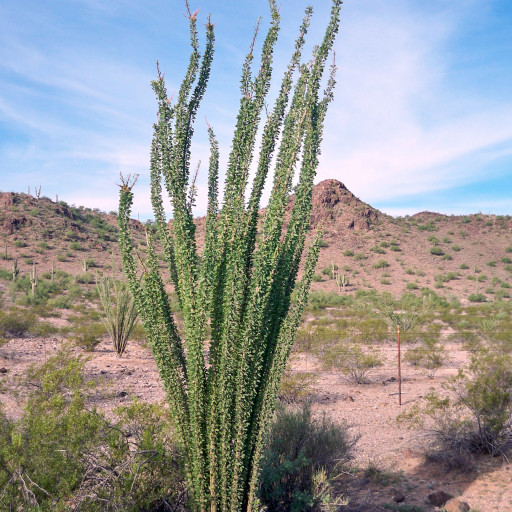
Plant Overview
Known as the "Coachwhip," "Jacob’s Staff," or "Vine Cactus," the Ocotillo is one of the most striking silhouettes of the American Southwest. Despite its thorny appearance, it isn't actually a cactus; it is a unique desert shrub that has mastered the art of the "quick change." For most of the year, it looks like a collection of dry, dead sticks, but a single desert rain can transform it into a lush, green wand in a matter of days.
🔍 How to Identify
- 🌵 Whip-like Stems: Long, unbranched, grayish-green canes that fan out from a central base, sometimes reaching heights of 20 feet.
- 🍃 Ephemeral Leaves: Small, teardrop-shaped green leaves that sprout directly from the stems after rainfall. These leaves are "drought-deciduous," meaning they drop off as soon as the soil dries to conserve water.
- 🔥 Fiery Blooms: Brilliant, tubular red-orange flowers that grow in dense clusters (panicles) at the very tips of the stalks, usually appearing in late spring.
🏡 In Your Garden
- 🏜️ The Need for Speed: In a garden setting, the Ocotillo requires exceptional drainage. It evolved on rocky desert slopes, so it hates "wet feet." If your soil is heavy clay, plant it in a raised mound of sandy or gravelly mix to prevent root rot.
- 🧱 Living Fences: One of the most traditional uses for Ocotillo is the "living fence." Stems are planted close together in a row; because they root easily from cuttings, they eventually grow into a formidable, leafy, and flowering wall that provides both beauty and security.
⚠️ Safety & Toxicity
- ⚔️ Physical Hazard: The Ocotillo is not known to be chemically toxic to humans or pets. However, the stems are armored with very sharp, stiff spines that can cause painful punctures.
- 🛡️ Placement is Key: Avoid planting this near walkways, playgrounds, or narrow paths. It is best used as a focal point in the back of a landscape bed where its thorns won't catch on clothing or skin.
✨ Fun Fact
🐦 The Hummingbird Express: The Ocotillo’s blooming cycle is perfectly synchronized with the northward migration of hummingbirds. Its bright red, nectar-rich tubes are the perfect shape for a hummingbird’s beak, making this plant a vital "refueling station" for birds traveling across the arid desert.

Detailed Care Instructions
| Lighting | Full Sun |
| Hardiness Zones | Min 8A |
Here are some tips on how to grow Fouquieria splendens, commonly known as the ocotillo plant:
- Climate: Ocotillo plants thrive in arid and semi-arid regions. They are native to the southwestern United States and northern Mexico. Make sure you have the appropriate climate to support their growth.
- Sunlight: These plants require full sun exposure for at least six hours a day. Choose a location in your garden where they can receive ample sunlight.
- Soil: Ocotillo plants prefer well-draining soil. Sandy or rocky soil with good drainage is ideal. Avoid heavy clay soils, as they can cause root rot.
- Watering: While ocotillo plants are drought-tolerant once established, they require regular watering during their first year to establish their root system. Water deeply once a week during hot and dry periods, allowing the soil to dry out between waterings. Reduce watering during cooler months.
- Pruning: Ocotillo plants have long, spiny stems that can reach up to 15 feet tall. Prune the stems to create a desired shape or to remove dead or damaged branches. Pruning is typically done in late winter or early spring before new growth begins.
- Fertilizer: These plants do not require frequent fertilization. Apply a balanced, slow-release fertilizer once or twice a year in early spring and early summer.
- Propagation: Ocotillo plants can be propagated through stem cuttings. Take a stem cutting of about 6-8 inches long and plant it in well-draining soil. Keep the soil slightly moist until the cutting establishes roots and starts growing.
- Pests and diseases: Ocotillo plants are relatively resistant to pests and diseases. However, they can occasionally be affected by scale insects or spider mites. Inspect your plant regularly and treat any pest infestations promptly using appropriate insecticidal soap or horticultural oil.
Remember, ocotillo plants are slow-growing, and it may take a few years for them to reach their full height and lush appearance. Be patient and provide the necessary care for optimal growth.

Place in a bright room that is sun drenched almost all day. Or directly in a south-facing window.

Fouquieria Splendens is a desert plant with a specific watering requirement. It is important to allow the soil to dry out completely between watering. Over-watering can lead to root rot and fungal diseases. It is best to water deeply but infrequently. When watering, direct the water towards the base of the plant rather than the leaves. Watering early in the morning or late in the evening will help reduce evaporation and ensure that the plant can absorb the water. During hot weather, the plant may require more frequent watering to prevent wilting. It is important to monitor the soil moisture level and adjust watering frequency accordingly.
To properly fertilize this plant, you should use a balanced fertilizer with equal parts nitrogen, phosphorus, and potassium. Apply the fertilizer during the growing season, which is typically in the spring and summer months. Mix the fertilizer with water according to the manufacturer's instructions and apply it to the soil around the base of the plant. Be sure not to over-fertilize as this can damage the plant and make it more susceptible to disease and pests.
The ideal soil to use for the Fouquieria Splendens plant should have a well-draining texture with a pH level that is slightly acidic to neutral. The soil mix should be porous and allow proper aeration to avoid waterlogged soil. Sand or perlite can be added to the soil mix for better drainage, and organic matter such as peat moss or compost can be added to improve soil fertility. The soil must also be able to retain enough moisture to keep the roots hydrated without causing waterlogging. The plant grows well in soil that is slightly dry but not bone dry. When watering, one should ensure that the soil is moist to the touch, but not waterlogged. Adding a layer of mulch around the plant can help maintain moisture and prevent weeds from growing.
To propagate this plant, you will need to take stem cuttings in the spring or fall. Choose healthy, non-flowering stems and cut them at an angle with a sharp, clean pair of pruning shears. The cuttings should be about 4-6 inches long and have at least 2-3 sets of leaves.
Remove any leaves from the lower half of the stem and dip the cut end in rooting hormone powder. Insert the cutting into a pot filled with a well-draining soil mixture, such as a mix of perlite and peat moss.
Water the cutting and cover with a plastic bag to create a humid environment. Place the pot in a bright, warm location but out of direct sunlight. Mist the cutting regularly to keep the soil moist but not waterlogged.
After a few weeks, the cutting should start to root. You can gently tug on the stem to check for resistance, which indicates that roots have formed. Once the cutting has established roots, you can remove the plastic bag and begin to fertilize the new plant.
Transplant the new plant into a larger pot or into the garden once it has outgrown its current container. Keep the soil moist and provide plenty of light to help the plant grow and thrive.
Common pests of the ocotillo include Scale insect, mealybugs, spider mites. Make a habit of checking your ocotillo frequently for pests so that any infestations can be caught and managed early.








