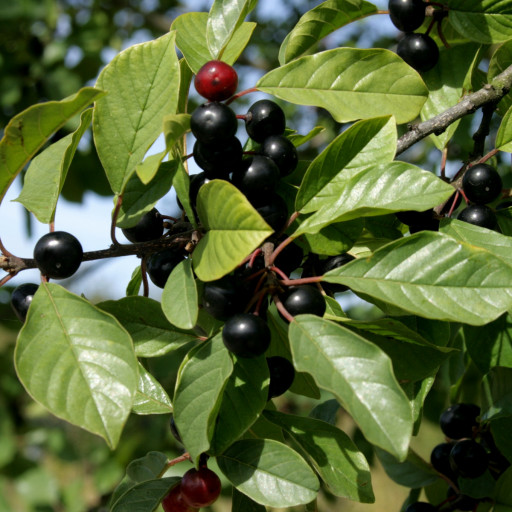
Plant Overview
Often called "Glossy Buckthorn" or "Breaking Buckthorn," this elegant deciduous shrub is a staple of European wetlands and damp woodlands. While it might look like a simple hedge plant, it carries a storied history involving everything from medieval medicine to high-grade explosives. Its most charming feature is the "stoplight" effect of its berries, which transition through green, red, and black all at once on a single branch.
🔍 How to Identify
- 🍃 The Glossy Leaf: Look for oval, dark green leaves with a polished sheen. Unlike many other shrubs, the veins are prominent and parallel, curving gently toward the leaf tip.
- 🍒 Multicolor Berries: It is famous for having fruit in various stages of ripeness simultaneously. You will often see green, bright red, and deep purple-black berries clustered together in late summer.
- 🪵 Spotted Bark: The bark is dark greyish-brown and marked with small, horizontal white dashes called "lenticels," which help the plant breathe.
- 🌼 Subtle Blooms: In late spring, look for tiny, star-shaped greenish-white flowers tucked into the base of the leaves; they are small but a favorite for honeybees.
🏡 In Your Garden
- 💧 Moisture Lover: Naturally found in fens and marshes, this plant thrives in wet, acidic soil. It is an excellent choice for those "boggy" corners of a yard where other plants might suffer from root rot.
- 🦋 The Brimstone Connection: If you want to see the vibrant yellow Brimstone butterfly, plant this! It is one of the few host plants where the butterfly will lay its eggs and the caterpillars will feed.
- ✂️ Brittle Character: Its nickname "Breaking Buckthorn" comes from its very brittle wood. Avoid planting it in high-traffic areas where people or pets might frequently bump into it, as the branches snap easily.
⚠️ Safety & Toxicity
- 🚫 Strong Purgative: All parts of the plant, especially the bark and raw berries, contain chemicals called anthraquinones. If ingested, these cause severe vomiting and intense stomach cramps.
- 🐾 Pet & Child Risk: The colorful berries can be tempting to children. Ensure they are educated to avoid them, and keep an eye on pets, as the berries can cause significant gastrointestinal distress in dogs and cats.
✨ Fun Fact
For centuries, the wood of the Alder Buckthorn was the most sought-after material for making charcoal. This specific charcoal was so high in quality that it was used to create the finest "brown gunpowder" for military artillery and time-fuses.

Detailed Care Instructions
| Humidity | Normal |
| Toxicity | Poisonous |
| Difficulty | Medium |
| Temperature | 14°C - 24°C |
| Hardiness Zones | 3 - 7 |
To grow Frangula Alnus plant, also known as Alder Buckthorn or Glossy Buckthorn, follow these steps:
- Choose a suitable location: Frangula Alnus prefers full sun to partial shade. Ensure that the soil is well-draining and fertile.
- Planting: The best time to plant Frangula Alnus is in spring or early fall. Dig a hole slightly larger than the root ball of the plant. Place the plant in the hole and backfill with soil, ensuring that the top of the root ball is level with the ground surface. Tamp down the soil gently around the plant.
- Watering: Provide regular watering to establish the plant. Keep the soil consistently moist, but not waterlogged. Reduce watering once the plant is established, as Frangula Alnus is moderately drought-tolerant.
- Mulching: Apply a layer of organic mulch around the base of the plant to help conserve moisture and suppress weed growth.
- Pruning: Prune Frangula Alnus in late winter or early spring to shape the plant and remove any dead or damaged branches. This plant can be pruned quite hard if necessary.
- Fertilizing: Frangula Alnus generally does not require excessive fertilization. However, if the soil is poor or lacking in nutrients, you can apply a slow-release fertilizer in early spring.
- Maintenance: Regularly monitor the plant for pests and diseases. Treat any issues promptly to keep the plant healthy. Also, remove any suckering shoots that appear around the base of the plant to prevent it from spreading excessively.
- Propagation: Frangula Alnus can be propagated from seeds or cuttings. Seeds need stratification, which involves a period of cold treatment before sowing. Softwood cuttings can be taken in spring or hardwood cuttings in winter.
Remember to check if Frangula Alnus is invasive in your area before planting, as it can be considered invasive in some regions.

Place in a window with dappled sun or a spot in the middle of a room. Or directly in a window facing west or east.

To water the plant with scientific name Frangula Alnus, first check the soil moisture level by inserting your finger up to the knuckle into the soil. If the soil feels dry, water the plant until water comes out of the drainage holes. If the soil is moist, wait a few days before checking again. Avoid overwatering as it can lead to root rot. Ensure that the pot has proper drainage to prevent waterlogging. Water the plant in the morning or evening to prevent evaporation and water stress during the hottest time of the day. Use room temperature water rather than cold water to prevent shock to the plant.
For optimal growth and health, it is recommended to fertilize your Frangula Alnus plant during the early spring months. Use a balanced fertilizer with equal amounts of nitrogen, phosphorus, and potassium. Apply the fertilizer evenly around the base of the plant, taking care not to get any on the leaves or stems. Water the plant thoroughly after applying the fertilizer. Repeat this process every four to six weeks throughout the growing season. Avoid fertilizing during hot or dry weather conditions, as this can damage the plant. Always follow the instructions on the fertilizer packaging and use gloves and protective clothing as needed.
Frangula alnus requires a well-draining soil mixture that is rich in organic matter. It thrives in a soil that is moderately moist but not waterlogged. The ideal soil pH for this plant is between 5.5 and 7.5. It is important to avoid heavy clay or sandy soils as they can hinder growth and development. When planting, it is recommended to loosen the soil around the roots and add a layer of compost or leaf litter to promote healthy growth.
Frangula Alnus can be propagated through several methods including seed propagation, layering, and hardwood cuttings.
Seed propagation involves collecting the small black fruits in the fall, removing the outer flesh, and planting the seeds in a moist and well-drained soil. Plants grown from seed can take several years to mature and begin producing fruit.
Layering is the process of bending a young, flexible branch down to the ground and securing it in place with a stake or rock. A small cut is then made on the underside of the branch where it touches the soil, and a small amount of rooting hormone can be applied to encourage root growth. Once roots have formed, the branch can be cut from the parent plant and transplanted to a new location.
Hardwood cuttings can also be taken in the late fall or early winter. Cuttings should be approximately 6-8 inches long and taken from the previous season's growth. Remove all but the top few leaves and dip the cut end in rooting hormone before planting the cutting in a well-draining soil and keeping it moist. Place the cutting in a sheltered location and it should develop roots by the following spring.








