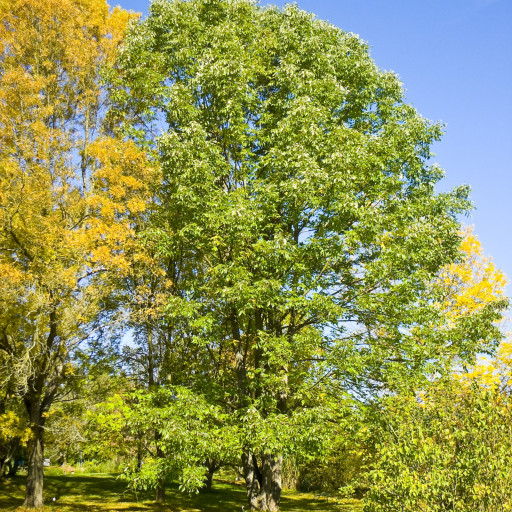
Plant Overview
Commonly known as the White Ash, this majestic giant is the backbone of North American forests and the secret ingredient behind professional sports history. Often called the "Biltmore Ash," it is the primary wood used to craft Major League baseball bats due to its incredible strength and flexibility. In the autumn, it steals the show by turning a stunning shade of deep purple or bronze-gold before the leaves fall.
🔍 How to Identify
- 🌿 Opposite Branching: Unlike many other trees, the White Ash has branches and leaves that grow directly across from one another in pairs, rather than alternating.
- 🍃 Compound Leaves: Each leaf is made up of 5 to 9 individual leaflets; look closely at the underside—the White Ash is named for the distinct, pale whitish-green color beneath the leaf.
- 💎 Diamond Bark: As the tree matures, the bark develops a very recognizable pattern of deep, interlocking ridges that form neat diamond shapes.
🏡 In Your Garden
- 🌳 Space Requirements: This is a "legacy tree" that can grow up to 80 feet tall. It is best suited for large yards or parks where its expansive root system won't interfere with foundations or sidewalks.
- 🛡️ The EAB Watch: The biggest challenge for this plant is the Emerald Ash Borer (EAB). If you are planting one, you must be prepared for preventative treatments, as this invasive beetle has devastated wild populations across the continent.
- 💧 Soil Preference: It loves deep, moist, and well-drained soils. While it is relatively hardy, it dislikes extremely dry, sandy sites and prefers to have "cool feet" provided by a layer of organic mulch.
⚠️ Safety & Toxicity
- ✅ Pet & Human Safe: The White Ash is generally considered non-toxic to dogs, cats, and horses, making it a safe choice for family environments.
- 🤧 Pollen Potential: Because it is wind-pollinated, male trees can release a significant amount of pollen in the spring, which may be a nuisance for those who suffer from seasonal hay fever.
✨ Fun Fact
- ⚾ The "Louisville Slugger" Legacy: White Ash wood is "ring-porous," meaning it has a unique cellular structure that allows it to absorb the shock of a 90mph fastball without shattering, which is why it has been the gold standard for baseball bats for over a century!

Detailed Care Instructions
Provided it can remain free of emerald ash borer and other pest and disease issues, a white ash tree can live for more than two centuries, achieving a height of 100 feet or more. But should your tree become stricken with emerald ash borer, it will likely survive no more than three to five years after infestation begins.
Is there another tree species that is recommended instead of ash?
Though they were once similarly devastated by Dutch elm disease, elms are now available in cultivars that have near-perfect resistance to that disease. With a growth rate and growth habit that is similar to ash, these elms are now good choices for locations where ash trees were once the recommended species.
How bad is emerald ash borer?
Very bad indeed. After appearing in 2002, the insect has spread to more than 35 states. Once it arrives in an area where the ash population is dense, it usually kills as much as 99 percent of the ash trees within a decade. It's strongly recommended not to plant this tree at the present time—the more ash trees that are present, the faster the insect can spread.
How effective are chemical treatments to prevent EAB?
Preventive treatment with a systemic chemical pesticide such as emamectin benzoate can help prevent a tree from succumbing to emerald ash borer if treatment is begun early enough—before a tree is infected and if the treatment is repeated every other year. But the cost of each treatment can be hundreds of dollars, and in an area where EAB has already gained a foothold, your tree may be living on borrowed time no matter what you do.That said, a healthy tree that is treated every other year by a professional can hold off EAB for a considerable length of time—enough time for a replacement tree of a different species to get a good start, for example. But be wary of any business that guarantees they can prevent EAB on any particular tree.
Are there any ash tree species or varieties that are resistant to EAB?
EAB affects virtually all native North American ash species, including green ash, white ash, and red ash. But some recently developed cultivars are showing some resistance to the insect, as are some species of Asian ashes and hybrids created by crossing North American with Asian species. Future years may see ash trees once more used as urban shade trees, but at this time, it is recommended to avoid planting any ash trees.
To grow Fraxinus Americana, also known as the American ash tree, you can follow the steps below:
- Choose the right location: American ash trees prefer full sun to partial shade and well-draining soil. Make sure the area has enough space for the tree to grow to its full size.
- Prepare the soil: Before planting, dig a hole that is two times wider than the root ball and of equal depth. Mix organic matter, such as compost, into the soil to improve its fertility and drainage.
- Planting: Place the root ball in the hole and fill it with soil, firming it gently to remove air pockets. Water the tree thoroughly to settle the soil around the roots.
- Watering: Keep the soil consistently moist, especially during the first few years of growth. Water deeply once a week, providing enough water to saturate the soil to a depth of 6-8 inches. Reduce watering during periods of heavy rainfall.
- Mulching: Apply a layer of organic mulch, such as wood chips or bark, around the base of the tree. This will help retain moisture, suppress weeds, and improve soil quality. Keep the mulch a few inches away from the trunk to prevent moisture-related issues.
- Pruning: Regular pruning is not necessary for American ash trees, but you can occasionally remove any dead, damaged, or overcrowded branches. Prune during the dormant season to avoid stressing the tree.
- Fertilizing: Apply a slow-release balanced fertilizer in the early spring to provide essential nutrients. Follow the manufacturer's instructions regarding the application rate.
- Pest and disease control: Monitor the tree for common ash tree pests, such as the emerald ash borer or fungal diseases. Consult with a local arborist or horticulturist if you notice any signs of infestation or disease.
- Winter protection: Young American ash trees may need winter protection from frost or extreme cold. Consider wrapping the trunk with burlap or providing a protective cover to prevent winter damage.
- Patience: Growing a tree takes time, so be patient and allow the American ash tree to mature and establish its roots. With proper care, it will grow into a majestic and beautiful specimen.
Remember to check with your local agricultural extension or nursery for any additional care guidelines specific to your region, as climate and soil conditions vary.

Place in a bright room that is sun drenched almost all day. Or directly in a south-facing window.

To properly water this plant, first, you need to check the moisture level of the soil by inserting your finger into the soil up to the second knuckle. If the soil is dry at this level, it is time to water the plant.
When watering, use a watering can or hose with a soft spray attachment to gently water the soil around the plant until the water starts to run off. Be sure to avoid getting water on the leaves as this can cause them to rot.
It is important to avoid overwatering this plant as it can lead to root rot. Allow the soil to dry out slightly between watering to prevent this from happening.
If the plant is planted in a container, be sure to check the drainage holes to ensure that excess water can escape properly. Otherwise, the plant might drown in the stagnant water.
To properly fertilize this particular plant, you will want to use a balanced fertilizer with equal parts of nitrogen, potassium, and phosphorus. It is recommended to apply this fertilizer during the early spring, before new growth starts. You will want to use a slow-release fertilizer and apply it evenly around the base of the plant. Be sure not to apply it too close to the trunk or stems as this can cause damage. Additionally, be sure to water the plant thoroughly after fertilizing to help the nutrients soak into the soil.
Fraxinus Americana plants prefer to grow in well-draining soil that is rich in organic matter. The soil should be slightly acidic to neutral, with a pH range of 6.0 to 7.5. Soil that is too alkaline can lead to nutrient deficiencies and hinder the growth of the plant. Sandy loam or loamy soil with good aeration is ideal for Fraxinus Americana plants. Compacted or heavy clay soil should be amended with organic matter, such as compost, to improve the soil structure and drainage. It is important to ensure that the soil is not waterlogged as excess moisture can lead to root rot and other diseases. Adding a layer of mulch around the base of the plant can help to retain moisture in the soil and suppress weed growth.
One way to propagate this plant is through hardwood cuttings. Select a healthy branch from the tree during the dormant season and make a cutting about 6-8 inches long. Make a straight cut at the bottom of the cutting and a slanted cut at the top. Remove all the leaves except a few at the top.
Dip the cut end in rooting hormone and plant it in a pot filled with well-drained soil. Keep the soil moist but not waterlogged and place the pot in a bright, indirect light.
After a few weeks, check the cutting for roots by gently tugging on it. If it resists, roots have formed. Wait a few more weeks for the plant to establish before transplanting it to its permanent location.
Common pests of the white ash include Spider mites, thrips, larvae. Make a habit of checking your white ash frequently for pests so that any infestations can be caught and managed early.








