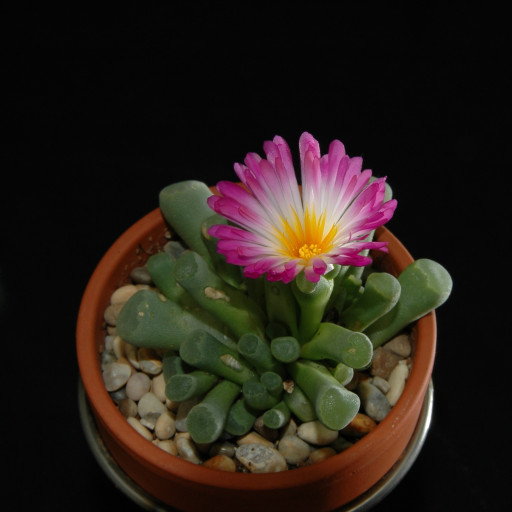
Plant Overview
Often called "Fairy Elephant’s Feet," Frithia pulchra is a tiny, gemstone-like succulent hailing from the high-altitude quartz fields of South Africa. In its native habitat, it plays a masterclass game of hide-and-seek, burying itself almost entirely in the gritty earth to survive the scorching sun. It is a prized "window plant," beloved by collectors for its architectural shape and its habit of looking more like a cluster of pebbles than a living plant.
🔍 How to Identify
- 🦶 The "Toes": It features small, upright, club-shaped leaves that grow in a tight, crown-like rosette. The leaves are usually a dusty, grayish-green.
- 🪟 Translucent Windows: The flat tips of the leaves are topped with clear, translucent "windows." These allow sunlight to filter down into the body of the leaf for photosynthesis while the rest of the plant remains safely tucked underground.
- 🌸 Vibrant Blooms: During the summer, it produces surprisingly large, daisy-like flowers. These are typically a brilliant magenta or deep purple with a bright white or yellow "eye" at the center.
🏡 In Your Garden
- ☀️ Light Filtration: While it loves light, the "windows" on its leaves act like magnifying glasses. In a home setting, move it slowly to brighter spots to avoid "internal" sunburn, and provide plenty of airflow to keep the soil cool.
- 🏜️ The Gritty Requirement: This plant is highly susceptible to "wet feet." It requires a soil mix that is almost entirely inorganic—think heavy on pumice, perlite, or coarse sand—to mimic the rocky crevices it calls home.
- 📅 Seasonal Rhythm: Unlike many of its look-alikes, Frithia is a summer grower. It appreciates light watering during the warm months but should be kept almost completely dry during the winter to prevent the leaves from splitting or rotting.
⚠️ Safety & Toxicity
- ✅ Status: Non-toxic and safe.
- 🐾 Pet Friendly: There are no known toxic effects for cats, dogs, or horses. However, because the leaves are very brittle and turgid (full of water), they snap easily. Keep it out of reach of curious paws to protect the plant’s slow-growing structure.
✨ Fun Fact
- 🧚 The Disappearing Act: Frithia pulchra possesses "contractile roots." During periods of extreme drought, the roots actually shrink and pull the entire plant body deeper into the soil, leaving only the very tips of the windows exposed to the sky to wait for the next rain.

Detailed Care Instructions
| Humidity | Dry |
| Lighting | Full Sun |
| Difficulty | Medium |
| Temperature | 21°C - 30°C |
| Hardiness Zones | 10 - 11 |
To grow Frithia pulchra, also known as baby toes succulent, you can follow these steps:
- Choose a suitable container: Select a shallow and wide container with good drainage holes. Frithia pulchra has a shallow root system, so a wider container is better than a deep one.
- Soil selection: Baby toes succulent prefers a well-draining soil mix. Use a combination of regular potting soil, coarse sand, and perlite or pumice for better drainage. Avoid using heavy or compacted soils.
- Planting: Gently place the Frithia pulchra seeds or plantlets on the soil surface and press them lightly. Cover the seeds or roots with a thin layer of soil, just enough to secure them in place. Do not bury them deep.
- Light requirements: Frithia pulchra thrives in bright, indirect sunlight. Place your container in a location where it can receive bright light for at least a few hours each day. Avoid placing it in direct sunlight as this may scorch the leaves.
- Watering: Water Frithia pulchra sparingly. Allow the soil to dry out between watering sessions. Overwatering can lead to root rot and other issues. Aim to water once every 7-10 days, depending on the moisture retention of your soil.
- Temperature and humidity: Frithia pulchra prefers temperatures between 60-80°F (15-27°C). It can tolerate slightly cooler temperatures, but avoid exposing it to extreme cold or frost. Maintain moderate humidity levels, but provide adequate ventilation to prevent fungal diseases.
- Fertilizer: Frithia pulchra is not a heavy feeder. Fertilize sparingly with a balanced, diluted succulent fertilizer during the growing season (spring to early fall) to promote healthy growth. Follow the instructions on the fertilizer packaging for proper dilution ratios.
- Propagation: Frithia pulchra can be propagated through seed or leaf cuttings. To propagate through leaf cuttings, gently remove a healthy leaf from the mother plant and allow it to callous over for a day or two. Plant the leaf in the same well-draining soil mix, making sure the cut end is inserted into the soil. Keep the soil slightly moist and provide bright, indirect light. Roots should develop over a few weeks, and a small rosette will form.
Remember, growing succulents can require some trial and error, and each plant may have specific preferences. Keep an eye on your Frithia pulchra for any signs of stress or pests, and adjust its care accordingly.

Place in a bright room that is sun drenched almost all day. Or directly in a south-facing window.

Frithia Pulchra is a succulent plant that belongs to the family Aizoaceae. It is best to water this plant when its soil is completely dry. If the plant is overwatered, its leaves may become mushy, and the roots may rot.
One way to water Frithia Pulchra is to use the "soak and dry" method. This method involves thoroughly watering the soil until water drains out of the bottom of the pot. The plant should be left to dry out completely before watering again. This method ensures that the roots are hydrated but not kept in a constantly moist environment, which can lead to root rot.
Another way to water Frithia Pulchra is through bottom watering. This involves placing the plant pot in a container filled with water and allowing the soil to soak up the water from the bottom. Once the soil has absorbed enough water, the plant can be removed from the water and left to drain.
When watering, it is important to avoid getting water on the leaves, as this can lead to the development of fungal diseases. In addition, it is important to avoid getting water on the plant's underground storage structures, as this can lead to rotting.
Overall, Frithia Pulchra requires infrequent but thorough watering to thrive. It is important to monitor the soil and adjust watering frequency depending on environmental conditions such as temperature and humidity.
To fertilize this plant, you should use a balanced, water-soluble fertilizer once every two weeks during the growing season. Dilute the fertilizer to half strength and apply it to the soil around the base of the plant. Do not fertilize during the winter dormant period.
Frithia Pulchra plant requires a well-draining soil with good water retention capacity. The soil should be slightly acidic with a pH of around 6.0 to 6.5. It should be rich in organic matter and should not contain any sand, as the plant prefers a more clay-like soil. A mixture of peat moss, perlite, and vermiculite is a good choice for soil. Avoid using heavy soil mixes or soils that contain a lot of fertilizer or nutrients, as this can harm the plant. Additionally, the plant prefers to grow in a slightly shaded area and should be watered sparingly, allowing the soil to dry out between waterings.
Frithia Pulchra is a succulent plant that can be propagated through leaf cuttings. To do this, carefully select a healthy, mature leaf and gently twist it off the stem. Allow the cut end of the leaf to dry for a few days until a callus forms over the wound. Once the callus has formed, place the leaf on top of well-draining soil and gently press it down so that it makes contact with the soil. Keep the soil just moist and in bright, indirect light until new roots and leaves start to emerge. It may take several months for new growth to appear, so be patient and be sure not to overwater the propagating plant.








