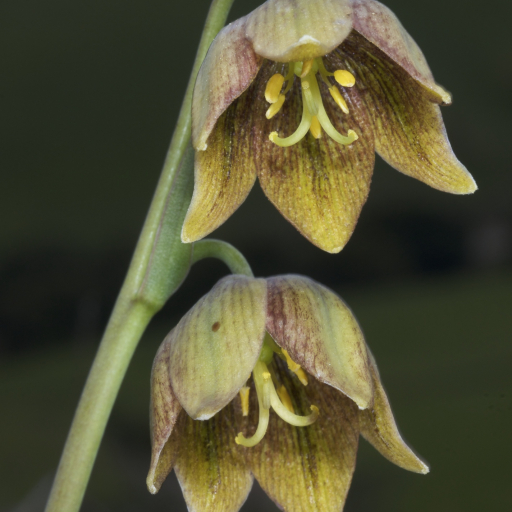
Plant Overview
Commonly known as Stinkbells, this California native is a rebel of the lily family. While most lilies aim to charm with sweet perfumes, Fritillaria agrestis leans into a more "earthy" strategy, emitting a scent often compared to carrion or old gym socks. It is a rare find, perfectly adapted to the heavy clay soils of the Golden State’s grassy hills and woodlands.
🔍 How to Identify
- 🔔 The Bloom: Look for nodding, bell-shaped flowers that hang downward. They are typically a muted yellowish-green on the outside and a deep, bruised purple or brownish-maroon on the inside.
- 🍃 Leaf Pattern: The leaves are long, narrow, and fleshy. They usually appear in a whorl (circular pattern) near the base of the stem but become alternate and smaller as they move upward.
- 📏 Growth Habit: This plant grows from a white, scaly bulb. It sends up a single, sturdy stalk that can reach up to 20 inches tall, topped with a cluster of 1 to 8 drooping bells.
🏡 In Your Garden
- 🧱 Clay Specialist: Unlike most garden plants that demand "well-draining sandy loam," Stinkbells actually thrive in heavy, "adobe" clay soils. They are great for native rain gardens or areas with heavy soil where other bulbs might rot.
- 💤 Summer Dormancy: This is a "spring ephemeral." Once it finishes blooming in late spring, the entire plant will wither and disappear underground to survive the hot, dry summer. Don’t dig it up—it’s just sleeping!
- 🪰 The Smell Factor: Because of its unique fragrance, it is best planted away from windows or patio seating. It evolved this scent specifically to attract flies and gnats, which act as its primary pollinators.
⚠️ Safety & Toxicity
- 🚫 Status: Toxic if ingested.
- 🐾 Details: Like many members of the Fritillaria genus, this plant contains various alkaloids (such as imperialine) that can affect the heart and digestive system. It is considered toxic to cats, dogs, and humans. Always wear gloves if you have sensitive skin, as the bulb juices can occasionally cause mild irritation.
✨ Fun Fact
The specific epithet agrestis is Latin for "of the fields" or "wild," but its common name "Stinkbells" is far more famous. In the wild, you will often smell these flowers before you actually see them hiding in the tall grass!

Detailed Care Instructions
To grow Fritillaria agrestis, also known as the San Francisco fritillary or grassland fritillary, follow these steps:
- Climate and Soil: Fritillaria agrestis prefers Mediterranean climates and well-draining soil. Make sure the soil is sandy or loamy with good drainage. If your natural soil isn't well-draining, you can amend it by adding sand or gravel.
- Propagation: Fritillaria agrestis can be grown from seeds or bulbs. However, propagating from seeds is more reliable. Collect the mature seeds in late summer and plant them immediately or store them in a cool, dry place until spring. Soak the seeds in water for 24 hours before planting.
- Planting: Prepare the soil by removing weeds and loosening it with a garden fork or tiller. In early spring, sow the seeds about 1 inch deep into the prepared soil, spacing them approximately 4 inches apart. Water the area thoroughly after planting.
- Light and Water: Fritillaria agrestis prefers full sun to partial shade. Ensure the plants receive at least 6 hours of direct sunlight per day. Water sparingly, allowing the soil to dry slightly between waterings. Overwatering can cause rotting of the bulbs.
- Mulching: Apply a layer of organic mulch around the plants to help retain moisture in the soil and suppress weed growth. Avoid covering the fritillaria bulbs with the mulch, as they need exposure to the air.
- Maintenance: Keep the area around the plants free of weeds to prevent competition for nutrients and water. Water sparingly during dry periods, and avoid heavy fertilization, as Fritillaria agrestis prefers lean soils.
- Blooming: Fritillaria agrestis typically blooms in late spring or early summer. The flowers are bell-shaped and usually reddish-purple or brownish-purple in color. Enjoy their unique and delicate beauty during the flowering season.
- Division: After a few years, the fritillary bulbs may become crowded. You can divide them in early autumn when the foliage starts to wither. Carefully lift the bulbs from the ground, separate them, and replant them in well-prepared soil.
By following these steps, you can successfully grow Fritillaria agrestis and enjoy its beautiful flowers in your garden or landscape.

Place in a bright room that is sun drenched almost all day. Or directly in a south-facing window.

Fritillaria Agrestis plants require regular watering to thrive. The soil should be kept evenly moist, but not waterlogged, as they are susceptible to root rot. Watering should be reduced during the plant's dormant period to prevent rotting.
When watering, use a watering can or hose to apply water directly to the soil. Avoid getting water on the plant's foliage as this can invite disease and pests. Watering should be done in the morning to allow excess moisture to evaporate during the day and prevent fungal growth.
The frequency of watering will depend on factors such as the plant's location, humidity, and temperature. In general, a Fritillaria Agrestis plant should be watered once a week during the growing season. However, if the weather is particularly hot or dry, more frequent watering may be necessary.
It is important to monitor the soil moisture level regularly to ensure that the plant is getting adequate water. Stick your finger an inch into the soil to see if it feels dry. If it does, it's time to water the plant.
Overall, proper watering is essential to keep a Fritillaria Agrestis plant healthy and thriving.
To fertilize this plant, you should use a balanced fertilizer with equal amounts of nitrogen, phosphorus, and potassium. Apply it in early spring, just before new growth appears. Use a granular fertilizer and sprinkle it around the base of the plant, being careful not to get it on the leaves or buds. Water the plant thoroughly after applying the fertilizer. Avoid over-fertilizing, as this can lead to weak growth and susceptibility to pests and diseases.
Fritillaria Agrestis requires a well-draining soil that is rich in organic matter. The soil should be slightly acidic, with a pH between 5.5 and 6.5. A mixture of sand, loam, and peat moss can be used to achieve the desired soil texture. The soil should be kept moist but not waterlogged, as excessive moisture can lead to root rot. When planting, ensure that the bulbs are spaced adequately and planted at a depth of two to three inches. Fertilizers should be applied sparingly, as Fritillaria Agrestis is a low-maintenance plant that does not require frequent feeding.
Fritillaria Agrestis can be propagated by bulb division or through seed propagation.
To propagate through bulb division, carefully dig up the parent plant and separate the bulbs. Each bulb should have at least one growing point and healthy roots. Replant the bulbs immediately at the same depth as before and water well.
To propagate through seed propagation, collect the seeds when mature in late summer. Plant the seeds in a well-draining soil mix in a seed tray or individual pots. Cover the seeds with a thin layer of soil and water well. Keep the seeds moist, but not waterlogged, and in a cool, dark place until germination occurs. Once the seedlings have established several leaves, they can be planted into their permanent location in the garden.
It is important to note that Fritillaria Agrestis can take several years to reach maturity and produce flowers, so patience is key when propagating this plant.








