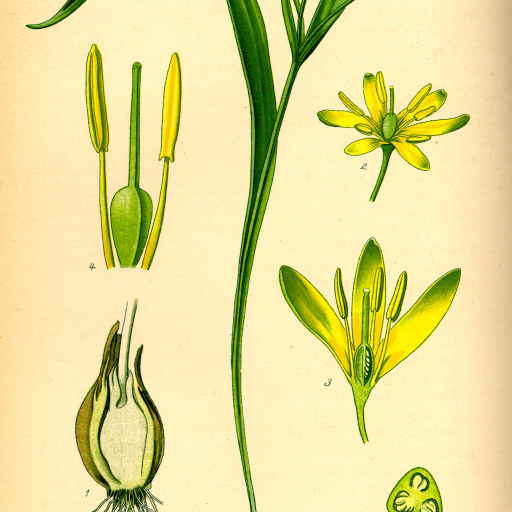
Plant Overview
Known as the Yellow Star-of-Bethlehem, this modest woodland gem is one of nature’s first signals that winter is finally retreating. Often found peeking through the damp leaf litter of European forests, it belongs to the lily family and behaves like a true "spring ephemeral." It rushes to flower in the early chill of March and April, soaking up the sun before the tall trees above grow their leaves and block out the light.
🔍 How to Identify
- 🌼 Golden Stars: It produces small clusters of bright yellow, star-shaped flowers with six petals. If you look closely at the underside of the petals, you will see a distinctive greenish tint or stripe.
- 🍃 The Lone Leaf: Most plants have a single, long, flat basal leaf that is slightly ribbed. This leaf usually grows taller than the flower stalk itself.
- 🌱 Slender Stature: It is a diminutive plant, rarely exceeding 15–20 cm in height. It often grows in small, scattered clumps rather than dense carpets.
🏡 In Your Garden
- 🍂 Woodland Mimicry: If you want to grow these at home, you must mimic the forest floor. They crave soil rich in organic matter (like leaf mold) and a spot that is damp in the spring but relatively dry while they sleep in the summer.
- ⏳ The Vanishing Act: Because it is an ephemeral, the entire plant will wither and disappear by early summer. Do not be tempted to overwater the "empty" spot; the bulb is simply resting underground and will return next spring.
⚠️ Safety & Toxicity
- 🐾 Pet Sensitivity: Like many members of the Lily family (Liliaceae), Gagea lutea contains alkaloids that can cause digestive distress. Keep an eye on cats or dogs that like to dig or chew on garden bulbs.
- 👶 General Caution: While not famously deadly, the plant is not edible and can cause nausea or stomach pain if ingested by children. It is best treated as an ornamental "look-but-don't-touch" species.
✨ Fun Fact
🐝 The Early Bird's Breakfast: Because it blooms when most other plants are still dormant, Gagea lutea is a critical survival resource for the very first solitary bees and hoverflies emerging from hibernation. It provides one of the earliest available sources of nectar in the wild!

Detailed Care Instructions
Gagea lutea, commonly known as Yellow Star-of-Bethlehem, is a perennial bulbous plant belonging to the lily family (Liliaceae). It is native to Europe and parts of Asia and is cherished for its beautiful yellow star-shaped flowers. Here are some tips on how to grow Gagea lutea successfully:
1. Choosing the Right Location:
- Light: Gagea lutea thrives in partial shade to full sunlight. It is typically found in woodland areas, so dappled sunlight under deciduous trees is ideal.
- Soil: Prefers well-drained soil that is rich in organic matter. A slightly acidic to neutral pH (6.0 - 7.0) is ideal.
2. Planting Bulbs:
- Timing: The best time to plant the bulbs is in the fall, usually between September and November, before the ground freezes.
- Depth: Plant the bulbs about 2 to 3 inches deep, with the pointed end facing upward.
- Spacing: Space the bulbs about 3 to 4 inches apart to allow for growth and propagation.
3. Watering:
- Water the newly planted bulbs well to help them establish. After that, Gagea lutea generally requires minimal watering, as it prefers moist but not waterlogged conditions. Ensure the soil remains slightly moist during the growing season (spring).
4. Mulching:
- Apply a thin layer of mulch (such as leaf litter or compost) around the planted area to help retain moisture and suppress weeds. Mulch also mimics the natural woodland environment.
5. Maintenance:
- Weeding: Keep the area free from competing weeds. Gagea lutea is a delicate plant and can be easily outcompeted by more aggressive species.
- Fertilizing: Typically, Gagea lutea does not require additional fertilization if planted in rich, organic soil. However, if your soil is poor, you can apply a balanced, slow-release fertilizer in early spring.
- Pruning: After flowering, the plant’s foliage will remain green for a while before dying back. Allow the foliage to die back naturally to help the bulbs store energy for the next growing season.
6. Propagation:
- Gagea lutea can be propagated by division of its bulbs. After a few years of growth, you can dig up the bulbs in the autumn, separate the bulb clusters, and replant them in new locations.
7. Pests and Diseases:
- Generally, Gagea lutea is not susceptible to many pests or diseases. However, watch out for slugs and snails which may feed on young plants.
8. Naturalizing:
- Gagea lutea naturalizes well in suitable conditions, meaning it can spread and form colonies over time. Once established, it often requires minimal intervention.
By paying attention to the plant's natural habitat and mimicking those conditions as much as possible, you can successfully grow and enjoy the lovely Gagea lutea in your garden or woodland space.

Place in a bright room that is sun drenched almost all day. Or directly in a south-facing window.

To properly water this plant, it is important to keep the soil consistently moist but not waterlogged. Before watering, make sure the top inch of soil is dry to the touch. When watering, use room temperature water and pour it slowly over the soil, making sure it reaches the roots. Avoid getting water on the leaves or flowers as this can cause damage. Water less frequently during the dormant season and increase frequency during active growth periods. It is also important to use well-draining soil and a pot with drainage holes to prevent water from sitting in the soil and causing root rot.
Here are the fertilizing instructions for Gagea lutea:
- Type of Fertilizer: Use a balanced, slow-release bulb fertilizer, such as a 10-10-10 (N-P-K) formulation. Alternatively, you can use organic options like well-rotted compost or bone meal.
- Fertilizing Time: Fertilize in early spring when you first notice the plant emerging and the foliage starting to grow. This is usually before flowering.
- Application Rate: Follow the manufacturer's instructions for the specific fertilizer product you are using. As a general guideline, apply about 1 to 2 pounds (0.5 to 1 kg) of fertilizer per 100 square feet (9.3 square meters).
- Method:
- Granular Fertilizer: Scatter the granules evenly around the base, but not directly touching the stems. Lightly work the granules into the top inch of soil, taking care not to disturb the bulbs.
- Liquid Fertilizer: Dilute the liquid fertilizer according to the manufacturer's instructions and apply it to the soil around the plant. Avoid getting the solution on the foliage to prevent burning.
- Granular Fertilizer: Scatter the granules evenly around the base, but not directly touching the stems. Lightly work the granules into the top inch of soil, taking care not to disturb the bulbs.
- Watering: After applying the fertilizer, water the area thoroughly to help dissolve the fertilizer and carry it down to the root zone.
- Additional Tips:
- Do not over-fertilize, as excessive nutrients, especially nitrogen, can lead to more foliage growth at the expense of flowers.
- Avoid fertilizing late in the growing season, as this can promote new growth that may not harden off before winter, potentially leading to damage from frost.
By following these guidelines, you can help ensure healthy growth and beautiful blooms for your Gagea lutea.
- Do not over-fertilize, as excessive nutrients, especially nitrogen, can lead to more foliage growth at the expense of flowers.
When planting Gagea Lutea, it is recommended to use a well-draining soil that is rich in nutrients. The ideal soil pH range for this plant is slightly acidic to neutral, between 6.0 to 7.5. It is important to avoid soil that is too clayey or compacted, as this can cause waterlogging and root rot. It is recommended to mix in some organic matter, such as compost or aged manure, to improve soil structure and fertility. This plant prefers moist soil, so it is important to maintain consistent moisture levels throughout the growing season.
Propagating Gagea lutea, a perennial bulbous plant belonging to the Liliaceae family, can be done both by seeds and vegetatively through bulb division. Here are detailed steps for each method:
Propagation by Seeds
- Seed Collection and Preparation:
- Collect seeds from mature plants once the seed capsules turn brown and dry.
- Clean the seeds to remove any debris or plant material.
- Collect seeds from mature plants once the seed capsules turn brown and dry.
- Sowing Seeds:
- Since Gagea lutea seeds require a period of cold stratification to germinate effectively, sow them in autumn directly into seed trays.
- Use a well-draining mix, such as a combination of garden loam, leaf mold, and sand.
- Since Gagea lutea seeds require a period of cold stratification to germinate effectively, sow them in autumn directly into seed trays.
- Cold Stratification:
- Place the seeded trays outside to undergo natural cold stratification over the winter or put them in a cold frame.
- Ensure the soil remains moist but not waterlogged.
- Place the seeded trays outside to undergo natural cold stratification over the winter or put them in a cold frame.
- Germination:
- In spring, as temperatures rise, the seeds will begin to germinate.
- Keep the emerging seedlings in a shaded area, ensuring they are not exposed to direct, intense sunlight.
- In spring, as temperatures rise, the seeds will begin to germinate.
- Transplanting:
- Once the seedlings have grown sufficiently, typically after one or two growing seasons, they can be transplanted to their final location.
- Choose a site with partial shade and rich, well-draining soil.
Propagation by Bulb Division
- Once the seedlings have grown sufficiently, typically after one or two growing seasons, they can be transplanted to their final location.
- Timing:
- The best time to divide bulbs is during the plant’s dormant period, usually in late summer to early autumn.
- The best time to divide bulbs is during the plant’s dormant period, usually in late summer to early autumn.
- Excavation:
- Carefully dig around the plant to avoid damaging the bulbs.
- Lift the clump of bulbs out of the soil.
- Carefully dig around the plant to avoid damaging the bulbs.
- Separation:
- Gently separate the offsets (small bulbs) from the parent bulb.
- Inspect the bulbs for any signs of disease or damage and discard any unhealthy ones.
- Gently separate the offsets (small bulbs) from the parent bulb.
- Replanting:
- Immediately replant the bulbs in a suitable location.
- Plant them at a depth of about 5-7 cm (2-3 inches) with the pointed end facing upwards, and space them about 10 cm (4 inches) apart.
- Immediately replant the bulbs in a suitable location.
- Aftercare:
- Water the newly planted bulbs well to settle them into the soil.
- Maintain moderate moisture levels, avoiding waterlogging.
Environmental Conditions
- Water the newly planted bulbs well to settle them into the soil.
- Light: Prefers partial shade but can tolerate full sun.
- Soil: Well-draining, humus-rich soil is ideal.
- Watering: Keep the soil moderately moist, especially during the growing season.
By following these guidelines, you can successfully propagate Gagea lutea, ensuring new generations of this charming plant.








