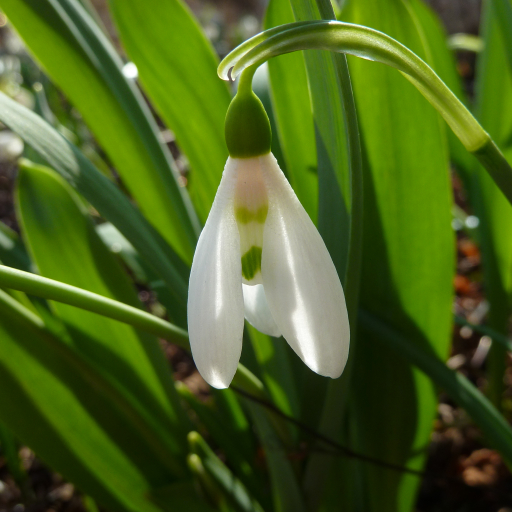
Plant Overview
Known as the Giant Snowdrop, Galanthus elwesii is a bold and elegant harbinger of spring that often pushes through the frozen crust of the earth while other plants are still deep in slumber. Named after the British botanist Henry John Elwes, who "discovered" it in Turkey in 1874, this species is cherished for being larger and more robust than the common snowdrop. It carries a delicate honey-like fragrance that can be caught on a rare warm breeze in late winter.
🔍 How to Identify
- ❄️ The Blossoms: Large, nodding, bell-shaped white flowers. Unlike common snowdrops, these usually feature two distinct green smudges on the inner petals—one at the base and one at the tip.
- 🍃 Foliage Style: The leaves are "supervolute," meaning one leaf wraps around the other at the base. They are noticeably wider than other snowdrops and have a beautiful glaucous, blue-green waxy coating.
- 📏 Stature: It stands significantly taller than its cousins, often reaching 8 to 12 inches, making it stand out in a woodland carpet or rock garden.
🏡 In Your Garden
- 🌱 The Dormancy Secret: These plants are geophytes, meaning they retreat into a bulb for most of the year. They absolutely hate being disturbed during their summer nap; if you must move them, the best time is "in the green"—just after the flowers fade but while the leaves are still healthy.
- 💧 Drainage is Key: While they love moisture during their growth phase in winter and spring, they require very well-drained soil. In heavy clay, the bulbs are prone to rotting during their summer dormancy.
- 🌳 The Canopy Benefit: They thrive under deciduous trees. This provides them with the full winter sun they need to bloom, followed by cooling shade once the trees leaf out in the summer.
⚠️ Safety & Toxicity
- 🚫 Toxicity Status: Toxic if ingested.
- 🐾 Risk to Pets & Kids: All parts of the plant, especially the bulb, contain alkaloids like lycorine. If eaten, it can cause nausea, vomiting, and diarrhea in cats, dogs, and humans.
- 🧤 Skin Sensitivity: Some gardeners experience mild skin irritation (daffodil itch) when handling the bulbs extensively without gloves.
✨ Fun Fact
Snowdrops contain a natural "antifreeze" protein that allows them to freeze solid and then thaw out without their cell walls bursting. This is why they can survive a sudden polar vortex and still look perfectly perky the next day!

Detailed Care Instructions
| Humidity | Normal |
| Lighting | Shade |
| Difficulty | Easy |
| Hibernation | Cold Period |
| Hardiness Zones | 4 - 8 |
To grow Galanthus elwesii (snowdrops), here are some steps you can follow:
- Planting: Snowdrops prefer well-drained soil in partial shade. Choose a location with dappled sunlight or where they will not be exposed to full sun during the hottest parts of the day. Plant the bulbs in the early autumn or late winter when they are dormant. Dig a hole that is about 2-3 inches deep and place the bulb in with the pointed end facing upwards. Space the bulbs about 2-4 inches apart.
- Soil preparation: Snowdrops prefer slightly acidic to neutral soil. Before planting, enrich the soil with organic matter such as compost or well-rotted leaf litter. This will improve drainage and fertility.
- Watering: After planting, water the bulbs thoroughly to settle the soil around them. During the growing season, keep the soil evenly moist but not waterlogged. Snowdrops do not require a lot of water but consistent moisture helps them establish.
- Mulching: Apply a layer of mulch, such as leaf litter or bark chips, around the snowdrops to help retain moisture and suppress weed growth. However, avoid burying the bulbs too deeply.
- Fertilizing: Snowdrops do not require much fertilizer. If your soil is poor, you can apply a balanced, slow-release fertilizer in early spring before they start actively growing.
- Care: Once established, snowdrops are relatively low-maintenance. Remove any spent flowers, but avoid removing leaves until they have turned yellow and died back naturally. This allows the bulbs to replenish their energy for the following year.
- Dividing: Snowdrops can be left undisturbed for several years, but if they become overcrowded or stop flowering well, you can divide the clumps in late spring after they have finished flowering. Dig up the clumps, separate the bulbs, and replant them in the desired location.
By following these steps, you can grow Galanthus elwesii and enjoy their delicate white flowers in late winter or early spring.

Place in a window with dappled sun or a spot in the middle of a room. Or directly in a window facing west or east.

Galanthus Elwesii is a type of plant that needs to be watered regularly for optimal growth. To water it, you need to ensure that the soil is moist, but not waterlogged. This can be achieved by watering the plant deeply once or twice a week, or as needed depending on the weather conditions. It's important to avoid getting water on the leaves or flowers, as this can cause damage or disease. To water the plant without getting water on the leaves or flowers, you can use a watering can or hose with a spray attachment that can direct the water to the soil. Additionally, it may be helpful to mulch around the base of the plant with organic material, such as leaves or straw, to help retain moisture in the soil. Overall, proper watering is essential to ensure the health and vitality of Galanthus Elwesii.
To fertilize this plant, you should apply a balanced fertilizer with an NPK ratio of 10-10-10 in the early spring when the plant starts to grow. It is recommended to apply the fertilizer once every two to three weeks until the end of the flowering season. In the fall, you can also apply a slow-release fertilizer to help promote root growth. Be sure to follow the instructions on the fertilizer package regarding application rates and timing.
The ideal soil for the plant in question would be rich in organic matter and well-draining to prevent waterlogging. Additionally, a slightly acidic to neutral pH range would be optimal for growth. It is important to avoid using heavy clay soils or those containing excessive sand. It is recommended to mix in compost or leaf mold to improve the soil structure and fertility. However, without knowing the common names for the plant, it is difficult to provide further specific guidance.
To propagate this plant, the first step is to carefully dig up the bulbs in the fall after their leaves have died back. Then, gently separate the individual bulbs, taking care not to damage the roots or foliage. Next, choose a well-draining soil mixture and plant the bulbs in a shallow hole, making sure they are not buried too deeply. Water the bulbs deeply and place them in a cool, shady spot. Over the winter, they will develop new roots and shoots. In the spring, the new shoots will begin to emerge and the bulbs can be transplanted to their permanent location. Alternatively, the seeds produced by the plant can be collected and sown in the fall.








