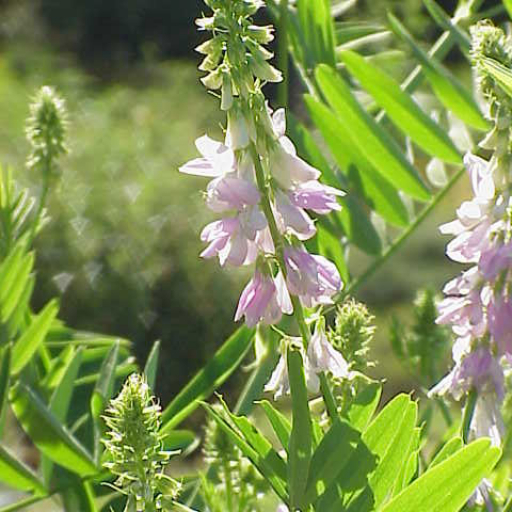
Plant Overview
Often referred to as Goat’s Rue or French Lilac, Galega officinalis is a beautiful but misunderstood member of the pea family. Originally native to parts of the Middle East and Europe, this plant was once a staple in medieval herbal gardens, prized for its supposed ability to increase milk production in livestock—a trait that earned it the name "Galega," meaning "milk-bringer."
🔍 How to Identify
- 🌸 The Bloom: Look for upright spikes (racemes) of delicate, pea-like flowers. They range from a soft, creamy white to a pale violet-blue.
- 🍃 The Foliage: Its leaves are "odd-pinnate," meaning they look like a long feather with 11 to 17 small, lance-shaped leaflets and a single leaf at the very tip.
- 🌿 Growth Habit: This is a tall, bushy perennial that can reach up to 5 feet in height. It has hollow, branched stems that give it a lush, dense appearance in a meadow or garden border.
🏡 In Your Garden
- 🌱 Nitrogen Power: Like many legumes, Goat’s Rue has a special relationship with soil bacteria. It "fixes" nitrogen from the air into the earth, naturally fertilizing the ground for neighboring plants.
- 🚜 Resilience and Spreading: While it is beautiful, be cautious—it is a prolific self-seeder and is considered a "Class A" noxious weed in some parts of the United States. It loves damp soil and can easily escape garden boundaries if not deadheaded (removing spent flowers) before it drops seeds.
⚠️ Safety & Toxicity
- 🚫 Livestock Warning: Despite its history as a "milk-bringer," the plant contains a potent alkaloid called galegine. It is highly toxic to sheep and cattle, leading to fluid in the lungs or even death if consumed in large quantities.
- 🐾 Pet & Human Safety: It is generally considered unsafe for human consumption and can be toxic to household pets if eaten. It is best enjoyed as a visual ornament rather than a culinary herb.
✨ Fun Fact
Modern medicine owes a debt to this plant! Scientists discovered that a compound in Goat’s Rue could lower blood sugar, which eventually led to the development of Metformin, one of the most widely used medications for Type 2 diabetes today.

Detailed Care Instructions
To grow Galega officinalis (goat's rue) plants, follow these steps:
- Find a suitable location: Select a sunny spot in your garden with well-draining soil. Goat's rue prefers full sun but can tolerate some shade.
- Prepare the soil: Ensure the soil is fertile and well-draining. Add organic matter, such as compost or well-rotted manure, to improve soil texture and nutrients. Work the soil to a depth of 6-8 inches.
- Propagation: You can start growing goat's rue from seeds or through division. Seeds should be sown directly in the ground in early spring or fall after scarification, which involves scratching the seed coat gently with sandpaper or rubbing it with a nail file. Alternatively, you can sow seeds indoors 6-8 weeks before the last frost and transplant them outside when they reach a suitable size. For division, separate the root clumps in early spring or fall, making sure each section has a healthy shoot and root system.
- Planting: If sowing seeds directly in the ground, scatter them evenly and cover lightly with soil. Space the seeds or divisions 18-24 inches apart to allow adequate room for their growth. Water the newly planted seeds or divisions gently.
- Watering and maintaining: Keep the soil evenly moist but not waterlogged until the plants establish themselves. Water deeply during dry spells, but avoid overwatering as it can lead to root rot. Mulching around the plants can help retain moisture and control weeds.
- Fertilizing: Apply a balanced organic fertilizer or compost in spring before new growth emerges to provide nutrients. Avoid excessive fertilization as it can promote leafy growth instead of flowering.
- Pruning: Deadhead the spent flowers regularly to encourage continuous blooming. Cut back the plants to the ground in late fall or early spring to remove old stems and promote fresh growth.
- Pests and diseases: Goat's rue is generally resistant to most pests and diseases. However, keep an eye out for common garden pests like aphids or spider mites and treat them as necessary using organic pest control methods.
- Harvesting: Harvest the aerial parts (leaves, flowers, and stems) of goat's rue when they are in full bloom for medicinal use. Cut the stems just above a leaf node to encourage branching and further growth.
Remember to research and consult reliable sources specific to your region to ensure ideal growing conditions and to learn about any local regulations related to growing Galega officinalis.

Place in a bright room that is sun drenched almost all day. Or directly in a south-facing window.

The best way to water this plant is to provide it with adequate moisture without overwatering. This can be achieved by watering deeply once or twice a week, depending on the soil's moisture level and temperature. It is important to avoid watering the leaves, as this can lead to fungal diseases. Instead, direct the water towards the base of the plant, near the soil. The soil should be kept evenly moist but not waterlogged. During the summer months, it may be necessary to increase watering frequency to prevent the soil from drying out too much. In addition, it is important to ensure that the soil has good drainage, which can be improved by adding perlite or sand to the soil mix. Finally, refrain from watering the plant during the dormant period in winter, allowing the soil to dry out slightly between watering sessions.
To fertilize the plant, apply a balanced fertilizer with equal amounts of nitrogen, phosphorus, and potassium. Use a rate of 1 tablespoon per square foot of soil and apply every four to six weeks during the growing season. Avoid over fertilizing as it can damage the plant and cause excessive growth. Water the plant well after fertilizing to ensure the nutrients are absorbed properly.
It is recommended to use a well-draining soil for this plant. The soil should be fertile and slightly acidic with a pH range of around 6.0 to 7.0. It is important to ensure that the soil is rich in organic matter as this plant requires a lot of nutrients to grow and flower. Heavy soils should be avoided as they can cause root rot. The ideal soil type is a loamy soil that holds moisture well but also drains well. Adding compost or other organic matter to the soil can help improve its structure and fertility. Regular fertilization may also be necessary to maintain healthy growth.
Galega Officinalis is a perennial plant that can be propagated by either seeds or stem cuttings. If propagating with seeds, they should be collected from mature plants in the fall and sown in the spring after the last frost. They should be planted in well-draining soil and kept moist until they germinate.
If propagating with stem cuttings, select healthy stems from the parent plant and cut 4-6 inch sections. Remove the leaves from the bottom half of the cutting and dip the cut end in rooting hormone. Place the cutting in a well-draining soil mixture and keep it moist, but not overly wet. Cover the cutting with a clear plastic bag or propagation dome to maintain humidity and place in a bright, but indirect light.
Both propagation methods require patience and consistent maintenance. It may take several weeks or months before the new plants are established enough to be transplanted.








