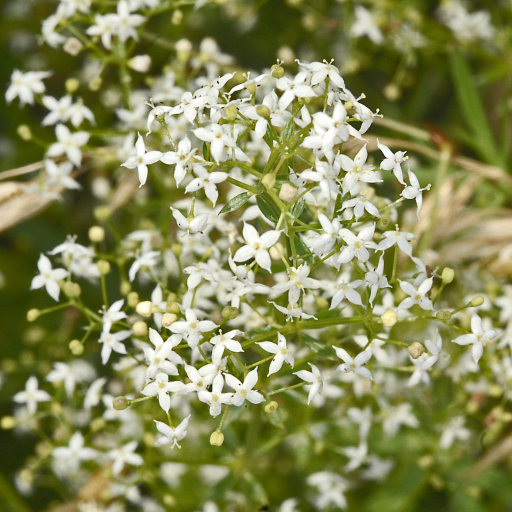
Plant Overview
Commonly known as Hedge Bedstraw or "False Baby’s Breath," this delicate wildflower creates a frothy, cloud-like appearance in summer meadows and along woodland edges. While it looks like a fragile ornamental, it is a hardy survivor that has traveled from Europe and North Africa to colonize much of North America. Its name comes from a long history of being used to stuff mattresses, providing a soft, sweet-smelling padding for a good night’s sleep.
🔍 How to Identify
- ☁️ The Flowers: Clusters of tiny, star-shaped white flowers with four petals. They bloom in dense, airy "panicles" that look like white mist from a distance.
- 🌀 The Leaves: Narrow, lance-shaped leaves that grow in distinct "whorls" (circles) of 6 to 8 around the stem at regular intervals.
- 🟩 The Stem: Unlike its cousin "Cleavers," the stem of Hedge Bedstraw is smooth and square-shaped. It doesn't have the "sticky" hooked hairs that make other bedstraws cling to your clothes.
🏡 In Your Garden
- 🌱 Spreading Nature: This plant is a scrambler. It doesn't climb with tendrils but leans on neighboring plants for support. In a garden bed, it can quickly become a "living mulch," covering bare ground with its fine foliage.
- 🦋 Pollinator Magnet: While humans might find the scent faint, hoverflies and small bees are highly attracted to the nectar-rich white froth of its mid-summer bloom.
- ⛰️ Soil Preference: It is particularly fond of calcium-rich, alkaline soils. If you see it thriving wild, it’s a good indicator that your soil is chalky or lime-heavy.
⚠️ Safety & Toxicity
- ✅ Status: Generally non-toxic and safe to handle.
- 🌿 Skin Sensitivity: While not poisonous, some individuals with sensitive skin may experience mild redness or itching (contact dermatitis) after handling large amounts of the plant, especially when it is dry.
- 🐾 Pets: It is not known to be toxic to cats or dogs, though it is not a plant intended for consumption.
✨ Fun Fact
In medieval times, Hedge Bedstraw was known as "Cheeserennet." It contains an enzyme that can curdle milk, and it was traditionally used by dairymen to help in the cheese-making process and to give some cheeses a yellow color!

Detailed Care Instructions
To grow Galium Mollugo, also known as hedge bedstraw, follow these steps:
- Choose a suitable location: Galium Mollugo prefers full sun to partial shade. Select a spot in your garden that receives at least 6 hours of sunlight each day. Ensure the soil is well-draining and fertile.
- Prepare the soil: Remove any weeds or debris from the planting area. Loosen the soil using a garden fork or tiller, ensuring it is well-drained. Galium Mollugo thrives in slightly acidic to neutral soil with a pH level between 5.5 and 7.0.
- Sow the seeds: Galium Mollugo can be grown from seeds. Sow the seeds directly into the prepared soil in late winter or early spring, as soon as the ground can be worked. Scatter the seeds evenly and lightly press them into the soil. Alternatively, you can start the seeds indoors 6-8 weeks before the last expected frost and transplant them outside later.
- Maintain moisture: Keep the soil consistently moist but avoid overwatering, as it can lead to root rot. Water the soil gently when it feels dry about an inch beneath the surface. Be careful not to disturb the seeds while watering.
- Provide support: Galium Mollugo tends to sprawl, so providing support to prevent it from trailing on the ground can be helpful. You can use a trellis or stakes to train the plant upward.
- Control weeds: Regularly remove any weeds that may compete with Galium Mollugo for nutrients and space. Mulching around the plants can help prevent weed growth and retain soil moisture.
- Prune if needed: Galium Mollugo can spread invasively, so pruning the plant after flowering can help control its growth and maintain its shape. Cut back any unwanted or unruly stems to keep it tidy.
- Fertilize sparingly: Galium Mollugo generally doesn't require heavy feeding. However, you can apply a balanced, slow-release fertilizer once in early spring to promote healthy growth.
By following these steps and providing adequate care, you should be able to successfully grow Galium Mollugo in your garden.

Place in a window with dappled sun or a spot in the middle of a room. Or directly in a window facing west or east.

To water this plant, it is important to regularly check the soil moisture level. The plant prefers moist, well-draining soil and can tolerate some drought. When watering, it is best to water deeply, saturating the soil to a depth of several inches. Avoid getting the leaves or stem wet, as this can encourage disease. Watering should be done early in the morning or late in the afternoon to prevent evaporation during the heat of the day. Overwatering can be harmful to the plant, so it is important to allow the soil to dry out slightly between waterings. Consider using a layer of mulch around the plant to help retain moisture in the soil.
To fertilize the Galium Mollugo plant, use a balanced fertilizer with equal parts nitrogen, phosphorus, and potassium. Apply the fertilizer once every three weeks during the growing season, which typically runs from spring to fall. Avoid fertilizing during the winter months when the plant is dormant. Scatter the fertilizer around the base of the plant and water well after application. Be cautious not to over-fertilize as this can cause the plant to become too lush and lead to weaker stems that are more susceptible to disease and breakage.
The Galium Mollugo plant prefers a well-draining soil that is moist and fertile. It can thrive in a variety of soil types, including sandy, loamy or clay soils. It benefits from a soil pH level between 6.0 and 7.5 and requires good air circulation around the roots. To ensure that the plant maintains optimal health, it is recommended to enrich the soil with organic matter such as compost or leaf mould before planting. Additionally, the soil should be kept consistently moist throughout the growing season, but not waterlogged.
To propagate the plant commonly known as Galium Mollugo, you can collect seeds from the plant once they have ripened and sow them in a suitable growing medium such as potting soil or a seed-starting mix. It is best to sow the seeds in the fall to give them time to germinate over the winter and begin growing in the spring.
Another method of propagation is through stem cuttings. Take cuttings from the parent plant in the early summer when the plant is actively growing. Choose healthy stems that are at least 4 inches long and have several leaves. Remove the leaves from the bottom half of the stem and insert it into a container of potting soil or a rooting hormone. Keep the soil moist and in a warm, bright location until the cutting begins to grow roots and new leaves.
Lastly, Galium Mollugo can also be propagated through division. When the plant is mature, dig up the root ball and separate it into several sections using a sharp knife or gardening tool. Each section should have several healthy stems and roots. Replant the sections in separate containers or in the ground and keep the soil moist until they establish themselves.








