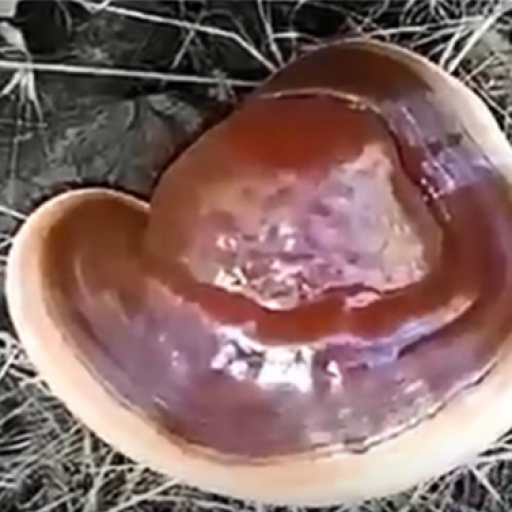
Plant Overview
Known for millennia in East Asia as "Lingzhi" or the "Mushroom of Immortality," the Reishi is one of the most revered fungi in history. Its striking, high-gloss appearance makes it look almost as if it were carved from polished mahogany and coated in a thick layer of lacquer. While you won't find it in a gourmet stir-fry due to its woody, cork-like texture, its legendary status in traditional medicine continues to fascinate foragers and researchers alike.
🔍 How to Identify
- 🎨 The Cap: Distinctly kidney-shaped or fan-shaped, featuring a vibrant reddish-orange to mahogany-brown color that often transitions to a pale yellow or white "growing edge."
- ✨ The Texture: The surface has a unique "varnished" or waxy sheen that looks artificially polished, even in the wild.
- 🕳️ The Underside: It is a polypore, meaning it has no gills. Instead, the underside is covered in tiny white-to-cream pores that turn brown when touched or bruised.
- 🪵 The Stem: Usually attached to the side of the cap (eccentric), the stem is tough, twisted, and shares the same dark, lacquered look as the cap.
🌲 Habitat & Ecology
- 🌳 Preferred Hosts: It is primarily found growing at the base or on the stumps of deciduous trees, particularly oaks, maples, and elms. It often appears to be growing from the soil, but it is actually attached to buried roots.
- 🍄 Decomposition Role: As a "white rot" fungus, it plays a vital role in the forest ecosystem by breaking down tough wood fibers (lignin), recycling nutrients back into the forest floor.
⚠️ Safety & Toxicity
- 🛑 WARNING: Never consume any wild mushroom unless you are 100% certain of its identity. While Ganoderma lucidum is not "deadly," it has several look-alikes, some of which can cause severe stomach upset.
- 🍵 Edibility Context: Reishi is not a culinary mushroom. It is incredibly tough, bitter, and woody. It is traditionally prepared by being sliced, dried, and simmered for hours into a dark, earthy tea or processed into extracts.
- 💊 Side Effects: It can interact with certain medications, particularly blood thinners or treatments for high blood pressure. Always consult a professional before using it as a supplement.
✨ Fun Fact
- 👑 The Imperial Fungus: In ancient Chinese art and folklore, the Reishi was a symbol of divine power and longevity. For centuries, it was so rare in the wild that it was reserved almost exclusively for emperors and the nobility.

Detailed Care Instructions
| Humidity | Dry |
| Lighting | Part Sun |
| Difficulty | Easy |
To grow Ganoderma Lucidum, commonly known as the Reishi mushroom, follow these steps:
- Obtain Ganoderma Lucidum spores or fungal culture from a reputable source. You may find them at specialty nurseries or online stores.
- Prepare a suitable growing medium. Reishi mushrooms prefer hardwood logs, such as oak or maple, although they can also be grown on various hardwood sawdust, wood chips, or straw.
- If using logs, select freshly cut logs that are around 3-5 feet long and 4-6 inches in diameter. Leave them in a shaded area for a few weeks to allow natural decay processes to soften the wood and make it more suitable for mushroom growth.
- Drill 5/16-inch diameter holes into the logs, spaced about 6 inches apart in a diamond pattern. The holes should be around 2.5 to 3 inches deep.
- Into each hole, insert Ganoderma Lucidum spores or fresh tissue culture. Cover the holes with melted cheese wax or beeswax to seal them and prevent contamination.
- Place the logs in a shady, humid area with good air circulation. The ideal temperature for Reishi cultivation is around 65-75°F (18-24°C), and humidity should be maintained at around 75-85%.
- Water the logs regularly to keep them moist. You can mist them with water or soak them for a short period every week. Avoid overwatering or allowing the logs to become waterlogged.
- After a few months, you may notice white mycelium growth appearing around the inoculation sites. This is a sign that the Reishi mushrooms are developing.
- Once the mushrooms start to emerge, be patient and allow them to mature. The growth process can take several months. Harvest the mushrooms by cutting them close to the log with a sharp knife or pruning shears.
- After harvesting, allow the logs to rest for a few months and regenerate before attempting to fruit them again.
Remember that Ganoderma Lucidum cultivation requires specific growing conditions and can be challenging for beginners. Proper research and following specific instructions for your specific growing medium will lead to better results.

Place in a window with dappled sun or a spot in the middle of a room. Or directly in a window facing west or east.
To water a plant of the species Ganoderma Lucidum, it is important to consider the specific watering needs of this particular plant. This may involve research on the plant's natural habitat and climate, as well as its specific requirements for moisture. Generally speaking, Ganoderma Lucidum will require regular watering to maintain healthy growth and development. However, overwatering can cause root rot and other issues, so it is important to be mindful of the amount and frequency of watering. Some tips for watering Ganoderma Lucidum plants may include using a watering can or hose to apply water directly to the soil around the base of the plant, avoiding getting water on the leaves or stems. The soil should be allowed to dry out slightly between waterings, but not to the point of becoming completely dry. It may also be beneficial to use a moisture meter or other tool to monitor the soil moisture levels and adjust watering accordingly. Additionally, providing adequate drainage and air circulation around the plant can help prevent waterlogging and other issues.
To fertilize this plant, use a balanced fertilizer with a ratio of 10-10-10. Apply the fertilizer once every three months during the growing season. Dissolve the fertilizer in water according to the package instructions, and drench the soil around the plant's base. Avoid applying fertilizer directly to the plant's stem or leaves. Ensure that the soil is well-draining and kept moist but not waterlogged.
Ganoderma Lucidum is a type of plant that is commonly used for medicinal purposes. When it comes to selecting soil for this plant, it is important to choose a soil that is rich in nutrients, well-draining, and has a pH level between 6.0 and 7.5. Additionally, it is important to ensure that the soil is not too compact, as this can impede root growth and prevent adequate circulation of air and water. Soil that is too dense can also limit the ability of the roots to absorb nutrients and can lead to nutrient deficiencies. It is also important to avoid soil that has been treated with pesticides or other chemicals, as these can negatively impact the health of the plant. Instead, choose a high-quality organic soil or create a soil mix using compost and other organic materials. Overall, the key to successful growth and development of Ganoderma Lucidum is to provide it with the right type of soil, as well as adequate water, light, and nutrients.
Propagation of this plant can be done through two different methods. The first way is through the use of spores, while the second way is through the use of tissue culture.
To propagate using spores, the first step is to harvest the mature fruiting bodies of the plant when they are fully developed. Next, the spores are extracted by breaking open the fruiting bodies and collecting the spores that are released. The spores are then placed onto a sterile substrate (such as agar) where they can germinate and grow into tiny mycelium mats. These mats can then be transferred to a suitable growing medium where they can continue to grow and develop into mature fruiting bodies.
Alternatively, propagation can be done through tissue culture. This method involves taking a tiny piece of tissue from a mature plant and placing it onto a sterile nutrient medium where it can grow and develop into a new plant. Tissue culture is a popular method for propagation of many plants because it allows for rapid growth and production of new plants in a controlled environment.
Whether using spores or tissue culture, it is important to maintain proper hygiene and sterility throughout the propagation process to prevent contamination and ensure successful growth of the new plants.







