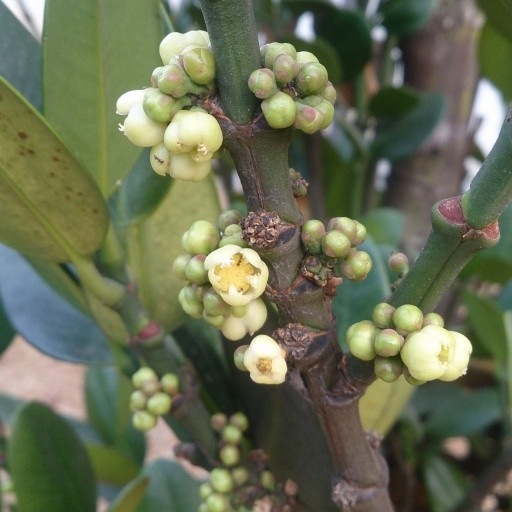
Plant Overview
Known as the "Happiness Tree" or the "Fukugi tree," Garcinia subelliptica is a symbol of resilience and protection. Native to the coastal regions of East Asia and the Ryukyu Islands, it has been planted for centuries around Okinawan homes to guard against fierce typhoons. Its dense, evergreen foliage and noble, upright stature make it a favorite for those seeking a "living wall" with a deep cultural history.
🔍 How to Identify
- 🍃 The Leaves: The leaves are thick, leathery, and oval-shaped, sporting a deep, glossy green color that looks almost polished. They grow in opposite pairs along the stems.
- 🌳 Growth Habit: It naturally grows in a very tidy, columnar or pyramidal shape. It stays compact and symmetrical, often looking like a manicured topiary even without frequent pruning.
- 🌼 Flowers & Fruit: It produces small, inconspicuous creamy-yellow blossoms followed by round, green fruits that turn a bright, mustard-yellow when ripe. Be warned: the ripe fruit has a very distinct, pungent odor.
🏡 In Your Garden
- 🌊 Coastal Warrior: This plant is incredibly salt-tolerant and wind-resistant. It is the gold standard for seaside gardens where salty spray and heavy gusts might wither more delicate species.
- ⏳ Patience Required: The Fukugi is a notoriously slow grower. It spends a lot of energy building a deep, sturdy taproot system, so don't be discouraged if it doesn't shoot up overnight—it is built for longevity, not speed.
- 🧤 Low Maintenance: Because of its natural resistance to pests and its tidy shape, it requires very little "policing." It’s a set-it-and-forget-it plant once it has established its root system.
⚠️ Safety & Toxicity
- 🛡️ General Safety: This plant is generally considered non-toxic to humans and pets. It is not a known "poisonous" plant in the traditional sense.
- 👃 Olfactory Warning: While not dangerous, the fallen fruits can smell quite strongly of fermented or rancid butter. If you have sensitive indoor pets or small children, you may want to clear fallen fruit to avoid a smelly mess or potential stomach upset from ingestion.
- 🧪 Staining Sap: The bark and fruit contain a yellow pigment that was historically used as a dye; be careful when pruning, as the sap can stain clothing or light-colored patio stones.
✨ Fun Fact
In Okinawa, Japan, some Fukugi trees are over 300 years old! They were strategically planted in "Fukugi-namiki" (tree-lined paths) to protect entire villages from the sea's salt spray and tropical storms, acting as a natural, green suit of armor for the community.

Detailed Care Instructions
Garcinia subelliptica, also known as fukugi in Okinawa, is a tropical plant native to Southeast Asia. Here are some tips on how to grow Garcinia subelliptica:
- Climate and temperature: Garcinia subelliptica thrives in warm, humid climates and is sensitive to cold temperatures. It is best suited for USDA zones 10-11, where temperatures do not drop below 50°F (10°C).
- Sunlight: Garcinia subelliptica prefers partial shade with some direct sunlight. Place the plant in a location where it can receive dappled sunlight throughout the day.
- Soil: Garcinia subelliptica prefers well-draining, slightly acidic soil. A mix of peat moss, perlite, and sand can provide the ideal growing medium for this plant.
- Watering: Keep the soil consistently moist but not waterlogged. Water Garcinia subelliptica regularly, especially during the growing season, but allow the soil to dry out slightly between waterings.
- Fertilization: Fertilize Garcinia subelliptica with a balanced, slow-release fertilizer every 4-6 weeks during the growing season. Avoid over-fertilizing, as this can lead to nutrient deficiencies and other issues.
- Pruning: Regular pruning can help shape the plant and promote healthy growth. Trim back any dead or diseased branches and pinch off the tips of new growth to encourage bushier growth.
- Propagation: Garcinia subelliptica can be propagated from seeds or cuttings. Seeds should be fresh and planted in a well-draining soil mix. Cuttings can be taken from healthy, mature plants and rooted in water or a soilless medium.
By following these tips, you can successfully grow Garcinia subelliptica and enjoy its beautiful foliage and exotic fruits.

Place in a window with dappled sun or a spot in the middle of a room. Or directly in a window facing west or east.

To properly water the Garcinia Subelliptica plant, it is important to first consider the soil type and drainage. The soil should be well-draining and should not be saturated with water for extended periods of time.
When watering, it is recommended to water deeply and moderately, rather than frequently and lightly. This allows the roots to fully absorb the water and prevents the soil from becoming too compacted.
It is important to avoid getting water on the foliage of the plant, as this can lead to fungal growth and disease. Instead, water around the base of the plant, ensuring that the water reaches the root zone.
During periods of drought or extreme heat, it may be necessary to increase watering frequency. However, it is important not to overwater, as this can lead to root rot and other issues.
Overall, proper watering techniques will help to ensure the health and vitality of the Garcinia Subelliptica plant.
To fertilize the Garcinia Subelliptica plant, use a balanced, slow-release fertilizer specially formulated for flowering and fruiting plants. Apply the fertilizer sparingly, following the instructions on the packaging for the correct dosage. Ideally, fertilize the plant every 6-8 weeks during the growing season, which is typically spring and summer. Water the plant thoroughly after fertilizing to help the nutrients penetrate the soil and reach the plant's root system. Avoid over-fertilization, as this can harm the plant. Regularly monitor the plant for signs of nutrient deficiencies, such as yellowing leaves, and adjust your fertilizing schedule as needed.
Garcinia subelliptica plant prefers well-draining soil that is loamy and slightly on the acidic side with a pH of 5.0 to 6.5. It requires soil that is rich in organic matter and nutrients such as nitrogen, phosphorus, and potassium, but not overly fertile as too much nitrogen can lead to leafy growth at the expense of fruiting. A soil mixture with equal parts of coarse sand, compost, and peat moss is ideal for growing this plant. The soil should be kept evenly moist but not waterlogged as excessive moisture can lead to root rot. It is recommended to amend the soil periodically with aged compost or a balanced fertilizer to maintain soil fertility.
Propagation of the Garcinia subelliptica plant is typically done using seeds or cuttings. Here are the steps to propagate Garcinia subelliptica:
- Seeds: Collect ripe seeds from the fruits of the Garcinia subelliptica plant. Clean the seeds and sow them in a well-draining potting mix. Keep the soil consistently moist and place the pot in a warm, humid environment.
- Cuttings: Take stem cuttings from healthy, mature Garcinia subelliptica plants. Cut the stem at a 45-degree angle and remove any lower leaves. Dip the cut end in rooting hormone to encourage root growth. Plant the cutting in a pot filled with well-draining soil and keep it moist.
- Maintain humidity: Garcinia subelliptica plants prefer a humid environment for successful propagation. Use a humidifier or mist the plants regularly to keep the humidity levels high.
- Provide light: Place the newly propagated Garcinia subelliptica plants in a warm, sunny location with indirect sunlight. Avoid direct sunlight, as it can damage the delicate young plants.
- Monitor growth: Keep an eye on the plants as they grow and establish roots. Water the plants regularly, but avoid overwatering, which can cause root rot. Once the plants have established roots and are growing well, transplant them into individual pots with a well-draining potting mix.
Common pests of the happiness tree include Scale insect, mealybugs, thrips. Make a habit of checking your happiness tree frequently for pests so that any infestations can be caught and managed early.








