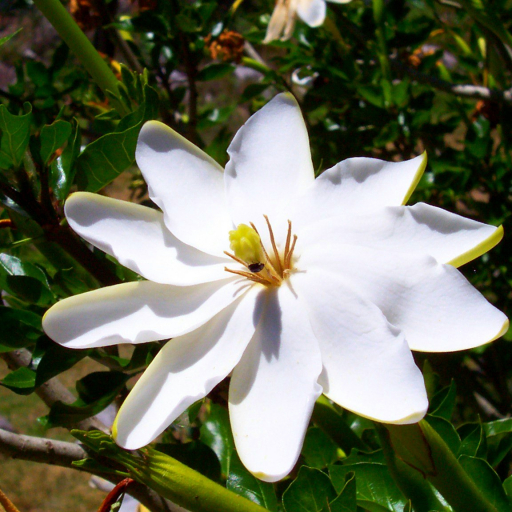
Plant Overview
Commonly known as the Forest Gardenia or Starry Gardenia, this South African native is a show-stopping ornamental shrub that transforms any garden into a fragrant sanctuary. Unlike the common gardenia, this species is prized for its architectural form and large, pinwheel-like white blossoms that glow under the moonlight. In its homeland, it’s often called "Wit-katjiepiering," a name as charming as the heavy, jasmine-like perfume it releases at dusk.
🔍 How to Identify
- 🌿 Leathery Foliage: Look for glossy, dark green leaves that grow in clusters of three or four along the stems. The leaves often have wavy margins and prominent veins.
- 🌸 Star-Shaped Blooms: The flowers are magnificent, featuring eight or more overlapping white petals that form a starry symmetry at the end of a long, elegant tube.
- 🥚 Woody Fruit: One of its most distinct features is the hard, egg-shaped, greyish-white fruit. These woody pods are remarkably tough and can remain on the branches for years without falling.
🏡 In Your Garden
- 🧪 Soil Sensitivity: This plant is an "acid-lover." If your soil is too alkaline, the leaves will turn yellow (chlorosis) because the plant can't take up iron. Mixing in peat moss or organic compost helps maintain the right acidity.
- 🦋 A Nocturnal Feast: Because the flowers have very long tubes, they are specifically designed to be pollinated by Hawk Moths with long proboscises. Planting one near a patio ensures you’ll enjoy both the scent and the sight of these "hummingbird moths" at night.
- 🌳 Structural Growth: While it is slow-growing, it eventually forms a sturdy, multi-stemmed small tree. It makes an excellent "specimen plant"—a focal point that draws the eye in a landscape.
⚠️ Safety & Toxicity
- 🐾 Pet Watch: While not considered deadly, most Gardenia species contain gardenoside and geniposide. If ingested by dogs or cats, it can cause mild to moderate gastrointestinal upset, including vomiting or diarrhea.
- 👶 Human Safety: The plant is generally safe for humans to touch and smell, though the woody fruits are extremely hard and should not be eaten.
✨ Fun Fact
The woody fruit of the Gardenia Thunbergia is so incredibly tough that in the wild, it often requires the powerful digestive tract of a large animal, like an elephant or a buffalo, to soften the seeds enough for them to germinate after being passed!

Detailed Care Instructions
To grow a Gardenia Thunbergia plant, also known as White Gardenia, you can follow these steps:
- Choose a suitable location: Select a spot that receives partial shade, as direct sunlight can scorch the leaves. The soil should be well-draining, slightly acidic (pH 5.0-6.0), and enriched with organic matter.
- Prepare the soil: Before planting, work in compost or well-rotted manure to improve soil fertility and drainage, especially if the soil is heavy clay. Remove any weeds or debris from the area.
- Planting: Dig a hole twice the size of the root ball of the plant. Place the Gardenia Thunbergia in the hole, ensuring that the top of the root ball is level with the soil surface or slightly raised. Backfill the hole with soil gently, firming it around the plant.
- Watering: Keep the soil evenly moist, but avoid overwatering, as Gardenia Thunbergia prefers moderately moist soil. Provide sufficient water during dry spells, especially when the plant is establishing its roots.
- Mulching: Apply a layer of organic mulch, such as wood chips or shredded bark, around the base of the plant to help retain moisture, suppress weeds, and maintain a cool root zone.
- Fertilization: Feed the plant with a balanced fertilizer specifically formulated for acid-loving plants in early spring. Follow the manufacturer's instructions for application rates. Avoid fertilizing later in the growing season to prevent tender growth before winter.
- Pruning: Prune after flowering to maintain the desired shape and control the size. Remove any dead or diseased parts of the plant throughout the year.
- Protection: Protect the Gardenia Thunbergia from extreme temperatures, such as frost or freezing conditions, as it is sensitive to cold. Consider bringing potted plants indoors during winter.
- Pest and disease control: Monitor the plant regularly for common pests such as aphids, mealybugs, or scale insects. Treat infestations promptly using organic or chemical methods. Ensure good air circulation around the plant to prevent fungal diseases like powdery mildew.
- Patience: Gardenia Thunbergia can be a challenging plant to grow, and it may take time to establish and bloom. Be patient and provide the plant with consistent care to encourage healthy growth.
Remember to consult your local gardening experts or resources for specific recommendations based on your region's climate and conditions.

Place in a bright room that is sun drenched almost all day. Or directly in a south-facing window.

To water this plant, first ensure that the soil is dry to the touch before watering. Use a watering can or hose to water the soil directly at the base of the plant, avoiding getting water on the leaves. Water until the soil is thoroughly moistened but not soggy. Allow the top inch of soil to dry out slightly before watering again, as overwatering can cause root rot. In the winter months, reduce watering frequency as the plant will not require as much moisture. It is also important to provide good drainage to prevent water from sitting around the roots.
To fertilize this plant, you should use a slow-release fertilizer with a balanced NPK ratio. Apply the fertilizer in early spring, just before new growth begins. Follow the manufacturer's instructions for application rates and frequency. Avoid over-fertilizing, as this can lead to burnt roots and poor plant health. Ensure the plant is well-watered before and after fertilization to prevent root burn.
Gardenia Thunbergia plants thrive in well-draining, slightly acidic soil with a pH ranging from 5.0 to 6.5. It is recommended to use a soil mixture that is rich in organic matter, such as compost or peat moss, to improve the soil's nutrient content and moisture retention. Avoid using soils that are heavy and compacted, as this can lead to poor drainage and root rot. It is also beneficial to incorporate perlite or sand into the soil mix to improve aeration. Additionally, using a slow-release fertilizer specifically formulated for acid-loving plants can help ensure proper nutrition and growth.
To propagate this plant, take stem cuttings that are about 6-8 inches long and remove the bottom leaves. Dip the bottom end of the cutting in rooting hormone and place it in a pot filled with a moist mixture of peat moss and sand. Cover the pot with a plastic bag to create a humid environment. Place the pot in a warm, bright location, but out of direct sunlight. Water the cutting whenever the soil feels dry to the touch. After a few weeks, new growth should appear, indicating that roots have formed. Gradually remove the plastic bag and move the plant to a brighter location. Transplant the new plant into a larger pot or into the garden once it has developed a strong root system.








