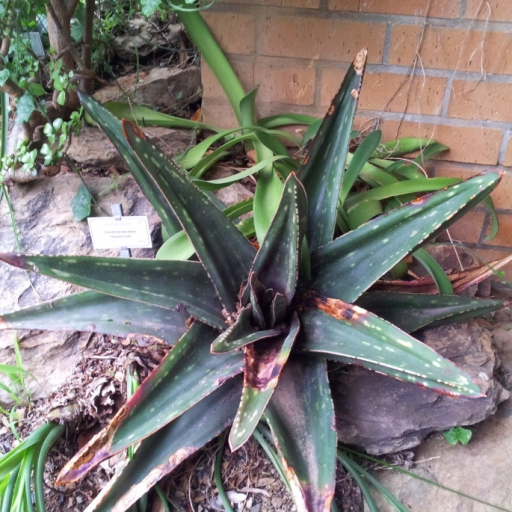
Plant Overview
Often referred to as the "Forest Gasteria," Gasteria excelsa is the stately aristocrat of the succulent world. Native to the shaded cliffs and thickets of South Africa’s Eastern Cape, this plant is beloved for its architectural silhouette and "plastic-like" durability. Unlike its smaller, warty cousins, this species grows into a massive, noble rosette that can command the center of any room or garden bed.
🔍 How to Identify
- 🍃 Stately Rosettes: It forms large, heavy, triangular leaves that grow in a spiral pattern. As it matures, it loses the "ladder-like" look of young Gasterias and becomes a massive, symmetrical star.
- 💎 Polished Texture: The leaves are exceptionally smooth, leathery, and dark green. They lack the white bumps (tubercles) found on many other species, giving them a clean, sophisticated look.
- 🏮 Stomach-Shaped Blooms: In winter or spring, it sends up a tall, branched flower spike with hanging, tubular pinkish-red flowers that are swollen at the base.
🏡 In Your Garden
- 🌥️ The Shade Seeker: Because its ancestors lived in the shadows of larger shrubs and forest canopies, this plant is a champion of low-light conditions. In fact, too much direct afternoon sun will cause the leaves to "bronze" or burn.
- 🪴 Slow and Steady: This is a slow-growing species that doesn't like to be disturbed. It develops a deep, thick root system, so while it hates "wet feet," it prefers a slightly deeper pot than most shallow-rooted succulents.
- 💧 Thirst Cues: Look for a slight inward curling or flattening of the thick leaves; this is the plant’s way of telling you its internal water reservoir is running low.
⚠️ Safety & Toxicity
- ✅ Non-Toxic: Gasteria excelsa is generally considered safe and non-toxic for both humans and curious pets like cats and dogs.
- 🌵 Mechanical Hazards: While it doesn't have spines, the leaf tips are extremely stiff and pointed. It should be placed away from high-traffic areas where a child or pet might accidentally bump into the sharp ends.
✨ Fun Fact
The name Gasteria is derived from the Greek word gaster, which means "stomach." This isn't because the plant is edible, but because the base of each flower is swollen and curved, looking exactly like a tiny, upside-down belly!

Detailed Care Instructions
| Lighting | Part Sun |
To grow Gasteria Excelsa plants, follow these steps:
- Choose a well-draining pot: Select a pot with drainage holes at the bottom to prevent water from pooling and causing root rot. Gasteria Excelsa plants prefer sandy or gravelly soil mix.
- Provide the right lighting conditions: Place your plant in a location with bright, indirect sunlight. Gasteria Excelsa plants can tolerate some shade, but too much direct sunlight can scorch their leaves.
- Water sparingly: Gasteria Excelsa plants are succulents that store water in their leaves. Water your plant only when the top inch of soil feels dry. Avoid overwatering, as it can lead to root rot. During the winter months, reduce watering frequency as the plant enters a dormant period.
- Maintain the right temperature: Gasteria Excelsa plants prefer average room temperatures between 65-75°F (18-24°C). They can tolerate slightly cooler temperatures but may experience damage if exposed to frost.
- Fertilize occasionally: Use a balanced, water-soluble fertilizer diluted to half-strength during the growing season (spring to summer). Apply the fertilizer every two to four weeks.
- Propagate through offsets: Gasteria Excelsa plants produce offsets, also known as "pups" or "babies," which can be separated and transplanted to grow new plants. Wait until the offsets are about 1/3 the size of the parent plant before carefully detaching and replanting them in their pots.
- Pruning and repotting: Prune off any damaged or dead leaves with clean, sharp scissors or shears. If the plant outgrows its pot, repot it into a slightly larger container with fresh soil.
By following these steps, you can successfully grow and care for Gasteria Excelsa plants.

Place in a dark room with little light, like a dark bedroom or a spot far away from a window or directly in a north-facing window.
To water this plant, check the soil moisture level before watering. Insert your finger into the soil up to your second knuckle and feel if it feels dry or moist. If it feels dry, it is time to water the plant.
Take a watering can with a spout, or a glass of water, and gently pour water into the soil. Be careful not to pour water directly onto the leaves as this can cause damage. Ensure the water is draining out from the bottom of the pot, as this ensures that the roots are receiving water.
Watering frequency can vary based on the environment the plant is growing in. In general, this plant does not require frequent watering. During the growing season (usually spring and summer), water it once every two weeks. During the dormant season (usually fall and winter), water it once a month. It is always better to underwater than overwater, as overwatering can cause root rot.
As the plant matures, its watering requirements may change. It is important to observe the plant and adjust watering as required.
To fertilize this plant, use a high-phosphorus, low-nitrogen fertilizer during the growing season. Dilute the fertilizer to half the recommended strength and apply every 4-6 weeks. Avoid fertilizing during the dormant season. Make sure to water the plant thoroughly before and after fertilization and always follow the manufacturer's instructions.
When cultivating the plant commonly known as Gasteria Excelsa, it is best to use a well-draining soil mix that has a high proportion of inorganic matter such as perlite or sand. This will ensure that excess water is drained away quickly and not retained in the soil, which can lead to root rot and other issues. Additionally, the soil should be slightly acidic and have a pH range of around 6.0-7.0, as Gasteria Excelsa prefers slightly acidic conditions. It is also important to choose a potting container that allows for good airflow and drainage, such as a clay pot with draining holes. Overwatering should be avoided, as well as exposing the plant to extreme temperatures or direct sunlight for extended periods of time.
To propagate this plant, start by taking a healthy stem cutting from the mother plant. Make sure the cutting is at least 3 inches long and has several leaves attached.
Next, allow the cutting to dry out for a few days so that the cut end calluses over. This will help prevent it from rotting when it is planted.
Once the cutting has callused over, plant it in a well-draining soil mix. Water it lightly and place it in indirect sunlight.
Keep the soil lightly moist but not overly wet. In a few weeks, roots should start to grow from the bottom of the cutting. Once the roots are established, the plant can be transplanted into a larger container or planted outdoors in a suitable location.








