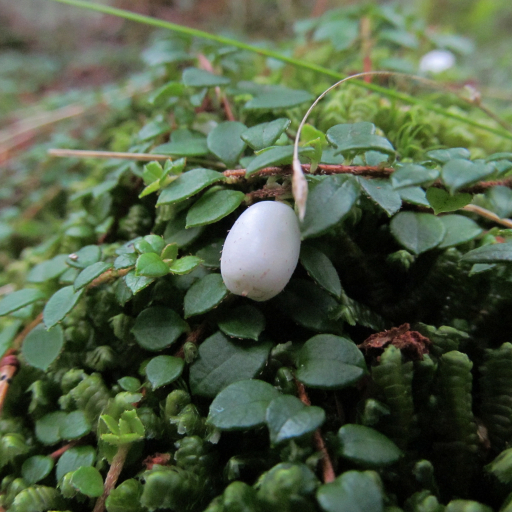
Plant Overview
Often called the Creeping Snowberry or Moxieberry, this tiny evergreen is a master of the "miniature forest." Native to the cool, acidic woodlands of North America, it forms a delicate, moss-like carpet across the damp forest floor. If you crush its leaves or berries, you'll be greeted by the nostalgic, cooling scent of wintergreen.
🔍 How to Identify
- 🌿 The Foliage: The leaves are incredibly small (less than half an inch), oval-shaped, and deep green. If you flip them over, you’ll see distinct brownish bristles on the undersides.
- 🔔 The Flowers: In late spring, it hides tiny, white, bell-shaped flowers that tuck themselves under the leaves, making them easy to miss unless you’re looking closely.
- ⚪ The Berries: Its most striking feature is the bright white, "porcelain-like" berry. These fruits are slightly fuzzy and have a soft, airy texture compared to the firm berries of other shrubs.
🏡 In Your Garden
- 💧 Moisture & Acidity: This isn't a "plug and play" garden plant; it is quite fussy. It demands highly acidic, peat-rich soil and constant moisture. In the wild, it often thrives right on top of decaying, moss-covered logs.
- 🌱 Transplant Sensitivity: Be cautious when moving it. It has a very delicate root system and relies on specific fungal relationships in the soil (mycorrhizae) to survive. It is best left to naturalize in cool, shaded woodland gardens where it won't be disturbed by foot traffic.
⚠️ Safety & Toxicity
- ✅ Edible Berries: The white berries are edible and have a refreshing wintergreen flavor. They were historically used in baking and preserves.
- 🐕 Pet Caution: While the berries are generally safe in small amounts, the plant contains methyl salicylate (wintergreen oil). Large ingestions could cause stomach upset in curious cats or dogs, so it is best kept as an ornamental rather than a snack for pets.
✨ Fun Fact
The specific epithet hispidula is Latin for "finely bristly," referring to the tiny hairs on its stems. Historically, French-Canadian voyagers used the leaves to brew a refreshing "Capillaire" tea, which was prized for its medicinal scent and cooling properties during long treks.

Detailed Care Instructions
| Humidity | High |
| Lighting | Full Sun |
| Difficulty | Medium |
| Hibernation | Cold Period |
| Temperature | 10°C - 26°C |
| Hardiness Zones | 5 - 9 |
To grow Gaultheria hispidula (creeping snowberry) plant, here are some steps you can follow:
- Choose the right location: Gaultheria hispidula prefers shaded areas with partial to full shade. This plant thrives in moist, well-draining soil.
- Prepare the soil: Dig the soil in the chosen location and remove any weeds or rocks. Gaultheria hispidula prefers slightly acidic soil, so you can add organic matter like compost or peat moss to improve the soil's acidity level.
- Planting: Dig a hole slightly larger than the root ball of the plant. Place the Gaultheria hispidula plant in the hole and backfill with soil. Firmly press the soil around the plant to eliminate any air pockets. Space multiple plants about 12-18 inches apart.
- Mulching: Apply a layer of organic mulch around the base of the plant, taking care not to cover the stem. This will help retain moisture in the soil and suppress the growth of weeds.
- Watering: Gaultheria hispidula prefers moist soil, so water the plant regularly to keep the soil consistently damp. However, avoid overwatering, as this can lead to root rot.
- Pruning: Gaultheria hispidula is a low-growing and spreading plant. You can prune it lightly to maintain its shape or remove any dead or damaged branches. It is best to do pruning in late winter before new growth appears.
- Fertilizer: Gaultheria hispidula doesn't usually require much fertilizer. However, you can apply a general-purpose slow-release fertilizer in early spring if needed.
- Protection during winter: Gaultheria hispidula plants are hardy in USDA zones 3-7. If you live in a colder climate, surround the plant with a layer of mulch or leaves to protect it from freezing temperatures and cold winds during winter.
By following these steps, you can successfully grow Gaultheria hispidula plant in your garden or landscape.

Place in a window with dappled sun or a spot in the middle of a room. Or directly in a window facing west or east.

Water the plant when the top inch of soil is dry to the touch. Use room-temperature water and water deeply, allowing the excess water to drain through the bottom of the pot. Avoid getting water on the leaves or foliage as it can lead to waterlogging and disease. Overwatering should be avoided as it can lead to root rot. Consider using a well-draining soil and a pot with drainage holes to prevent waterlogging. In the winter, reduce watering to once a month as the plant becomes dormant.
To fertilize this plant, you should use a balanced fertilizer with equal amounts of nitrogen, phosphorous and potassium. Apply the fertilizer in the early spring before new growth begins and again in the late fall after the growing season ends. Follow the manufacturer's instructions for the correct amount of fertilizer to use. Spread the fertilizer evenly around the base of the plant, being careful not to let it touch the leaves or stems. Water the plant thoroughly after applying the fertilizer to help it absorb the nutrients. Avoid over-fertilizing as this can damage the plant.
The soil that is best for the plant is acidic, rich in organic matter, and well-draining. It should have a pH range of 4.5 to 6.0. You can use a soil mix that is specifically formulated for acid-loving plants, or you can create your own by mixing peat moss, perlite, and pine bark. It is important to avoid using soil that is heavy in clay or sand, as these can lead to poor drainage and root rot. Additionally, the soil should be kept consistently moist, but not waterlogged, as an overly wet environment can also lead to root rot. Consider using a layer of mulch around the base of the plant to help maintain moisture levels and discourage weed growth.
Propagating Gaultheria Hispidula plant can be done by collecting seeds in late summer or taking cuttings in early spring. To collect seeds, wait until the berries turn purplish red and are slightly soft to the touch. Remove the seeds from the berries and sow them immediately in a seed tray or small pots filled with a mix of seed compost and sand. Water the seeds lightly and place them in a shaded area. Keep the soil moist and wait for the seeds to germinate, which can take up to six weeks.
To take cuttings, select a healthy stem from the plant and cut it with a clean, sharp knife just below a leaf node. Remove the leaves from the bottom half of the stem, leaving just a few at the top. Dip the cut end of the stem in rooting hormone powder and plant it in a pot filled with a mixture of peat and perlite. Water the cutting thoroughly and cover it with a plastic bag to create a humid environment. Place the pot in a warm and bright area but out of direct sunlight. In about four to six weeks, roots should appear, and the plant can be moved to a bigger pot or planted outside.








