Plant Overview
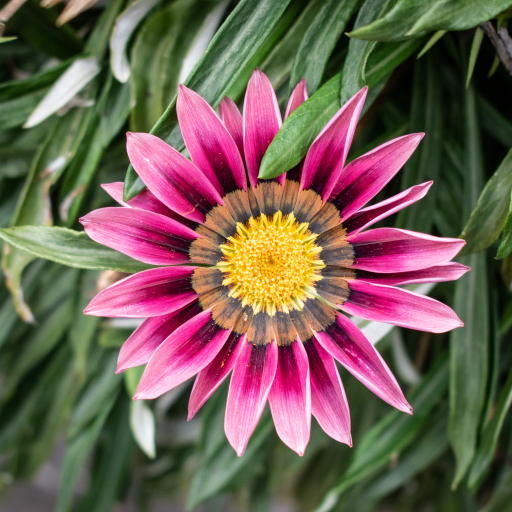
Often called the "Treasure Flower" due to its rich, jewel-toned petals and metallic centers, the Gazania is a sun-loving powerhouse from Southern Africa. These resilient perennials (usually grown as annuals in cooler climates) are famous for their ability to thrive in coastal sands and urban heat where other plants might wither. They are the ultimate "morning glory" of the daisy world, performing a daily ritual of opening wide to the sun and tucking themselves away at night.
🔍 How to Identify
- ☀️ The Bloom: Large, daisy-like flower heads featuring a distinct dark "eye" or ring of contrasting spots around the central disc.
- 🍃 The Foliage: Long, narrow leaves that are often deep green on top with a surprising, fuzzy silver-white underside.
- 📏 Growth Habit: A low-growing, clumping plant that typically forms a dense mat no higher than 6 to 12 inches.
🏡 In Your Garden
- 🏜️ Drought Warrior: Because they evolved in arid regions, Gazanias have deep taproots. This means they prefer "tough love"—let the soil dry out completely between waterings to prevent root rot.
- 🌥️ Light Sensitivity: Keep in mind that these flowers are strictly sun-dependent. They will remain closed on cloudy days and at night, so they aren't the best choice for shaded balconies or indoor spots.
- 🧂 Salt Tolerance: They are one of the best choices for seaside gardens, as they handle salt spray and sandy soil with ease.
⚠️ Safety & Toxicity
- ✅ Safe Status: Gazanias are generally considered non-toxic to humans and common household pets like dogs and cats.
- 🧤 Skin Sensitivity: While not poisonous, the milky sap found in the stems can occasionally cause mild skin irritation or "contact dermatitis" in people with sensitive skin. Wearing gloves while deadheading is a good practice.
✨ Fun Fact
The Gazania is named after Theodorus Gaza, a 15th-century scholar who was famous for translating the botanical works of Theophrastus from Greek into Latin, bridging the gap between ancient and modern plant science!

Detailed Care Instructions
Here are some steps for growing Gazania Spp. plants:
- Choose a suitable location: Gazanias prefer full sun, so select a location in your garden that receives at least 6-8 hours of direct sunlight per day.
- Prepare the soil: Gazanias thrive in well-draining soil. Amend the soil with organic matter like compost or aged manure to improve its fertility and drainage.
- Planting: Dig a hole slightly larger than the root ball of the plant. Place the Gazania in the hole and backfill with soil, firming it gently around the roots. Ensure that the crown of the plant (where the stem meets the roots) is at soil level.
- Watering: After planting, water the Gazania thoroughly to settle the soil. Gazanias are drought-tolerant plants but need regular watering until established. Once established, water them deeply but infrequently, allowing the soil to dry out slightly between waterings.
- Mulching: Apply a layer of organic mulch around the base of the plant to retain moisture, suppress weed growth, and regulate soil temperature.
- Fertilizing: Gazanias don't require heavy fertilization. A balanced, slow-release fertilizer applied once in spring should be sufficient. Avoid excessive nitrogen as it can encourage foliage growth at the expense of flowers.
- Deadheading: To encourage continuous blooming, remove faded flowers by pinching them off or snipping with garden shears. This will redirect the plant's energy into producing new blooms.
- Pests and diseases: Gazanias are generally resistant to pests and diseases. However, watch out for aphids, snails, and slugs. Regularly inspect the plant for any signs of damage or infestation, and take appropriate measures if necessary.
- Overwintering: Gazanias are perennial plants in warmer climates but are often grown as annuals in colder regions. If you're in a cold climate, you can attempt to overwinter Gazanias indoors. Dig up the plants before the first frost, pot them in containers with fresh potting soil, and place them in a sunny location indoors.
Remember to check the specific care requirements for the particular Gazania species you're growing, as there may be slight variations in their needs.
To water this plant, moisten the top layer of soil and allow it to dry slightly before watering again. Avoid overwatering as it can lead to root rot. Water deeply once a week or more frequently in hot, dry weather. It's important to water at the base of the plant instead of showering the foliage to prevent fungal diseases. Use room temperature or lukewarm water to avoid shocking the plant.
To fertilize this plant, apply a balanced fertilizer with equal parts nitrogen, phosphorus, and potassium every two weeks during the growing season, which is typically from spring to fall. Avoid over-fertilizing, as this can lead to lush foliage but fewer flowers. Water the plant thoroughly before and after applying fertilizer to prevent burning. Additionally, consider using a slow-release fertilizer to provide nutrients to the plant over an extended period.
Gazania Spp. plants prefer a well-draining soil that is not too rich in nutrients. A sandy or loamy soil mix with a pH of 6.5 to 7.5 is ideal. It is important to avoid soil mixes that contain too much clay or peat moss, as these can hold too much water and cause root rot. Adding perlite or sand to the soil can also improve drainage. Additionally, a slow-release fertilizer can be added to the soil mix before planting to provide nutrients over time. It is important to avoid over-fertilization, as this can lead to excessive foliage growth at the expense of flower production.
Gazania Spp. plants can be propagated by dividing the root ball or stem cuttings.
To propagate by dividing the root ball, first choose a healthy plant and carefully dig it up from the soil. Gently remove the excess soil and separate the root ball into smaller sections using a clean and sharp knife. Each division should have a portion of the root and stem system, and several foliage leaves. Replant the divisions into prepared soil and water thoroughly.
To propagate by stem cuttings, select a healthy plant and cut 4 to 6 inches of stem with leaves. Remove the lower leaves from the stem and dip the cutting into rooting hormone powder. Insert the cutting into a pot filled with moist soil mix. Cover the pot with a clear plastic bag and place it in a bright but indirect sunlight spot. Keep the soil moist and check regularly for roots. Once the cutting has rooted, remove the plastic bag and relocate the new plant to a larger container or into the garden.
Propagation of Gazania Spp. plants can be done during the spring or summer seasons for the best results.







